

A Structural Shift in Global Innovation
Over the past decade, the nature of innovation funding in the United States has been changing in a very clear direction. Venture capital is no longer concentrated only in software or consumer internet companies. Instead, investors are increasingly moving toward technologies that solve large-scale industrial and environmental challenges.
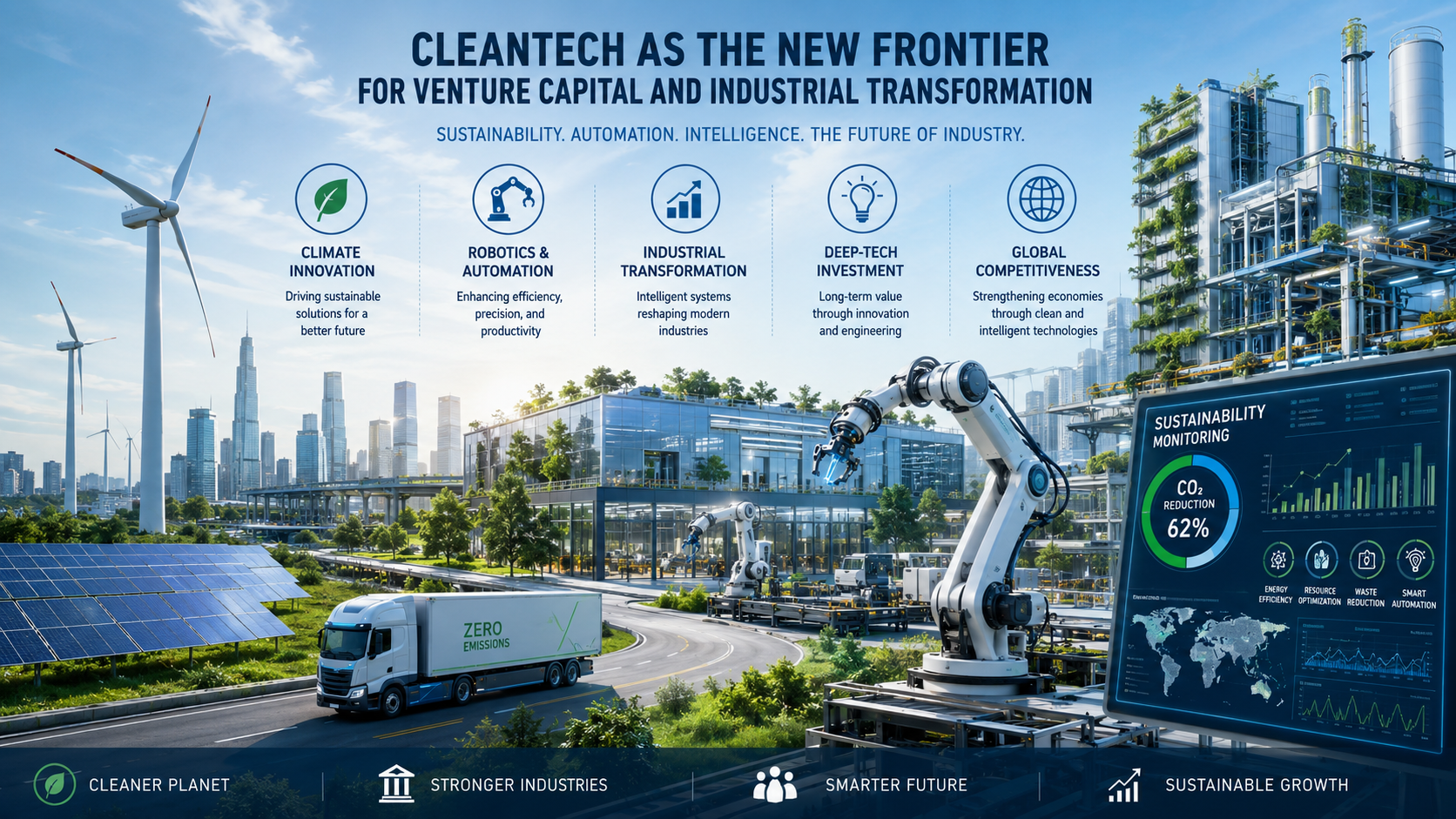 Among these emerging domains, clean technologies have become one of the most important areas of focus. What was once considered a niche segment driven by policy incentives has now evolved into a core investment category linked directly to global competitiveness, energy security, and industrial modernization.
This shift reflects a broader transformation in how value creation is understood. The future of venture capital is now deeply connected to physical-world technologies that combine engineering, intelligence, and sustainability.
The Rise of Climate-Focused Innovation
Climate-related technologies are becoming central to industrial planning and investment strategies in the United States. Companies are no longer treating sustainability as a secondary objective; instead, it is being embedded directly into product design, manufacturing processes, and supply chain systems.
This evolution is driven by three major forces. First, regulatory frameworks are pushing organizations toward reduced emissions and greater transparency in environmental impact. Second, large corporations are under increasing pressure from consumers and shareholders to adopt sustainable practices. Third, technological advancements are making clean solutions more economically viable than ever before.
As a result, climate technology is transitioning from a policy-driven sector to a market-driven industry.
Venture Capital and the Long-Term Deep-Tech Approach
Unlike traditional digital startups, clean technology ventures require long development cycles, significant research and development investment, and strong technical expertise. This naturally aligns with a different type of venture capital approach—one that focuses on long-term value creation rather than short-term returns.
In this new environment, investors are prioritizing companies that are building foundational technologies for energy efficiency, sustainable infrastructure, and industrial optimization.
Firms operating in the deep-tech ecosystem often support innovation that sits at the intersection of science and industry. These investments are not limited to software; they extend into hardware systems, energy platforms, and intelligent automation technologies.
This long-term mindset is essential because clean technology solutions typically require years of validation, scaling, and real-world deployment before they achieve widespread adoption.
Robotics as a Key Enabler of Sustainability
One of the most important developments in the clean tech space is the increasing role of robotics and autonomous systems. These technologies are becoming essential tools for achieving sustainability at scale.
In industrial environments, advanced robotic systems are being used to improve precision, reduce waste, and optimize energy consumption. Manufacturing facilities are integrating automation not only to increase productivity but also to reduce their environmental footprint.
In logistics and supply chain operations, autonomous systems are helping companies design more efficient transportation routes, reduce fuel usage, and minimize unnecessary emissions. In agriculture, intelligent machines are improving resource management by optimizing irrigation, fertilization, and harvesting processes.
These applications demonstrate that robotics is no longer limited to traditional factory automation. It is now a foundational layer for sustainable industrial transformation.
Industrial Transformation Through Intelligent Systems
The integration of intelligent systems into industrial processes is reshaping how modern economies function. Factories and production units are becoming increasingly data-driven, automated, and interconnected.
This transformation allows businesses to monitor energy usage in real time, identify inefficiencies, and implement corrective actions immediately. Predictive maintenance systems reduce equipment failure and extend machine lifecycles, leading to lower material waste and reduced operational costs.
At the same time, smart manufacturing systems are enabling higher levels of precision, reducing defect rates, and improving product quality. These improvements contribute directly to sustainability goals by minimizing resource consumption and maximizing output efficiency.
The Evolution of Investment Thinking
The shift toward clean and intelligent industrial systems is also changing how investors evaluate opportunities. Instead of focusing solely on user growth or digital engagement, venture capital firms are now assessing technological depth, engineering complexity, and real-world impact.
Investment decisions increasingly depend on factors such as scalability of hardware systems, energy efficiency improvements, and the potential for cross-industry adoption.
This new evaluation framework requires a deeper understanding of science, engineering, and global industrial trends. As a result, investors who specialize in long-horizon technologies are playing a more influential role in shaping the future of innovation.
Climate Technology Becoming Economically Competitive
One of the most important changes in recent years is that clean technologies are no longer dependent on subsidies or government incentives alone. Many solutions are now economically viable on their own due to improvements in engineering efficiency and production scale.
Energy storage systems, renewable energy infrastructure, and industrial optimization technologies are becoming more cost-effective and commercially attractive. This shift is encouraging broader adoption across both public and private sectors.
As climate-focused solutions become more competitive, they are increasingly integrated into mainstream business operations rather than being treated as experimental initiatives.
The United States as a Global Innovation Hub
The United States continues to play a leading role in the development of clean and industrial technologies. Its strong venture capital ecosystem, advanced research institutions, and robust startup environment create favorable conditions for innovation.
In addition, collaboration between universities, private companies, and research organizations is accelerating the development of next-generation technologies.
This ecosystem is particularly strong in areas such as energy systems, robotics, artificial intelligence, and advanced manufacturing. Together, these fields are driving a new wave of industrial transformation that has global implications.
The Convergence of Automation and Sustainability
A major trend shaping the future is the convergence of automation technologies with sustainability objectives. Intelligent machines are now being designed not only to improve efficiency but also to reduce environmental impact.
This convergence is creating new categories of innovation where robotics, artificial intelligence, and clean technology are deeply interconnected. The result is a more integrated industrial ecosystem where efficiency and sustainability reinforce each other.
In this environment, companies that can combine technical innovation with environmental responsibility are gaining a significant competitive advantage.
A New Era of Industrial Intelligence
The global investment landscape is entering a new phase where clean technology is becoming a core pillar of industrial and economic development. The combination of sustainability, automation, and intelligent systems is reshaping how industries operate and how value is created.
In this evolving ecosystem, venture capital is playing a critical role in enabling long-term innovation. The focus is shifting from short-term digital disruption to deep technological transformation that impacts real-world systems.
As robotics, climate technology, and advanced industrial systems continue to evolve together, they are defining a new era of industrial intelligence. This is not just a technological shift—it is a structural transformation of how modern economies function and grow.