

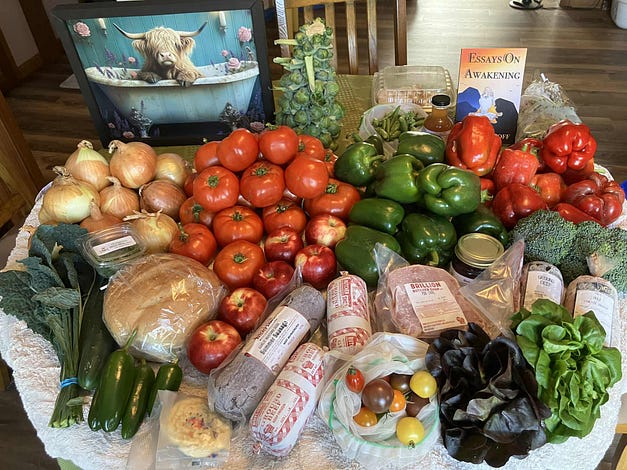
 (A week’s haul from local farmers, along with a picture of a highland cow and my newest book.)
Before I eat something, I ask myself certain questions. Like any other sort of mindfulness, mindful eating helps put you in charge of your daily habits, making you a more powerful and rational human being.
Question #1. Do I like it?
I think everyone asks that question. For some people, that’s the only question they have to answer before swallowing what is before them. Sometimes I never make it past that question, but usually I do. But yeah, temptation is the initial response. I have found, however, that through the practice of asking other questions, I have found my initial reaction to junk food to be not so strong or mindless. I don’t think we are biologically programmed to find brown food appealing, which is what used to trigger me (burgers, chocolate, gravy, etc.).
Question #2. Is it good for me?
A lot of people ask that question, too, but not as many as probably ought to. If it is not a healthy food, that might not be a deal breaker for me, but it is definitely a factor. Nobody is perfect all the time, least of all me. Fortunately, the question of whether a food is good for me or not is supported by the other questions I ask. I am less tempted by a piece of candy if I know a child wants it, and I am less tempted by chocolate if I know there is a poor cocoa farmer at the end of the supply chain who has never had the opportunity to even taste chocolate.
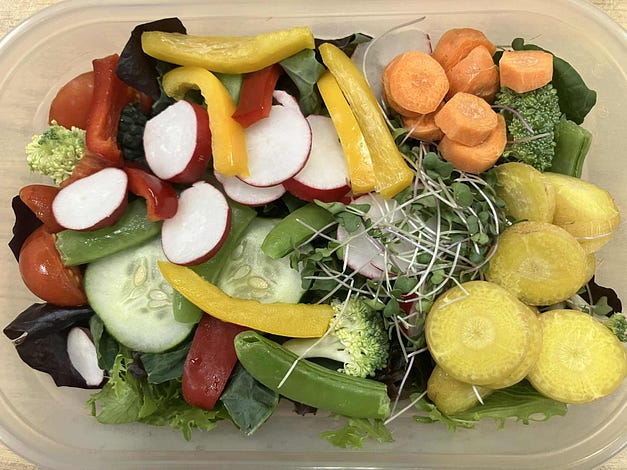 (Today’s lunch, all purchased by local farmers or gardeners. Yes, it was delicious, thanks for asking.)
Question #3. Is it good for the planet?
This is a question that not too many people ask before taking a bite of something, but there are a ton of environmental factors I consider before eating or purchasing food. Like, does it contain palm kernel oil, the production of which is highly destructive of forests? I also consider how far it has to travel and how much packaging is required. Not too many people will refuse to buy an item because it is sold in unnecessary packaging, but I am one of them.
Question #4. Is it enriching corporations?
I don’t want to give my money to corporations any more than I absolutely have to. The power corporations possess over our country and our world is both immense and corruptive. Why should I strengthen them so that they can influence more politicians and buy the genetic copyright of the crops we eat? I have found that questions number 2 (is it good for me?) and number 4 (Is it enriching corporations?) are almost in direct contrast. The more I try to avoid food that enriches corporations, the healthier food I am forced to eat. Corporate foods profit from selling highly processed food, and highly processed food is generally not good for us. Even corporate-grown raw fruits and vegetables are often shipped great distances and are treated in some way or another in order to preserve them for maximal shelf life. If I am able to avoid that, I will.
Question #5. Is it bad for people?
The thought that I have to rely on exploited labor to eat disgusts me. The people who work on factory farms are doing some of the most horrible work for minimal pay while many of them work under the threat of being deported if they speak up for themselves. I basically assume that any food produced outside the country is the same way. Also, factory farms are toxic and unpleasant things to have in your neighborhood. Many a town have been ruined by having an animal rendering plant nearby. It pervades both the air and the water.
Question #6. Is it harmful to animals?
The Indigenous Americans had a sacred relationship with the animals they hunted for food. I hardly think anybody could describe the way we treat the animals we eat as a sacred relationship. The closer we get to knowing the source of our meat and dairy the better, and knowledge of how our food is raised is something corporations like Tyson do their best to keep from you. Hunting or fishing would be the ideal way to supply your meat. And of course, animal products are not a necessary part of most people’s diets.
Question #7. Does my purchase of a food product help a small farmer or business?
I want to support local farmers, restaurants and stores. Building relationships with small businesses helps to promote the kind of changes that big businesses will never respond to. Until, of course, small businesses have proven there’s a market that they can barge into. I break other of these rules sometimes in order to buy from local businesses.
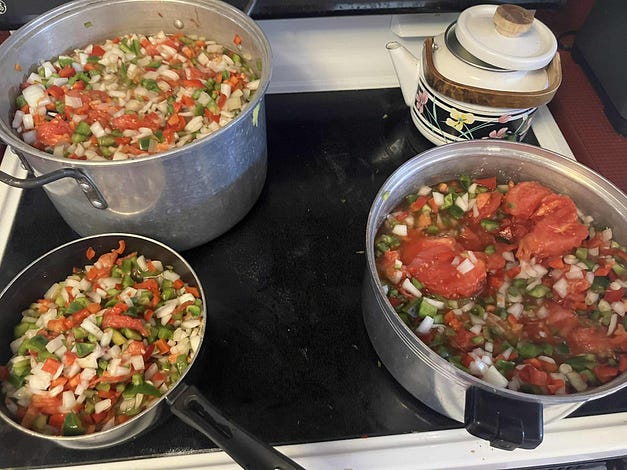 (Canning fall produce for the winter months. It’s work, but so is driving to Costco in January.)
Question #8. Is there something sitting in my refrigerator that will go to waste if I choose to eat this particular food instead?
It must be something about getting older, but I hate to waste. I’m not especially cheap, I just hate to see things that are perfectly useful not be appreciated. Most of the meat I eat I eat because it will be thrown out if I do not. Similarly, most of the processed foods I eat are foods that I have purchased for others that they did not consume. For example, Halloween candy. Although for the last few years, I have been offering trick-or-treaters a choice between store-bought candy and chocolate chip cookies I make from scratch, and kids so prefer the cookies that I’m thinking of dropping the store-bought candy option.
There is one last question I ask, but I am blessed that I don’t have to worry too much about it:
Question #9. Can I afford it?
Don’t get me wrong, there is nothing extravagant about my diet. In fact, I eat like a peasant. But eating like a peasant isn’t cheap these days. Those who have to cut corners can’t afford to eat the basic foodstuffs a peasant centuries ago had: organic food without artificial dyes, glyphosates or other unnecessary additives. The food poor people have available today is of inferior quality to what our ancestors ate, though it is undoubtedly made to be more appealing to the palate and available in mass quantities.
I know that I am fortunate to live in an area where local food producers are abundant. We also have a thriving farmers market. Not everybody has the opportunities I have to access local food, but everybody has the same opportunity to encourage a local food scene. Support whatever it is you have. Strengthen it, nurture it, and it will grow stronger.
These are the questions I ask before purchasing or consuming food. Perhaps it sounds difficult, but I have found it rewarding. I understand many people simply don’t have the time or the money to live the way I do, I often cannot live according to my own standards. In fact, it is difficult for me to align affirmative answers to all of the above questions to any one food purchase, let alone a dinner. But the more I travel this path, the easier it becomes. The more I travel this path, the further I want to explore it. Buying local can be more expensive, but not as much as you might think. A local farmer would rather give you food he has too much of than let it go to waste. Chain grocery stores would rather toss something in the garbage than give it away. Also, not wasting food is the single most important thing you can do to save money, and too many of us never even factor this into our food expenses.
What we feed, grows. What we starve, withers. We feed small and local farmers with every tomato we buy from a CSA (community supported agriculture) or farm stand. In doing so, we also help starve a corporate box store that drains money from your community and funds your local political representatives. You can make your community and the planet healthier by your buying choices, and you will make yourself healthier and happier in the process. That’s worth asking yourself a few questions.