

 Trigger warning: this post contains a story of sexual violence.
Something strange happens when you look back on a moment when you suddenly stopped feeling safe.
You know how it ended.
You know you left.
You know you eventually made it home safely.
But when you go back to the beginning, you can also see how ordinary everything still seemed.
During Amsterdam Pride, I attended a queer event about sexual violence against men. It was one of those places where I felt safe. Surrounded by other queer people. People with similar experiences, questions and stories. An environment where we were talking precisely about boundaries, safety and what it means when those boundaries are crossed.
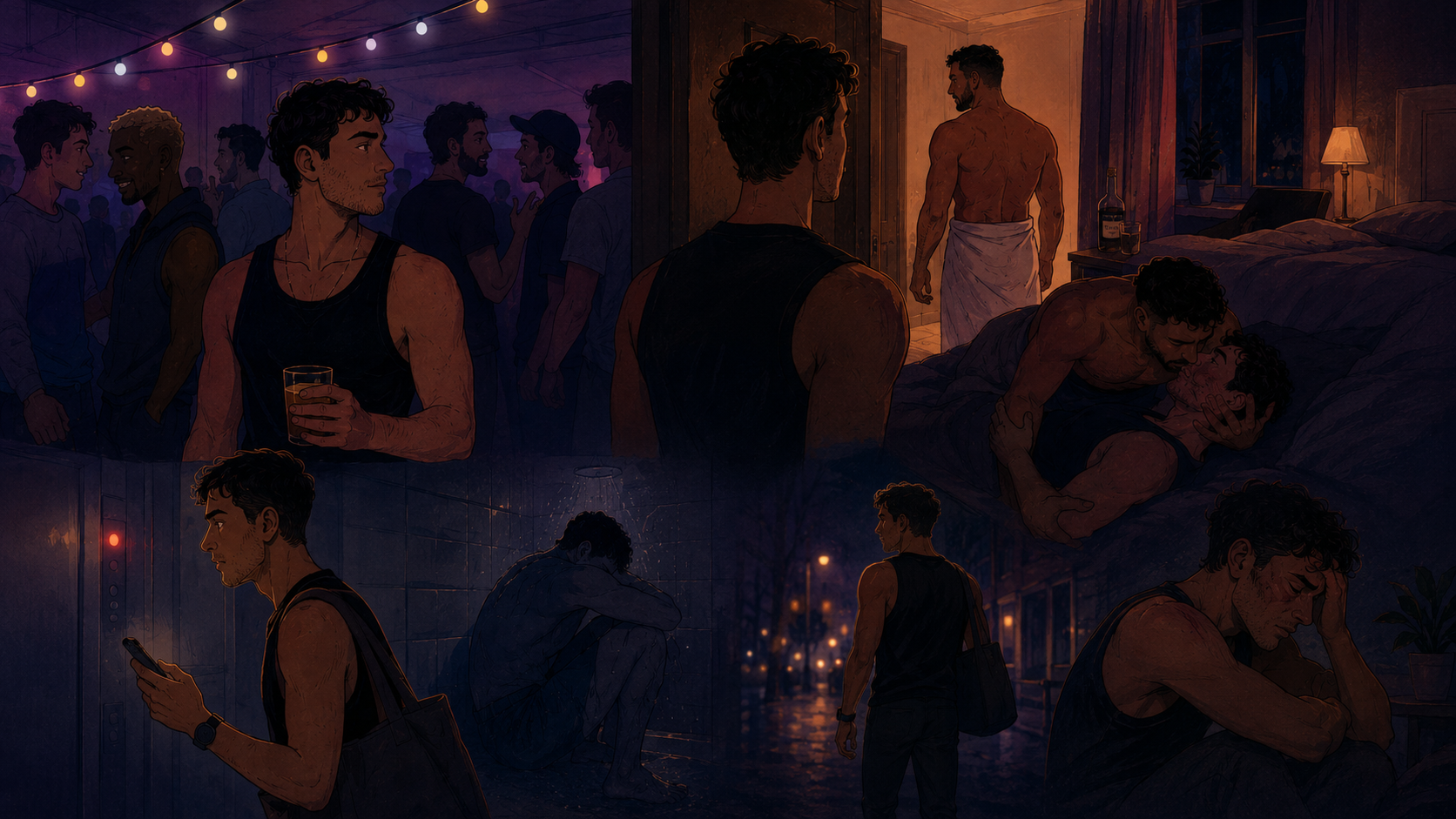
After the event, I met someone through Grindr at The Social Hub. The hotel bar had already closed. He suggested having a drink upstairs. I was clear about it. I was happy to have a drink with him in his room. But nothing more. I had stated that boundary before I even went upstairs.
I still remember walking into the room and almost immediately feeling that something was wrong. The room smelled of cannabis. The open window had done little to clear the smell. There was a half-empty bottle of whisky. He looked as though he had just come out of the shower and was wearing only a towel around his waist.
Then the door closed behind me.
He was standing between me and the exit. And somewhere in that moment, my brain stopped doing what I had always assumed it would do in a situation like that.
I had always thought I would defend myself. That I would clearly say no. That I would push someone away. That I would get angry. That I would leave.
But that is not what happened.
I froze.
A few minutes earlier, I had been in a queer community setting where I felt safe and understood. Now I was standing in a hotel room, afraid.
He started kissing me by force. I remember the taste of alcohol. The bitter taste of weed. He grabbed my crotch. And while my mind was screaming at me to get out of there, I noticed that my behaviour was doing something entirely different.
I tried to keep him calm.
I went along with the conversation.
I tried not to make the situation worse.
My response to danger was to appease him.
He was taller than me.
Broader.
More muscular.
In a moment like that, your body sometimes makes a calculation before your conscious mind has the chance to.
Not: what do I actually want to do?
But: what gives me the best chance of getting out of here safely?
He threw me onto the bed and wanted to go further. I stammered that I had not taken my PrEP. It was a lie. But apparently, it was the right one. He got up, turned his back to me and started searching his suitcase for a condom. That was my moment. I pushed him forward. I ran to the door. He had not locked it. I ran into the hallway and stepped into the lift.
Once inside, I immediately grabbed my phone. I blocked him on Grindr so he could not use the app’s distance feature to track me. That also made his profile disappear. His information. His room number. Everything that might later have helped me identify him. At that moment, I did not think about any of that. I thought about only one thing.
Get out.
The next day, I could barely recall parts of what had happened. I had showered several times. I had not slept. And that morning, I wanted only one thing: to leave that hotel as quickly as possible. What perhaps surprised me most afterwards was how differently my body had reacted from the image we often have of ourselves. We talk about fight or flight. Fighting or running away. But there are more responses to danger. Freezing is one of them. Becoming compliant can be one too.
In the 2023 Sexual Health Monitor, 8 percent of men who had experienced sexual violence said they froze during what happened. Almost a quarter of male victims said that, in the moment, they did not fully realise that they did not want sex.
After sexual violence, we often ask ourselves questions from the safety of hindsight.
Why did you not say no more forcefully?
Why did you go to that room in the first place?
Why did you not fight back?
Why did you not go straight to the police?
But a boundary does not only exist once someone starts shouting. My boundary was clear before I entered that room. A drink. Nothing more. Nothing that happened afterwards changed that. Something else that has stayed with me, and that I also see in my work, is how little we talk about sexual violence between men. Perhaps because men are still raised with the idea that they should be able to protect themselves. Perhaps because sex between queer men is sometimes seen as more direct, freer or more sexually explicit. Perhaps because dating apps, hookups, Pride and sexual freedom can unconsciously create the idea that boundaries are somehow less clear in those spaces. But sexual freedom does not mean that boundaries disappear.
Quite the opposite. Freedom can only exist when a no is respected as naturally as a yes. And the figures show that my experience was not an isolated incident.
According to the most recent Prevalence Monitor on Domestic Violence and Sexual Transgressive Behaviour by Statistics Netherlands (CBS), 7.4 percent of all men in the Netherlands experienced some form of sexually transgressive behaviour in the previous year in 2024. Among gay men, that figure was 25.7 percent. More than one in four. Among bi+ men, it was 15.3 percent. The numbers for specific forms of behaviour also stand out among gay men. In 2024, 14.9 percent reported offline sexual harassment and 17.3 percent reported online sexual harassment. Among men overall, those figures were 4.2 and 3.9 percent respectively.
Rutgers sees the same pattern in broader research into sexual health. Among men in the general Dutch population, 5 percent have experienced sexual violence at some point in their lives. When unwanted kissing and sexual touching are also included, the figure rises to 19 percent. Rutgers explicitly identifies gay and bi+ men as groups that are relatively often victimised.
Two years later, I still find those figures confronting. Not only because I recognise myself in them. But because I am reminded that behind every percentage are men who may have done exactly what I did.
Go home.
Shower.
Not sleep.
Carry on as usual the next morning.
Maybe tell no one what happened.
Maybe convince themselves it was not serious enough.
Maybe think this is simply part of dating as a queer man.
Fortunately, I did not have to go through that last part. My friends did not pretend it had simply been an unpleasant Grindr date. They did not minimise it. They did not make jokes about it. They did not tell me I should have known better than to go to a hotel room. They took it seriously. And in doing so, they took me seriously. I also had almost immediate access to a psychotherapist through the foundation I was working with at the time. For me, that made processing what had happened much easier. From the beginning, I had someone beside me who helped me put into words what had happened. Someone who did not ask why I had not acted differently. But someone who understood that, in that moment, my body did what it thought it needed to do to keep me safe.
Still, there was one group of people I never told. My parents. Not because I was afraid they would not believe me. Not because I was ashamed to tell them. But because I did not want to burden them with the knowledge that their son had walked into a hotel room one night and had not been sure whether he would get out safely. One of my parents’ greatest fears had, after all, become reality.
Some things we do not tell people because we are afraid of rejection. Other things we do not tell them because we know how much they love us. I did not want them to worry about my safety every time I went out. I did not want every Pride, every date or every weekend away to become a source of fear for them too. So I carried that part on my own.
Perhaps that is also why I want to write about it now that my parents are no longer here. Because silence around sexual violence against men keeps certain ideas alive. The idea that men are always in control. That we should be strong enough to defend ourselves. That sexual violence is primarily something that happens to women. That sex between men is automatically more equal because both people are men. That a hookup means consent can be taken for granted.
None of those things are true. I went to that hotel room voluntarily. I agreed to a drink. I did not agree to the rest. Those two things can be true at the same time. And perhaps that is the sentence we need to say more often. Because boundaries do not become less valid because someone is on Grindr. Not because someone goes to Pride. Not because someone is sexually liberated. Not because someone has said yes before. Not because two men are supposedly of roughly equal physical strength. And not because someone freezes instead of fighting.
I still think sometimes about the moment when he turned around to get a condom from his suitcase. About how small that opening really was. And how enormous it felt to me.
I ran.
I made it outside.
I was safe.
But what I ultimately carried out of that room was more than fear. It was also a sharper understanding of what safety really means. Safety is not only knowing that you are allowed to say no. It is knowing that someone will stop when your boundary is clear. Safety is not only being able to defend yourself. It is not having to defend yourself. And consent is not the absence of resistance. It is the presence of mutual willingness. Perhaps this is something we need to talk about much more often, especially within our own queer community. Not because queer sexuality is dangerous. But because our freedom deserves to be safe.
Source:
For the statistics, I deliberately used the CBS Prevalence Monitor 2024 as the main recent Dutch source, alongside Rutgers for broader context and the data on freezing during sexual violence. The CBS category “sexually transgressive behaviour” is broader than physical sexual violence alone, which is why I have not used those terms as synonyms in the text. (Statistics Netherlands / CBS)