

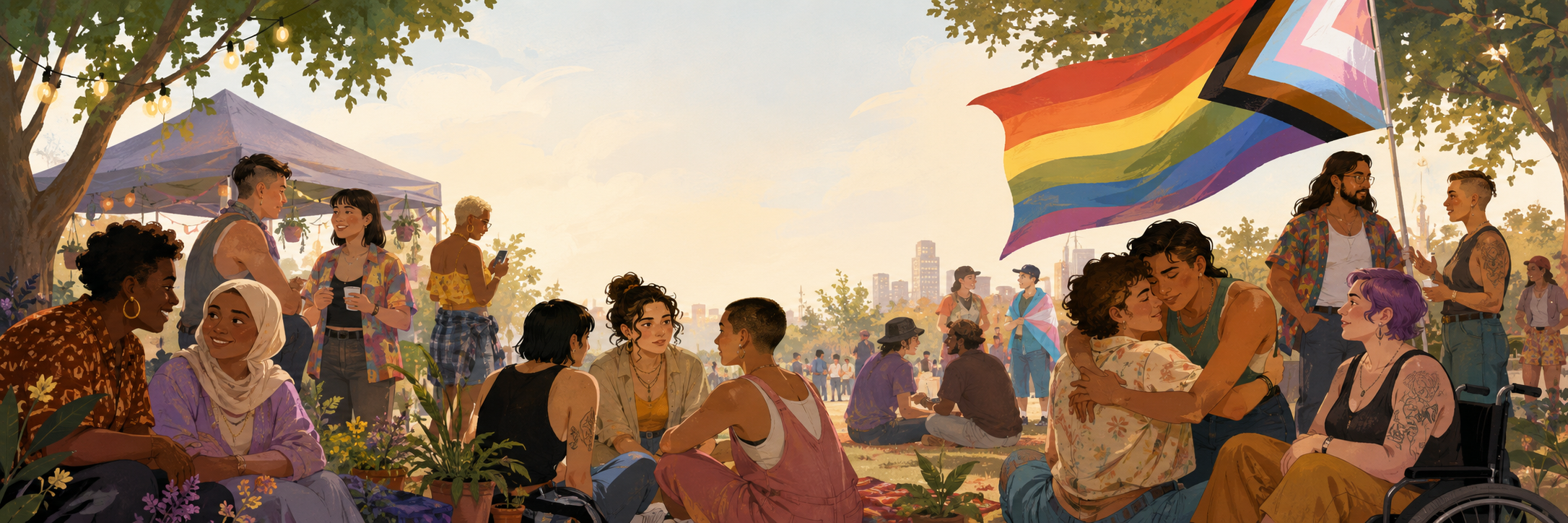
 Something shifts when you begin to understand that safety does not mean the same thing to everyone. And sometimes, you only learn why later. A place can feel like a safe haven to me. And at the very same time, for the person standing next to me, entering that place may require taking a risk I have never had to take.
That realization took on a different meaning for me when I was working around Mardi Gras in Sydney in 2006. What struck me there was how visibly community played a role. Not simply in the sense of: we are all LGBTQI+ and therefore we belong together. Quite the opposite.
There was room for the fact that people within that larger community had different lives, backgrounds, beliefs and needs. There were activities and meeting places for different groups.
For different cultural backgrounds.
Religions.
Generations.
Interests.
Ways of life.
And yet, it did not feel as though this separated everyone from one another. Everything existed under the same rainbow flag. I found that remarkable. The rainbow did not seem to be there to erase differences. Instead, it hung above a community in which those differences were allowed to remain visible.
One of the places where I experienced this most strongly was Fair Day. It was not only about visibility or celebration. It was also about families.
Chosen families.
Associations.
Interests.
Connection.
And all the different ways in which people could be part of the same community. You did not have to be queer in one particular way in order to belong. That set something in motion for me.
At the time, I did not yet know the concept of intersectionality in the way I would later come to understand it through the work of Kimberlé Crenshaw. But looking back, what I saw in Sydney helped me understand what intersectional thinking can mean in practice. People never enter a space as just one identity. Someone is not only queer. They also bring their culture.
Skin colour.
Gender.
Class.
Religion.
Family.
Age.
Abilities.
Dependencies.
And all these different aspects influence how someone experiences a community. That may sound self-evident. But within queer spaces, this has not always been the case. There, too, a particular idea can exist about what freedom means.
Being visible.
Coming out.
Showing yourself openly.
Speaking up.
For me, those things could indeed represent freedom. But increasingly, I began to ask myself: Who does that actually apply to?
For some queer young people I knew, visibility could mean something very different. It could put things at risk at home. Their relationship with their family. Their place within a community. Sometimes their housing. Sometimes even their safety. Coming out then suddenly becomes more than a personal choice. It becomes a choice connected to culture, religion, family, dependency and social position.
And that is exactly where community building becomes more complicated. Because good intentions are not enough. You can say that everyone is welcome. You can hang a rainbow flag. You can explicitly describe a space as queer-friendly. But that does not mean everyone has the same freedom to walk through its doors. For one person, a queer space feels like coming home. For another, simply being seen at the entrance may have consequences. For one person, visibility means freedom. For another, remaining invisible may be a form of protection. Neither of those experiences makes someone more or less queer. They mainly tell us something about the different worlds people carry with them when they enter the same space.
Later, the work of Gloria Wekker helped me find more language for this. Ideas about freedom, emancipation and what we consider normal are not always as neutral as we think. We look at the world through our own experiences. And sometimes, without realizing it, we turn those experiences into the norm. Perhaps that is also why I have come to see community less and less as something that automatically emerges when people share an identity. A shared identity is a beginning. But it is no guarantee of connection.
Community also asks us to think about the conditions under which people can genuinely participate.
Who can walk in without thinking twice?
Who looks around first?
Who can afford to be seen?
Who has to hide part of themselves in order to stay safe?
Who recognizes themselves in the people organizing the space?
And whose ideas about freedom form the starting point?
For me, this also connects to what bell hooks wrote about community, learning and difference. Connection does not emerge because we ignore our differences in order to preserve harmony. Sometimes, genuine connection begins precisely when we are willing to see those differences. And to take them seriously. That requires more than tolerance. It requires curiosity. Listening. It asks us to be willing not to treat our own experiences as universal. And to be prepared to change a space when someone tells us that the space works differently for them than it does for us.
Sydney did not show me what a perfect community looks like. I do not think such a thing exists. What it did show me was another possibility. A community in which we do not only ask: What do we have in common? But also: What is different between us? And what do people need in order to genuinely be able to take part? That question has stayed with me. Also in the work I went on to do afterwards.
Because, for me, inclusion has increasingly come to mean more than allowing everyone to enter through the same door. It is also about what someone has to risk in order to walk through that door. Whether they recognize themselves once they are inside. Whether they feel safe enough to stay. And whether there is room for the parts of an identity that may not fit the dominant image of what queer freedom is supposed to look like.
Sydney planted a seed for me in that respect. Not as a theory. Not as a model. But as an experience. The realization that community does not emerge simply because people have something in common. Community also emerges when we consciously make room for the differences that exist within that shared identity. Because belonging should not mean that everyone has to become the same. And perhaps even more importantly: That we should not ask everyone to leave parts of themselves at the front door in order to be allowed inside.
Sources and Further Reading
For this article, I drew inspiration, among other sources, from the following publications:
Kimberlé Crenshaw
Crenshaw, K. (1989). Demarginalizing the Intersection of Race and Sex: A Black Feminist Critique of Antidiscrimination Doctrine, Feminist Theory and Antiracist Politics. University of Chicago Legal Forum, 1989(1), 139–167.
In this influential article, Crenshaw introduces the thinking that would later become known as intersectionality: the way in which different forms of exclusion and social position can intersect and cannot be understood separately from one another.
Gloria Wekker
Wekker, G. (2016). White Innocence: Paradoxes of Colonialism and Race. Duke University Press.
Wekker examines how the Dutch self-image of tolerance and progressiveness exists alongside the ongoing impact and denial of racism and the colonial past.
Her work helps us critically examine which norms and ideas are treated as self-evident or neutral within spaces that appear to be inclusive.
Bell Hooks
Hooks, b. (2003). Teaching Community: A Pedagogy of Hope. Routledge.
In Teaching Community, Hooks explores how communities can be created in which difference, anti-racism, engagement, learning and responsibility are central.
Her thinking about community forms an important starting point in this article for the question of how we can create spaces in which difference is not merely tolerated, but is genuinely allowed to be part of the community.
About the Theoretical Concepts in This Article
I do not use the theories of Crenshaw, Wekker and Hooks in this article as a fixed model or step-by-step framework for community building. Instead, they provide a lens through which I look back at my own experiences: Who is seen? Whose experience is treated as the starting point? Which differences remain invisible? And what does it really mean to take responsibility for a community?