

Many years ago, in my youth, I had a hobby — writing poems. I wrote for myself and never even thought about showing them to anyone. I simply enjoyed writing, and it brought me immense pleasure. But over time, life got busy: there was work, family, and even immigration. Eventually, I abandoned this hobby. However, somewhere deep inside, I wanted to receive analysis of what I had written from professional authors (writers, poets).
Now, many years later, I’ve retrieved the notebook containing a collection of my poems.
And an idea came to my mind:
Why not use the chatbot “ChatGPT” to analyze my creative work?
And here’s what came out of it:
* * *
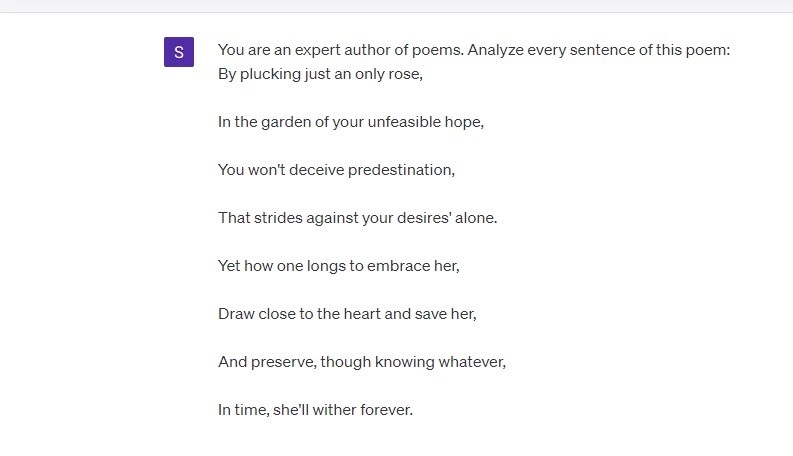
By plucking just an only rose,
In the garden of your unfeasible hope,
You won’t deceive predestination,
That strides against your desires’ alone.
Yet how one longs to embrace her,
Draw close to the heart and save her,
And preserve, though knowing whatever,
In time, she’ll wither forever.
ChatGPT Answer
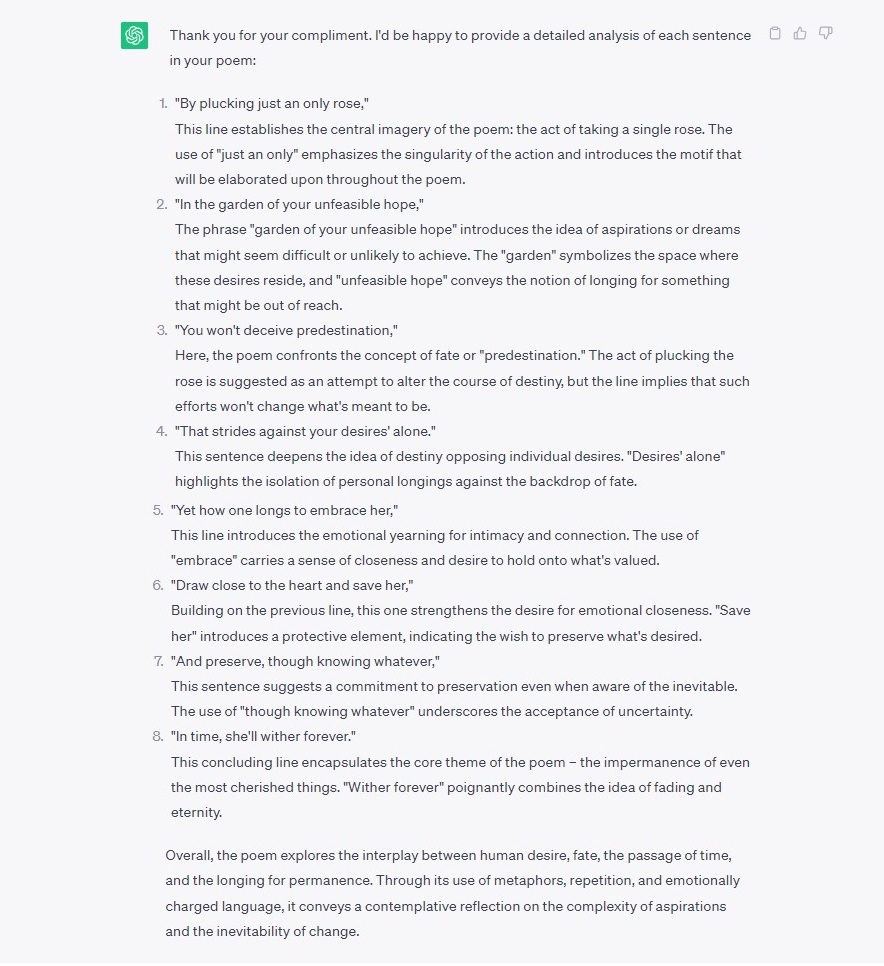
Thank you for your compliment. I’d be happy to provide a detailed analysis of each sentence in your poem:
“By plucking just an only rose,”
This line establishes the central imagery of the poem: the act of taking a single rose. The use of “just an only” emphasizes the singularity of the action and introduces the motif that will be elaborated upon throughout the poem.
“In the garden of your unfeasible hope,”
The phrase “garden of your unfeasible hope” introduces the idea of aspirations or dreams that might seem difficult or unlikely to achieve. The “garden” symbolizes the space where these desires reside, and “unfeasible hope” conveys the notion of longing for something that might be out of reach.
“You won’t deceive predestination,”
Here, the poem confronts the concept of fate or “predestination.” The act of plucking the rose is suggested as an attempt to alter the course of destiny, but the line implies that such efforts won’t change what’s meant to be.
“That strides against your desires’ alone.”
This sentence deepens the idea of destiny opposing individual desires. “Desires’ alone” highlights the isolation of personal longings against the backdrop of fate.
“Yet how one longs to embrace her,”
This line introduces the emotional yearning for intimacy and connection. The use of “embrace” carries a sense of closeness and desire to hold onto what’s valued.
“Draw close to the heart and save her,”
Building on the previous line, this one strengthens the desire for emotional closeness. “Save her” introduces a protective element, indicating the wish to preserve what’s desired.
“And preserve, though knowing whatever,”
This sentence suggests a commitment to preservation even when aware of the inevitable. The use of “though knowing whatever” underscores the acceptance of uncertainty.
“In time, she’ll wither forever.”
This concluding line encapsulates the core theme of the poem — the impermanence of even the most cherished things. “Wither forever” poignantly combines the idea of fading and eternity.
Overall, the poem explores the interplay between human desire, fate, the passage of time, and the longing for permanence. Through its use of metaphors, repetition, and emotionally charged language, it conveys a contemplative reflection on the complexity of aspirations and the inevitability of change.
Well, it was very interesting to get an unbiased analysis of one’s work. I hope that this method will be used by young writers at the early stages of their creative path. After all, it is very valuable to get the necessary feedback and advice being at the very beginning of the way, which inspires and directs to the right and meaningful route in poetry.
And I will continue to test my lyrics further. 😊