

Some of you may know the VULONE platform and the people behind it. This week, I spoke to Walless Al Essa, Co-Founder of VULONE.
 Hi Walless, thanks for taking the time to speak with Inside Darknet. For people who don't know you yet, who are you?
Hey, thanks for having me. I'm Walless Al Essa, CEO and Co-Founder of VULONE, a cyber threat intelligence platform I'm building together with my co-founder Adem El Adeb and some other colleagues.
My background is in IT and cybersecurity. I'm particularly interested in red teaming, adversary emulation, threat intelligence and understanding how threat actors operate, their infrastructure, methods and tradecraft.
Most of my work revolves around investigating cybercriminal ecosystems, connecting digital identities and turning fragmented information into something investigators and companies can actually use.
Before we dive into this, I am curious - how did you first get into cybersecurity and threat intelligence?
I actually started at a pretty young age. I came across a Python programming course and got curious about programming and how software works. From there I somehow ended up in the cybersecurity world after coming across an introductory cybersecurity crash course.
That was basically where my interest in IT and cybersecurity started.
I eventually started an apprenticeship as an IT Specialist for System Integration, or Fachinformatiker für Systemintegration here in Germany, and successfully completed it.
After that I moved into red teaming and offensive security. I also developed a strong interest in adversary emulation and understanding how real-world threat actors operate.
At some point I decided to leave my job and focus on building something that could bring more value to companies and law enforcement together with my co-founder Adem El Adeb and some other colleagues.
My interest in threat intelligence actually grew through Adem. We had a lot of discussions about ransomware groups, threat actors, their methods, playbooks and tradecraft.
Those discussions got me interested in looking beyond the technical side of an attack and understanding the people and operations behind it. Eventually that interest turned into VULONE.
You and Adem are building VULONE. Can you explain what it is, who it is for, and why?
VULONE is a cyber threat intelligence platform primarily built for investigators, DFIR teams, cryptocurrency recovery specialists and companies looking for actionable threat intelligence.
Our main focus is identity resolution and attribution across underground ecosystems. We collect and correlate information from different sources to help investigators understand who they're dealing with, what they're connected to and what their historical activity looks like.
But VULONE isn't limited to investigations.
We also provide features around exposure and identity exposure management. For companies we can identify discussions, leaked information and campaigns targeting their organization across underground communities.
We also conduct manual investigations for companies when something requires a deeper look beyond automated intelligence collection.
I'd say VULONE is essentially about finding needles in haystacks.
There is an enormous amount of fragmented information across underground forums, marketplaces and messaging platforms. Most of it looks unrelated when you examine it individually.
What we do is connect those pieces, identify patterns and uncover relationships that would otherwise take investigators days or weeks of manual research to discover.
We're turning massive amounts of scattered data into actionable intelligence. That's what VULONE is.
Our approach is to provide more investigative value for less. We want to make this kind of intelligence accessible without requiring companies to spend enormous budgets.
For people who have never worked in threat intelligence, what are you actually trying to find out? How can that information help, and who?
Think of threat intelligence as trying to understand what's happening before, during or after a cyberattack.
A vulnerability scanner might tell you that a system is vulnerable. Threat intelligence tries to answer different questions.
Who's exploiting it? Are threat actors discussing it? Is your organization being targeted? Are your credentials being sold?
We're trying to connect those pieces of information.
For example a company might discover that its employees' credentials are circulating on an underground forum. That's already concerning, but it becomes much more valuable when you can identify who's selling them and whether the company is being specifically targeted.
This helps security teams prioritize their response and investigators understand incidents.
It's about moving from knowing that something happened to understanding why, how and who's behind it.
Let's say your starting point is just a nickname used by a hacker. Could you walk us through how that becomes an investigation and what happens next?
Let's say we have nothing but a nickname.
The first thing we'd do is identify what that account has been involved in. What was it targeting? What kind of activity was it conducting? Has it appeared in other underground communities before?
We'd take that handle and search it through VULONE's search engine.
From there we can retrieve its historical activity, forum posts, marketplace listings, private messages and associated selectors.
That could include IP addresses, email addresses, other accounts and additional identifiers.
We then start correlating those records to build a timeline and understand the account's relationships.
Now if it's a completely fresh handle with no historical traces, the investigation becomes more difficult.
In certain investigations we may also use HUMINT to develop a better understanding of the subject and gather additional context through controlled investigative methods.
The interesting part is that people eventually make OPSEC mistakes. They reuse identifiers, reveal details or leave traces without realizing it. Those small details can become valuable investigative leads.
The goal is to build an evidence-backed picture of the individual or operation behind that identity.
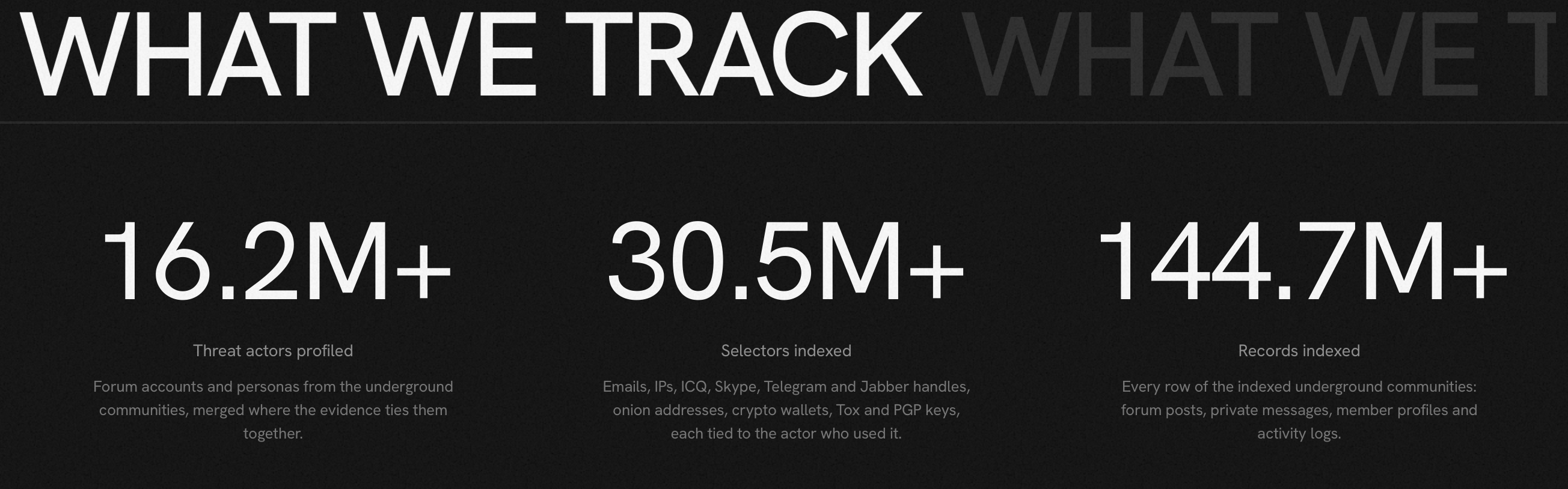 The website states more than 16 million threat actors profiled. What exactly does that number represent; individual people, forum accounts or something else?
That's a good question because there's an important distinction between digital identities and actual individuals.
The number represents the scale of intelligence records and profiles available across our ecosystem. It should not be interpreted as 16 million independently verified real-world individuals.
One person can have multiple accounts across different forums and one account can contain multiple identifiers.
That's actually one of the problems we're trying to solve with VULONE: connecting these fragmented identities and determining which relationships are supported by evidence.
We don't want to inflate numbers by pretending every account represents a unique person. What matters much more is the quality of the relationships and the evidence behind them.
People reuse nicknames, share infrastructure, sell accounts and get their own accounts hacked. What makes you confident that two accounts really belong to the same person?
That's one of the biggest challenges in attribution.
A matching username doesn't prove anything by itself. Even matching email addresses or infrastructure can sometimes be misleading.
We look at multiple indicators and how they relate to each other.
For example we might find the same cryptographic identifier across different platforms, historical communication patterns, reused contact details or other technical relationships.
Then we look at the timeline. Did these accounts operate during overlapping periods? Is there evidence of an account transfer? Could one account have been compromised?
We also look for contradictory evidence rather than just collecting information that supports our initial assumption.
At the end of the day attribution is not about finding similarities. It's about establishing whether those similarities actually support a defensible connection.
And sometimes the correct conclusion is that we simply don't have enough evidence.
How has AI changed the work in this space?
AI has changed the scale at which we can conduct investigations.
Previously analysts had to manually search through enormous amounts of forum data, translate conversations, extract identifiers and compare records.
Now AI can significantly accelerate those processes.
At VULONE we have a feature called Backtrack AI.
You can provide it with a selector or identifier, or even unstructured and scrambled investigative notes. It then searches across the records available to us, identifies potential relationships and generates an investigative canvas and a draft report containing the findings.
This makes it much easier to follow the investigation and understand how different pieces of information connect.
But AI also introduces a major problem: false positives.
A model can identify a relationship that looks convincing but has no actual evidentiary basis.
That's why we don't treat AI-generated conclusions as facts. The purpose is to accelerate the analyst, not replace them.
Connecting two online accounts is one thing; publishing a person's identity is another. What evidence do you need before taking that step, and what do you deliberately keep private?
We take this extremely seriously.
Before publishing an attribution we follow a review process. Where appropriate we share our findings with relevant law enforcement and government investigative agencies so they can independently assess the information and take appropriate action.
We don't want to expose the wrong person. A false attribution can have serious consequences.
If you look at VULONE's public research you'll notice that we have only published two investigations explicitly revealing an identity.
Those findings were shared with relevant authorities before publication and we received clearance to publish them.
We also deliberately avoid exposing unnecessary personal information, credentials or information that could put unrelated individuals at risk.
There's a difference between having access to information and having a legitimate reason to publish it. Our responsibility is to provide intelligence, not to dox people.
You investigated an operator using AI agents against government and company systems across Asia. Could you explain in simple terms what the agents were doing themselves and what still required a human?
This was particularly interesting because of the level of autonomy involved.
The operator was using an open-source framework called Cairn.
In simple terms Cairn is an AI-powered autonomous problem-solving framework. It uses agents to explore different possible paths towards a defined objective rather than simply following a fixed sequence of predefined tasks.
What made this particular investigation concerning was the amount of accumulated context and capabilities involved.
We identified more than 3.7 GB of stored skills and over 100,000 conversations associated with the operation.
The objective was to achieve remote code execution against targets.
The human involvement was surprisingly limited. The operator primarily needed to provide the target URL or selector and define the objective. From there the agents could work through the process autonomously without requiring continuous human interaction.
Of course this doesn't mean the AI has unlimited capabilities. But the bigger picture is that we're moving towards operations where humans define the objective while AI systems handle increasingly large portions of the execution and decision-making process.
That changes the economics and scalability of offensive operations quite significantly.
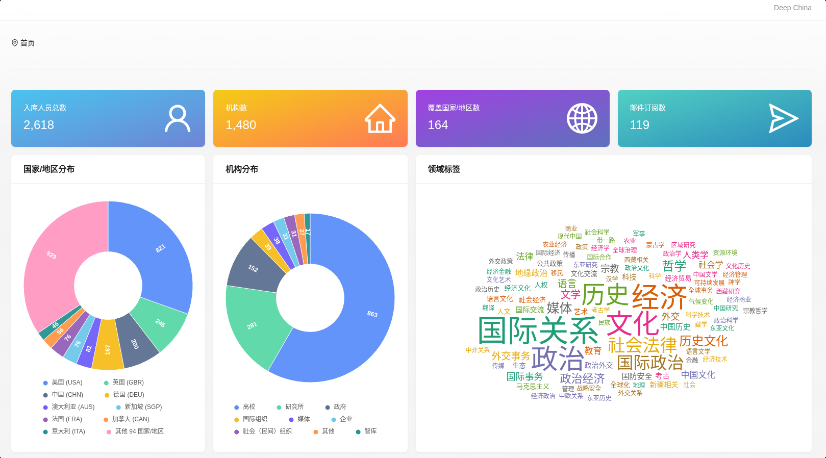 You also found an exposed Chinese database tracking people across more than 100 countries. What convinced you what the system was used for, and how did you handle the risk to the people named in it?
We initially identified a publicly exposed host running a management panel without any authentication barrier.
What caught our attention was that the interface was in Chinese and displayed information about multiple countries. The whole thing looked suspicious.
We translated the interface and started understanding what the system was actually displaying. That's when things became considerably more interesting.
We then conducted additional reconnaissance to identify whether there were other exposed components or traces of the same infrastructure.
Eventually we found that the information wasn't just some random collection of records. The database contained extensive information about individuals across more than 100 countries.
The concerning part was the apparent purpose and structure of the system.
We had to be particularly careful because the people listed in that database weren't necessarily involved in anything themselves. They were potentially the targets of the system.
We deliberately avoided unnecessarily exposing their personal information. Our focus was on documenting the system, understanding its purpose and assessing the potential impact.
What happens after you finish an investigation; do you contact the affected companies, CERTs or law enforcement? Have any findings led to a takedown or another outcome you can discuss publicly?
It depends on the scale and nature of the findings.
For larger incidents, especially when there's evidence of widespread compromise or campaigns affecting significant numbers of people, we contact relevant law enforcement agencies and CERTs.
One example is our research into NASbleed, where we identified more than 343,000 compromised NAS devices.
For other findings involving specific companies, exposures or threats targeting an organization, we generally notify the relevant security team and provide them with a report containing the findings and supporting evidence.
The goal is to make sure the information reaches the people who can actually do something about it.
We don't believe intelligence should just sit in a report or on a platform. It should lead to action.
When you follow these forums over time, what changes about your picture of ransomware? Are the same people moving between groups, or are there more genuinely new people entering the business?
One thing we've noticed is that the ransomware ecosystem is much more interconnected than it might appear from the outside.
Groups disappear, rebrand, fragment and reorganize, but that doesn't necessarily mean the people behind them disappear.
Operators move between groups, affiliates switch programs and infrastructure gets reused.
That's why tracking ransomware groups only by their names can be misleading. You need to follow the individuals, relationships and infrastructure behind them.
At the same time new people continue entering the ecosystem, especially through affiliate programs and specialized services.
The interesting part is understanding which changes represent genuinely new actors and which are existing actors operating under a different name.
Is there a moment from an investigation that particularly surprised you; an unexpected connection, a mistake by an attacker, or something that changed your original theory?
One thing that constantly surprises me is how much information people leave behind over the years without realizing its potential significance.
You might start with a completely unrelated account from an old forum, and years later discover that it has connections to a much larger operation.
Sometimes it's a reused identifier, an old conversation or a small detail in a historical record.
The individual piece of information might look insignificant on its own. But when you connect it with other records it can change the entire direction of an investigation.
It also reminds you not to become too attached to your initial theory. If the evidence points somewhere else, you have to follow it.
Can you share what comes next for VULONE?
Our main focus is improving the quality and coverage of our intelligence.
We're working on expanding our data sources, improving identity resolution and making our investigative capabilities more accurate.
We're also putting a lot of attention into AI-assisted investigations, particularly making it easier for analysts to go from a single identifier to a complete investigative picture.
On the commercial side we're expanding our API capabilities and working with organizations that need intelligence for investigations, exposure monitoring and risk assessment.
We want VULONE to become a platform that investigators and companies can genuinely rely on, not just another database full of indicators.
Any final words for the people out there?
To the younger generation getting into cybersecurity: learn, experiment, build things and stay curious. There's an incredible amount of opportunity in this industry.
But I also want to say something to the people getting involved in blackhat activities and cybercrime.
I understand the adrenaline and dopamine rush you get after compromising a target, gaining access or extorting someone. It can feel like you've achieved something extraordinary.
But that feeling is temporary.
You're playing a game where the consequences don't disappear when you close your laptop. Every operation creates traces, every mistake adds up and time doesn't erase evidence.
Law enforcement doesn't need to catch you tomorrow. They can spend years connecting the pieces until eventually they know exactly who they're looking for.
You might win an operation, make money and think you're untouchable. But you're building a case against yourself with every move.
Cybercrime is a game where you can delay losing, but you cannot control when the game ends.
Take those skills and put them into legitimate security research, red teaming, vulnerability research or building something meaningful.
There's a much bigger future in being the person who understands how to break systems and gets paid to protect them rather than the person who eventually gets caught.
Thanks for having me.