

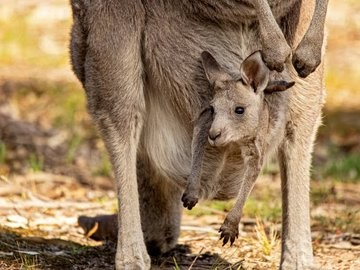
The ability of female kangaroos to raise three offspring simultaneously, all from the same place, fascinates me!
Female kangaroos have one vaginal opening and two uteruses. The left facilitates sperm transport to the left uterus, while the right does the same for the right uterus. The middle opening is where the baby descends from. This unique anatomy allows her to conceive in either uterus, using them interchangeably
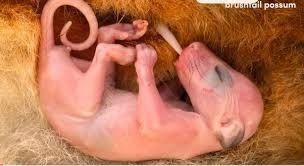
After mating, she may become pregnant. It takes kangaroo babies only 33 days to be born; they are in embryonic form. At this point, the undeveloped embryo measures a mere two centimetres in length. They lack hair, and their eyes and ears are still in the early stages of formation.
Despite their small size, these newborns instinctively crawl from the female kangaroo's vagina into her marsupial pouch.
There, the joey continues its development for about nine months, drawing vital nourishment from its mother
Around eight to nine months later, the little kangaroo starts venturing out of the pouch to explore and feed by grazing on grass.
But it returns to the pouch for three to four months to nurse. Meanwhile, the mother continues to mate while tending to the first baby (Joey number 1).
After getting pregnant again, she goes into a state called embryonic diapause with the new embryo. This means it waits its turn until the first joey can leave the pouch. This waiting period lasts about 235 days.
Once the second embryo is born and makes its way into the pouch, the mother kangaroo can conceive again for the third baby. But this third baby remains in a state of diapause.
The milk produced by a mother kangaroo is remarkable. Her body can tailor the milk's composition to meet each joey's specific growth needs. For instance, newborn infants receive a milk composition similar to the colostrum found in species like humans and llamas. As the joey grows, the milk composition adjusts accordingly.
To simplify, within the pouch, there are four teats (similar to human nipples) for feeding the babies. Joey number 2 latches onto one, while Joey number 1, now out of the pouch, latches onto another by simply burying its head in to suckle.
What's truly astounding is that the milk Joey 2 consumes differs from that of Joey 1, despite both originating from the same source. Each joey receives a precise formula tailored to its specific age and growth stage. For instance, Joey 2 might be taking a formulation like SMA GOLD (for newborns), while Joey 1 receives SMA GOLD 2 (for 6–12 months), all simultaneously.
Meanwhile, baby number 3 is already in the uterus, receiving nourishment, but does not go into the pouch, waiting for the other to leave.
So, one female can have up to three babies at different stages: one in the womb, one in the pouch, and one that's already out exploring.
It's amazing that she can take care of three little ones at the same time!
Resources
Inside the Kangaroo by Daxon
For updates on my latest work, feel free to connect with me on Twitter and LinkedIn.
Thanks for Reading 💖