

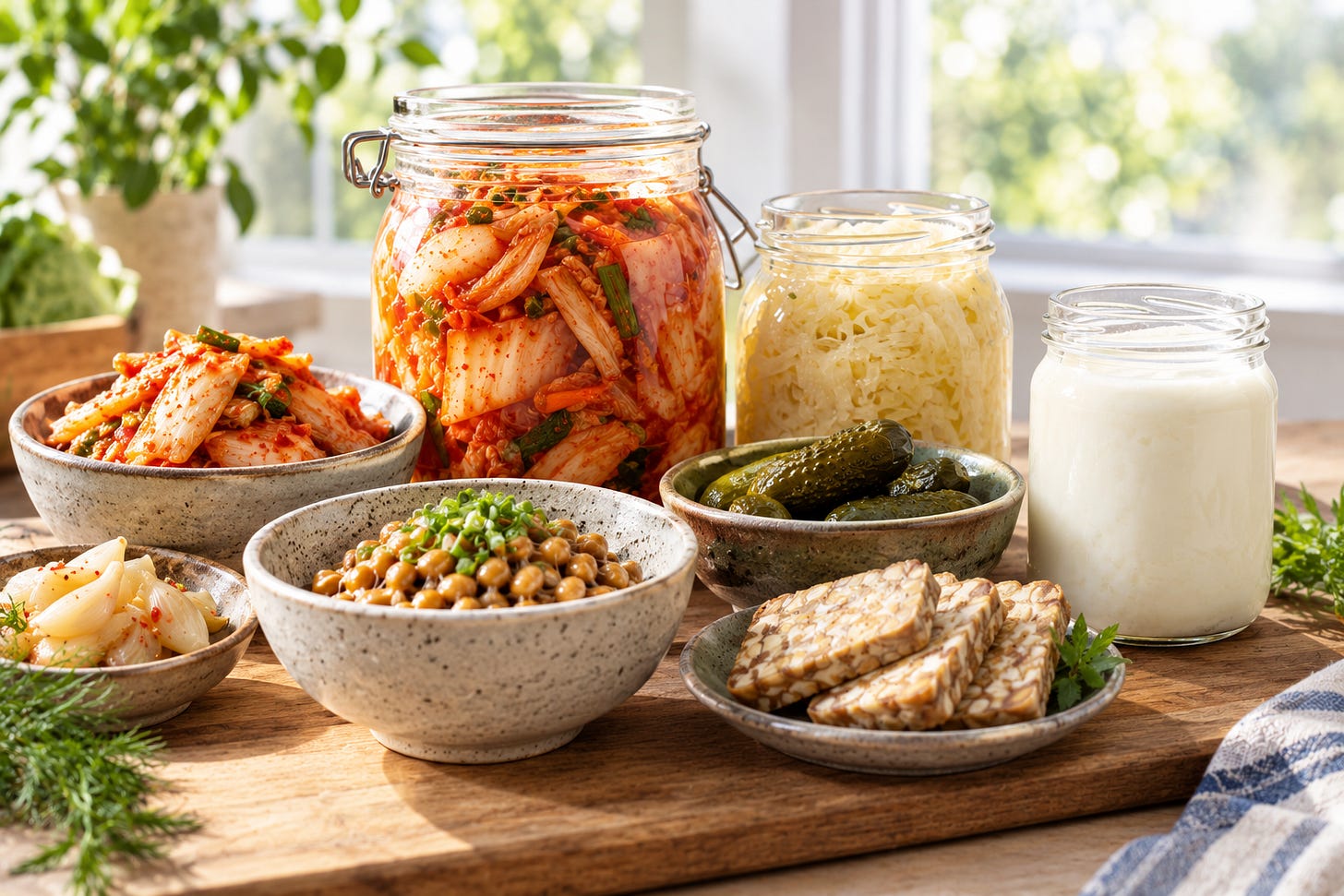
Before anything else, a quick self-check. How many of these sound like you?
You sleep enough hours, and you’re still tired by mid-morning;
Allergies, itchy skin, or a stuffy nose that never fully goes away;
Brain fog: words that sit on the tip of your tongue, books you can’t get through;
Blood work that comes back “basically normal,” while you feel off in a way you can’t name;
Aches that drift around your body, never sharp enough to report, never quite gone;
A cold that used to clear in three days and now lingers for two weeks.
If more than one of these sounds familiar, don’t rush to blame your routine or your stress levels.
Because in the eyes of researchers, these seemingly unrelated complaints may be different faces of the same thing: a quiet fire that has been burning inside you this whole time, in a place nobody thought to look.
It has a name: chronic inflammation.
And this article has one job: to show you that the thing that puts this fire out may already be in your fridge. Most people never even learn how the fire got started.
Inflammation Has Two Faces. The Second One Is the Problem
The inflammation you know is an open flame.
A sore throat. A swollen ankle. Red, hot, painful. It arrives fast, does its job, and leaves within days. That’s your immune system fighting at full power. That’s a good thing.
The dangerous one is quieter: chronic low-grade inflammation.
No swelling. No fever. It doesn’t stop you from showing up to work. It just keeps your immune system idling at a low boil: a steady drip of inflammatory signals, circulating through your blood, all day, every day.
A small fire. But one that never goes out.
And small fires burn longest, and deepest. Decades of research have drawn this line clearly by now: chronic inflammation is the common soil in which accelerated aging, cardiovascular disease, type 2 diabetes, Alzheimer’s, and multiple cancers all take root. It isn’t the cause of one disease. It’s the growing environment for many of them at once.
The real danger of a quiet fire isn’t that it makes you tired today. It’s that it burns every single day, and the bill goes to the person you’ll be in ten years.
So researchers have spent years circling one very direct question: can food turn this fire down?
In 2021, a team at Stanford delivered an answer that surprised almost everyone.
The Stanford Trial: 19 Inflammatory Proteins, Down in 10 Weeks
Published in Cell, this is one of the most talked-about randomized controlled trials in nutrition science.
The design was clean: 36 healthy adults, split into two groups. One ate a high-fiber diet. One ate a diet high in fermented foods. Ten weeks of intervention, with full blood and gut analysis before and after.
Start with the fermented group. Their assignment: six daily servings of fermented foods. Unsweetened yogurt, kefir, kimchi, kombucha, on rotation.
After ten weeks, the results landed:
19 inflammatory proteins in their blood had dropped significantly, including interleukin-6 (IL-6), one of the core pro-inflammatory signals;
The diversity of their gut microbiome had risen steadily. More diversity, more stability;
The response pattern of their immune cells had shifted.
Now, the part nobody expected.
The fiber group: no rise in microbiome diversity. And of the 19 inflammatory proteins, not one came down. Not a single one.
Remember, high-fiber eating has been the gold standard for gut health for decades. Every guideline says so. You may have been eating that way for years. In this trial, the fiber group did improve some gut measures. But the quiet fire? It didn’t move an inch.
One more detail worth keeping: the effect in the fermented group was dose-dependent. The more servings they ate, the harder the markers fell. So the question was never whether it works. It’s how much you eat.
Why did fiber “lose”? The researchers’ explanation is refreshingly blunt: fiber feeds the bacteria that already live in your gut. You’ve been feeding the same residents for years, and they’re still the same residents. Fermented foods bring in new ones. An ecosystem doesn’t change because you fertilized it. It changes when new settlers arrive.
One caution, before you run with the wrong takeaway. Fiber didn’t lose. It’s playing a longer game. This trial ran ten weeks; fiber’s deepest work happens on much longer timelines. As a prebiotic, it remains an irreplaceable foundation in decades of cohort research, both for the gut’s long-term environment and for metabolic health. Ten weeks simply can’t see that far. So the two aren’t rivals. They’re a division of labor: fiber lays the soil, fermented foods bring the settlers. The right move is not a swap. Keep the fiber. Add the ferments.
An honest note before we go further: 36 people is a small sample. But it was a clean randomized controlled trial, published in one of the most rigorous journals in biology, and the intervention costs a few dollars a day. The worst-case scenario is that you ate some good food. So no one is asking you to bet on anything. Just keep reading.
It Does Two Jobs: Sends Reinforcements and Repairs the Wall
Think of your gut as a city.
Job one: sending reinforcements. Every serving of living fermented food delivers new settlers to your gut. A microbiome is not a ledger, where one capsule offsets one bad meal. It’s an ecosystem. And an ecosystem’s first vital sign is diversity. When diversity rises, the whole system becomes harder to destabilize. Which is why those 19 proteins came down together.
Job two: repairing the wall.
During fermentation, those microbes produce a family of compounds called short-chain fatty acids, and one of them matters most: butyrate. Butyrate is the primary food of your intestinal lining. It feeds the barrier directly. A stronger wall means fewer bacterial fragments leaking into your blood. An immune system with less to patrol drops its alert level, and the inflammation across your whole body recedes.
One sentence: fermented foods deliver the garrison and the material to rebuild the wall, in the same bite.
And when that wall loosens, a condition you may have heard called “leaky gut,” you’re looking at one of the most common ignition points of the quiet fire.
It Doesn’t Stop at Inflammation: The Evidence Keeps Growing
The Cell trial is the most important recent piece of the picture, but it isn’t the only one. Around fermented foods, the evidence base is growing fast.
Aging. In 2025, a research team from Westlake University analyzed diet and biological age data from nearly 8,000 American adults, sorting foods by how many living microbes they carry. The group eating the most live-microbe foods had a roughly 20 to 30 percent lower risk of accelerated biological aging than the group eating the least. (An observational study. It shows association, not cause. More on that at the end.)
Stress. In a 2022 trial published in Molecular Psychiatry, healthy adults ate a diet rich in fermented foods and fiber for just four weeks. Their perceived stress levels dropped. The highway between your gut and your brain is no longer speculation.
The brain. A team at Juntendo University in Japan ran small randomized controlled trials giving older adults with mild cognitive impairment a specific strain of Bifidobacterium. After 24 weeks, cognition improved and the pace of brain shrinkage slowed. To be clear: that trial used a single-strain probiotic supplement, not fermented food itself. But it points down the same road: your gut microbiome participates in your brain’s health.
And the official stamp has arrived: the 2025 to 2030 Dietary Guidelines for Americans created a dedicated Gut Health chapter, naming sauerkraut, kimchi, kefir, and miso by name, precisely for their support of microbial diversity.
Now I want you to sit with one thought.
Your great-grandparents never saw a probiotic capsule. What they had was a crock, a jar, a vat of brine working on the counter. Fermentation may be the oldest biotechnology humans own: archaeologists have found residue of fermented drinks in pottery at least 9,000 years old. The craft has been field-tested for thousands of years. Science is only now catching up to its instinct.
But You’re Probably Eating “Fake” Ferments
Reading this far, you might think: simple enough. I drink yogurt every day. I eat bread. Isn’t that the same thing?
Unfortunately, probably not. Here are three traps, and almost everyone has stepped in at least one.
Trap one: confusing pickled with fermented.
They look like family. They are two different roads entirely:
Fermentation: low salt, lactic acid bacteria in charge, a controlled process, and the product is lactic acid plus living cultures. It’s alive.
Pickling: heavy salt, preservation through dehydration, flavor built by time. The microbes are mostly dead, and there’s still the nitrite window to survive.
In the first days after vegetables go into brine, nitrite climbs to a peak, and it usually takes two to three weeks to fall back to safe levels. That’s why “quick pickles” eaten within days are the most dangerous, while a properly fermented sauerkraut or kimchi is not. Exact numbers vary a lot by recipe and process. Buy from reputable makers, and read the label.
And one fast trick for the store: check the ingredient list for vinegar. Vinegar-pickled means sterilized, because vinegar’s entire job is to stop bacterial growth. Fermentation is bacterial growth. Opposite directions. A jar of “sauerkraut” with vinegar in the list is vinegar-brined cabbage. It has nothing to do with feeding your microbiome.
Trap two: assuming bread covers your quota.
Sourdough and other naturally leavened breads are genuinely fermented, and genuinely easier to digest. But most of the microbes died in the oven. What you’re eating is the aftermath of fermentation, what scientists call postbiotics: valuable, but not a living workforce. And their core nature as refined carbs hasn’t changed. They make decent supporting players. They will never carry the lead.
Trap three: assuming all yogurt is equal.
Standard supermarket yogurt usually contains two or three strains. Kefir is fermented by a symbiotic community of dozens of bacteria and yeasts. The two aren’t in the same league. And those sweet “probiotic drinks” on the shelf, where the first ingredient is water and the second is sugar? That’s not feeding bacteria. That’s feeding yourself sugar.
So which foods actually do the work? All three traps hide behind one move. Pick up any “fermented food” and ask three questions. Three seconds:
Is it in the refrigerated case? Live cultures need cold. Anything sitting on a dry shelf has almost certainly been heat-treated after fermentation. The fermentation happened. Then the heat killed everything it produced.
Does the label say “live and active cultures” or “unpasteurized”? If it says pasteurized with no cultures added back, you know the story: alive once, dead now.
Is vinegar in the ingredients? Then it’s pickled, not fermented. For the reason above: vinegar stops bacterial growth. Fermentation is bacterial growth.
Refrigerated. Live cultures. No vinegar. Three words, three seconds. That’s all you need to separate the living from the dead, on every shopping trip, for the rest of your life.
The Five Ferments That Actually Do the Work
Skill in hand. Now the shelf. The real workhorses are the five foods below. They aren’t ranked by fame or price, but by one standard only: the number and diversity of living microbes they deliver. You don’t need all of them. Two or three, rotated through the week, is enough to carry that keyword.
1. Kefir: the ceiling of microbial diversity
What it is: a fermented milk drink, thinner and tangier than yogurt, with a light fizz. It isn’t fermented by two or three strains. It’s fermented by a symbiotic community of 30 to 50 bacteria and yeasts, against the two or three in standard yogurt. For the sheer number of new settlers one food can deliver, nothing else competes.
How to eat it: half a cup at breakfast, straight or over oats and fruit. Start at half a cup. Let your gut meet the new settlers slowly.
How to pick it: from the refrigerated case, labeled “live and active cultures,” unsweetened. The first two ingredients should be milk and cultures. If sugar sits in the first two, that’s a dessert, not a ferment.
One tip: if you already drink yogurt daily, don’t stop. Add the kefir, and run your own two-week comparison. You’re probably not going back.
2. Raw fermented sauerkraut and kimchi: the cheapest daily side
What it is: vegetables transformed by nothing but salt, time, and lactic acid bacteria. Their microbial lineup is completely different from dairy ferments, which is exactly the point of rotating: a new food, a new set of settlers.
How to eat it: two to three tablespoons with any meal. Eggs, rice bowls, noodles, roast chicken, it doesn’t matter. It’s a condiment, not a main course. But two or three tablespoons a day, every day, adds up to a serious delivery.
How to pick it: the ingredient list should read vegetables and salt, plus maybe garlic and chili. A faint fizz when you open the jar, a tangy smell instead of a vinegar smell: that’s a living one. Shelf-stable versions, or anything with vinegar in the list, goes back on the shelf.
One tip: refrigerate after opening, and use clean utensils every time. You’re growing the right microbes, not the wrong ones.
3. Plain unsweetened yogurt: the easiest entry point, and only the passing grade
What it is: the easiest to find, the easiest to keep up. But be clear about its rank: standard yogurt usually carries two or three strains. It’s the passing grade of fermentation, not the ceiling. Drinking yogurt daily does not complete the assignment.
How to eat it: one serving at breakfast, with nuts or a spoon of oats. Unsweetened is the only non-negotiable.
How to pick it: look for “live and active cultures,” first two ingredients milk and cultures. Shelf-stable yogurt labeled pasteurized has no live cultures left. Easier to digest, yes. Feeding your microbiome, no.
One tip: if milk bloats you, yogurt and kefir usually don’t. The cultures have already digested most of the lactose for you. That’s fermentation working, on display.
4. Miso: one tablespoon, thirty seconds, pennies per serving
What it is: fermented soybean paste, and the most underrated bargain in the category. By cost per serving, it may be the cheapest living food on this list.
How to eat it: stir one tablespoon into a cup of warm, not hot, water, top with sliced scallions, and you have a bowl of soup. Mid-afternoon, in place of cookies and a latte: thirty seconds, one delivery complete. And keep the water below a simmer. Heat kills the cultures.
How to pick it: refrigerated and labeled unpasteurized. Shelf-stable miso is usually pasteurized.
One tip: miso carries real sodium. One bowl a day is fine; if you watch your blood pressure, just count it into your day.
5. Low-sugar kombucha: for the person who wants “something to drink”
What it is: fermented tea, lightly fizzy, naturally tart. Its live microbe count is modest next to kefir or kimchi. Its real value is the swap: the slot where your afternoon soda sits, filled by something alive instead.
How to eat it: one bottle in the afternoon, replacing the sweetened drink. Replacing, not stacking. Stacking just means you drank an extra bottle.
How to pick it: refrigerated, labeled raw or unpasteurized, with sugar as far down the ingredient list as possible. Shelf-stable, crystal-clear, soda-sweet kombucha is a soft drink wearing a fermentation costume.
One tip: start with half a bottle. The tartness takes a few days, and then most people get hooked.
6. Natto and tempeh: one more line for the diversity ledger
What it is: fermented soybeans. What sets them apart from the five above is the fermenter itself: natto is fermented by Bacillus subtilis, tempeh by a mold. Entirely different family from lactic acid bacteria. In other words, they deliver microbes the other five can’t.
How to eat them: natto over warm rice with the included soy sauce and mustard, the classic way. Slice tempeh and pan-fry until golden on both sides; it eats like a hearty main. No need for daily. Once or twice a week is enough. Their job is to widen the roster, not to add volume.
How to pick them: natto from the refrigerated section of Japanese grocery stores or online; don’t toss the sauce packets. Tempeh should smell faintly nutty. Sour, or sharp with ammonia, means no.
One tip: the sticky strings and the smell are a hurdle. Start with half a pack. If it’s truly not for you, tempeh is the silent substitute with a similar microbial payoff.
As for the supporting cast: sourdough, naturally leavened breads, aged cheeses. Better than refined staples and processed cheese, but what they mostly deliver is flavor and the aftermath of fermentation, the postbiotics, not a living workforce. Fine as supporting players. They will never carry the lead.
That’s the roster: five starters and one line from the bean family. Don’t overbuy. Two or three, rotated through the week, beats ten lined up on the counter. The keyword of this research was never quantity. It was diversity.
A 4-Week Ramp, One Formula, and 5 Reminders
Six servings a day was the trial dose, not a lifestyle prescription. The realistic path is a four-week ramp:
One principle before you start, and it’s the sentence this whole article most wants to leave with you: fermented foods are condiments, not staples. Dose-dependent doesn’t mean the more the better. Don’t let “the more servings, the stronger the effect” talk you into eating kimchi by the bowl. That’s a condiment used in the wrong place, and it quietly loads up your sodium along the way. Its job is to add settlers to a normal diet. Your foundation is still vegetables, legumes, and whole grains, fiber included, all of it. They’re partners, not substitutes.
Week 1: one serving a day. Easiest version: a fixed serving of plain unsweetened yogurt at breakfast, or two spoonfuls of kimchi with one meal;
Week 2: two servings. Add kefir, or a bottle of low-sugar kombucha;
Weeks 3 and 4: three to four servings, rotating across two or three different foods. Remember, diversity beats volume. The entire logic of the trial was ecological variety.
One day, why just one serving? Read this part carefully.
When new microbes arrive in the gut, they compete for space with the established residents, and the displaced ones die off and break down. The result is temporary gas and bloating. That’s the ecosystem turning over, not the food going wrong. But if you don’t know this, here’s how the story goes: you start at the full trial dose on Monday, you feel bloated by Wednesday, and by Friday you’ve concluded that fermented foods “just don’t agree with me.” And you stop at Week 1 forever. The food wasn’t wrong. The introduction was just too fast for the ecosystem to adapt.
There’s one more trap most people have never heard of: histamine. Fermented foods naturally contain it, and a small number of people react within half an hour with headaches, flushing, or hives. If kimchi or sauerkraut, which are high-histamine, trigger you, switch to the low-histamine options first: fresh yogurt, kefir, miso. If everything fermented triggers you, see a doctor about histamine intolerance.
Above the ramp, here’s the daily formula, simple enough to run without thinking:
Two or more servings a day, from two or more different foods. Rotation is diversity.
Kefir and sauerkraut today. Yogurt and kimchi tomorrow. Miso soup and kombucha the day after. The same yogurt every day delivers the same two or three strains daily. A week of rotation walks dozens of different microbes through the door. Diversity is the goal. Rotation is the method.
Finally, 5 reminders. Each one has claimed real victims:
1. Heat kills the cultures. Long simmering wipes them out. Don’t heat natto. Add kimchi at the end of cooking, not the beginning. Don’t stir yogurt into something scalding.
2. Don’t feed both sides at once. Ultra-processed food, alcohol, and sugar are fertilizer for the wrong crowd. The reinforcements arrive on one side while the wall is being demolished on the other.
3. Read the label. Three signals, straight back on the shelf: sugar in the first two ingredients, “pasteurized” (meaning no live cultures), an ingredient list long enough to scroll. Real fermented sauerkraut reads: cabbage, salt. Maybe garlic and chili.
4. Home fermenting is risk, not a hobby. Fermentation means culturing microbes. Done right, it’s kefir. Done wrong, it’s pathogen cultivation. Without a sterile setup and reliable cultures, skip homemade kefir and kombucha.
5. Special conditions, ask first. If you have kidney disease, hypertension, gout, or an immune condition, talk to your doctor before you start.
One Last Thing
Back to the six lines at the top. The tiredness, the brain fog, the allergies that never fully leave, the feeling you can’t name: now you know they may all be the same quiet fire.
And here’s the most unfair part: this fire has burned for years while you booked the blame to yourself. “Not sleeping enough.” “Too anxious.” “Just getting older.” The truth is, your body never betrayed you. It has been sounding the alarm, quietly, over and over. You just couldn’t speak the language, and no one ever translated it for you.
So no, this is not your fault. Growing up, nobody told us that a microbiome is not a ledger you balance, one capsule at a time. It’s an ecosystem that needs to be fed, continuously, gently, and with variety. And nobody told us that the fire extinguisher isn’t sold in the glass bottles of the supplement aisle. It’s sitting at the back of your fridge, in a jar that costs a couple of dollars.
Your grandmother never said the words “microbial diversity” as she set a jar of fermented vegetables on the table. She just knew this food kept people going. That craft passed from her grandmother to her, and from her to you, without a single break. Science didn’t invent it. Science finally recognized it.
And the good news: this ecosystem doesn’t ask for a perfect owner. No strict protocols, no obsession at every meal. It only asks that you keep showing up: a cup of yogurt today, a spoonful of kimchi tomorrow, a glass of kefir the day after. Like watering a plant: what matters was never how hard you pour. It’s that the soil never goes dry.
Picture a scene, very close to now. Next grocery run, you stop at the refrigerated case, pick up a jar of sauerkraut, and flip it over. Cabbage, salt. That’s it. Into the cart. On your way past the center aisles, you see the shelf-stable jar you’ve been buying for years. This time, your hand doesn’t move. You don’t need to read the label. You already know.
That quiet fire was never your body’s betrayal.
It’s your gut, sending the message it has been sending all along: feed me. I’ve been running on empty.
If you’ve ever held a “perfectly normal” lab report and still felt tired, still felt off, this article was written for you: the signals no marker ever caught are very likely talking to you through another channel. Your gut.
iBetterWithin exists to translate exactly these quiet signals, one by one, so you can actually hear what your body is saying, instead of writing it all off as “a rough week.”
If that sounds like your kind of conversation, subscribe, and let’s keep listening.
If you know someone who always says “I’m just tired lately” while their labs keep coming back clean, send them this article. It might be the explanation they’ve been waiting for.
Let’s keep listening to what happens within.
References
Wastyk HC, et al. Gut-microbiota-targeted diets modulate immune status. Cell, 2021. Stanford randomized controlled trial: 36 adults, 10 weeks; fermented food group: 19 inflammatory proteins down, microbiome diversity up, dose-dependent effect.
Bourrie BCT, Willing BP, Cotter PD. The microbiota and health promoting characteristics of the fermented beverage kefir. Frontiers in Microbiology, 2016. Kefir contains 30 to 50 bacterial and yeast species, far exceeding ordinary yogurt.
Westlake University team. Dietary live microbe intake and biological aging (NHANES analysis). Food & Function, 2025. About 7,719 adults; the highest live-microbe intake group showed lower risk of accelerated biological aging.
University College Cork team. The psychobiotic diet. Molecular Psychiatry, 2022. Four weeks of a fermented-food and fiber diet reduced perceived stress.
Juntendo University team. Probiotic Bifidobacterium breve A1 in mild cognitive impairment. Journal of Alzheimer’s Disease, 2020 & 2022. 24-week randomized trials: cognitive improvement, slower brain atrophy.
Marco ML, et al. Health benefits of fermented foods: microbiota and beyond. Current Opinion in Biotechnology, 2017. Review of fermented foods, microbiota, and health.
2025 to 2030 Dietary Guidelines for Americans. Gut Health chapter: recommends sauerkraut, kimchi, kefir, and miso.
Honesty Note
1. Association is not causation. The aging study is a cross-sectional analysis of NHANES data. It cannot tell whether fermented foods slow aging, or whether people who eat them simply live healthier overall. Intervention trials are still needed.
2. Small samples. The Cell trial had 36 participants over 10 weeks. It’s promising, early evidence, and the effect needs replication in larger groups. “Six servings a day” was the trial dose, higher than normal eating; the 4-week ramp in this article is a general suggestion, not the trial protocol.
3. The brain research used supplements, not food. The brain-atrophy trials tested a single probiotic strain in about 80 adults with mild cognitive impairment. They cannot be read as “eating fermented foods produces the same effect.”
4. This is not medical advice. Nitrite windows, home-fermentation risks, and food safety details vary widely by process; defer to the product and reputable makers. If you have kidney disease, hypertension, gout, or an immune condition, talk to your doctor first.