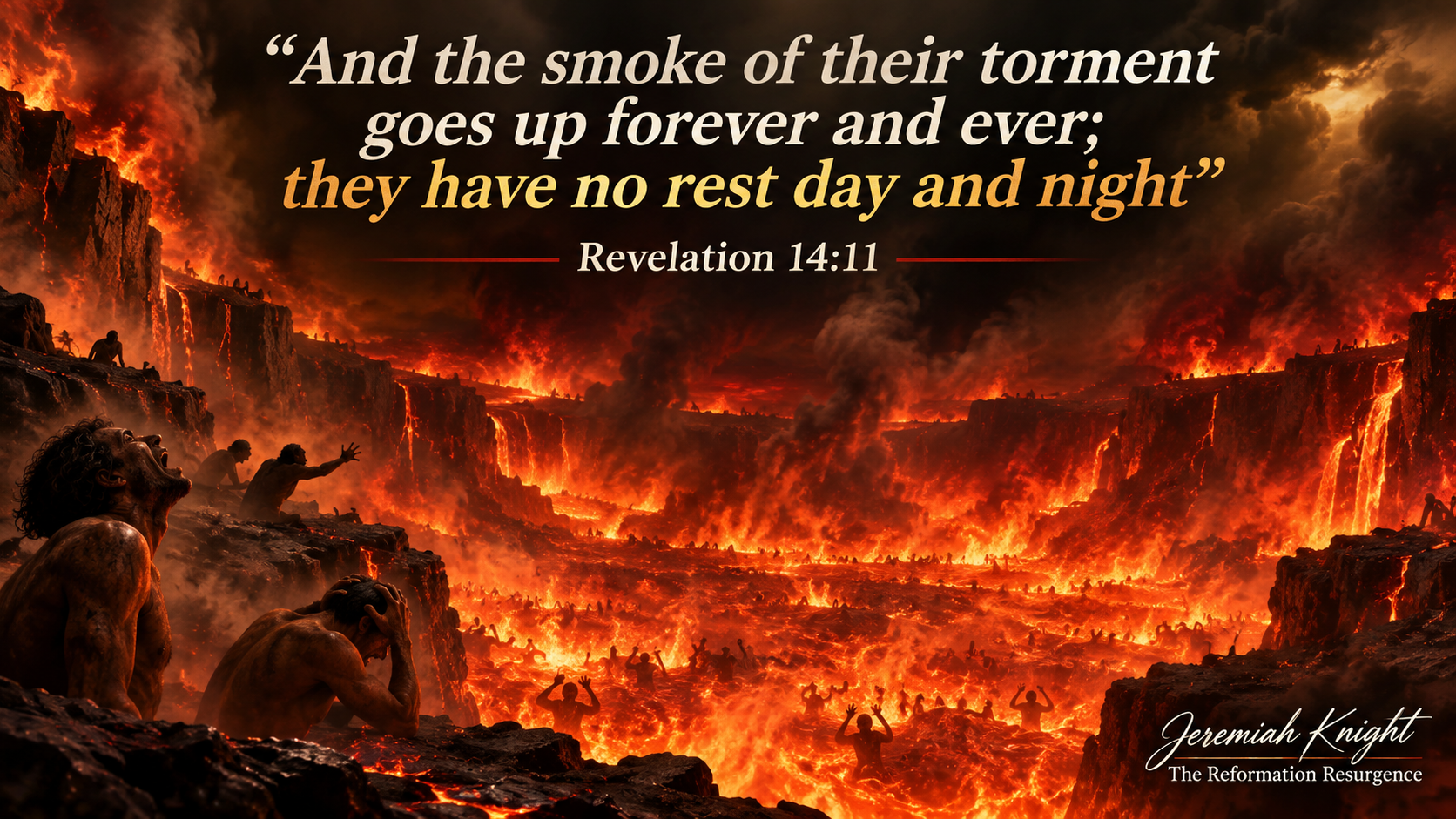

A sister wrote to me and asked why nobody preaches on hell anymore. She remembers the early years of her walk with Christ when preachers spoke plainly about sin and judgment, and she looks around today and the word has simply vanished. Honestly, she is right, and her question has been sitting on my own heart for a long time. We have pulpits full of sermons about our dreams, our breakthrough, our best life now, and the subject that the Lord Jesus spoke about more than anyone else in the whole Bible has been quietly buried like an embarrassing relative nobody wants to mention.
And that is the first thing we need to face. The man who preached hell the most is JESUS. The word He used was Gehenna, and it appears twelve times in the New Testament, eleven of them from His own lips. The One who touched lepers, who let children climb on Him, who wept at the tomb of His friend, that same mouth said, “Do not fear those who kill the body but are unable to kill the soul; but rather fear Him who is able to destroy both soul and body in hell” (Matthew 10:28). So when preachers today say that talking about hell is unloving, they are accusing the most loving man who ever lived of being unloving, because He would not stop talking about it.
Now take that word Gehenna, because most of us have never been told what it meant to the people hearing Him. Gehenna is the valley of Hinnom, a real valley outside Jerusalem. In the darkest days of Israel, parents burned their own sons and daughters alive in that valley as offerings to Molech, and God said of it, “Therefore, behold, days are coming,” declares the LORD, “when it will no longer be called Topheth, or the valley of the son of Hinnom, but the valley of the Slaughter” (Jeremiah 7:32). When Jesus said Gehenna, His hearers pictured that cursed ground, the place of fire and abomination and the judgment of God. He reached for the most horrifying location in their national memory and said, that is where sin is taking you.
Listen to how He described what waits there. A fire that is not put out. A worm that does not die (Mark 9:48). Outer darkness, where “there will be weeping and gnashing of teeth” (Matthew 8:12). And we should understand what gnashing of teeth means in Scripture. When Stephen preached, his hearers “began gnashing their teeth at him” (Acts 7:54). Gnashing is rage. Even when God pours out His judgments on the earth, Revelation shows us men who “blasphemed the God of heaven because of their pains and their sores; and they did not repent of their deeds” (Revelation 16:11). Judgment does not make a sinner repent, and at the very end of the Bible God says, “Let the one who does wrong, still do wrong; and the one who is filthy, still be filthy” (Revelation 22:11). There is no repentance in hell. The sinner there goes on hating God, and justice goes on answering the hatred, and this is one reason the punishment never ends, because the sinning never ends.
Then in Luke 16 the Lord pulls back the curtain and lets us hear a man who is actually there. A rich man died and was buried, “In Hades he lifted up his eyes, being in torment” (Luke 16:23). He sees. He feels. He pleads for a drop of water on his tongue, crying, “I am in agony in this flame” (Luke 16:24). And he remembers, for Abraham tells him, “Child, remember that during your life you received your good things” (Luke 16:25), which means memory goes with a man into that place. Then comes the sentence that buries every hope of a second chance. “Between us and you there is a great chasm fixed, so that those who wish to come over from here to you will not be able, and that none may cross over from there to us” (Luke 16:26). Fixed. No crossing, no climbing out, no purgatory, no prayers of relatives shortening the sentence, for “it is appointed for men to die once and after this comes judgment” (Hebrews 9:27). And when the man begs for someone to rise from the dead and warn his five brothers, heaven answers, “They have Moses and the Prophets; let them hear them” (Luke 16:29). When he presses again, Abraham says, “If they do not listen to Moses and the Prophets, they will not be persuaded even if someone rises from the dead” (Luke 16:31). The Bible sitting on our shelf is the warning God has given us, and we will answer for what we did with it.
And it does not end. “These will go away into eternal punishment, but the righteous into eternal life” (Matthew 25:46). The same word ETERNAL stands over both destinies in one sentence, so if the fire ever goes out, heaven goes out with it by the very same word. But here is the verse that took my breath when I finally saw it. The lost one “will be tormented with fire and brimstone IN THE PRESENCE of the holy angels and IN THE PRESENCE OF THE LAMB” (Revelation 14:10). We talk about hell as separation from God, and in the sense of His mercy, His blessing and His glory that is true, for they suffer “away from the presence of the Lord and from the glory of His power” (2 Thessalonians 1:9). But no sinner ever escapes God. David said, “If I make my bed in Sheol, behold, You are there” (Psalm 139:8). The horror of hell is that He is there, and there is no mercy left in His face.
Many today teach that hell does not last, that the lost are simply burned up and cease to exist. They point to words like “destroy” (Matthew 10:28) and “eternal destruction” (2 Thessalonians 1:9). But in Scripture to be destroyed means to be ruined and lost. The same Greek word Jesus used in Matthew 10:28 is used for wineskins that burst and are “ruined” (Matthew 9:17) and for the sheep the shepherd “has lost” (Luke 15:4), and nobody thinks the wineskins or the sheep stopped existing. Paul calls it ETERNAL destruction, a ruin that never comes to an end. And the very next verse after the one we just read settles it. “And the smoke of their torment goes up forever and ever; they have no rest day and night” (Revelation 14:11). A person who no longer exists cannot have no rest day and night.
We should also get the order of the end straight, because Scripture is more precise than our preaching has been. The lost who die now go to Hades, the place of torment where that rich man lifted up his eyes, and Hades is the prison before the courtroom. On the last day the dead are raised and judged, and then “death and Hades were thrown into the lake of fire. This is the second death, the lake of fire” (Revelation 20:14). And the lost are not raised as souls floating in the dark. They are raised bodily, for “all who are in the tombs will hear His voice, and will come forth; those who did the good deeds to a resurrection of life, those who committed the evil deeds to a resurrection of judgment” (John 5:28-29), to “disgrace and everlasting contempt” (Daniel 12:2). And let us bury the cartoon our generation grew up with, the devil in red ruling hell with a fork in his hand. Satan rules nothing there. Hell was “prepared for the devil and his angels” (Matthew 25:41), and on that day he becomes its chief sufferer, “thrown into the lake of fire and brimstone... and they will be tormented day and night forever and ever” (Revelation 20:10).
Why must it be so? Because God is holy and we have never once seen our sin from His side of it. “Your eyes are too pure to approve evil, And You can not look on wickedness with favor” (Habakkuk 1:13). We weigh sin by the damage it does to us, which is why it always looks small and manageable to us. God weighs sin against the One it is committed against, and David understood this when he cried, “Against You, You only, I have sinned And done what is evil in Your sight” (Psalm 51:4). Sin against an infinite and eternal God carries a weight we cannot begin to calculate, and every day the unrepentant man lives, he is, in Paul’s words, “storing up wrath for yourself in the day of wrath and revelation of the righteous judgment of God” (Romans 2:5). Hell is that stored wrath finally paid out in full.
And we need to be honest about who will be there, because most people think hell is only for murderers and atheists. Jesus said some of the most shocked people on that day will be religious people. “Many will say to Me on that day, ‘Lord, Lord, did we not prophesy in Your name, and in Your name cast out demons, and in Your name perform many miracles?’ And then I will declare to them, ‘I never knew you; DEPART FROM ME, YOU WHO PRACTICE LAWLESSNESS’” (Matthew 7:22-23). These were men and women who preached, prayed and did miracles in His name, in churches in every nation, and He never knew them. And look at who God puts first in this list. “But for the cowardly and unbelieving and abominable and murderers and immoral persons and sorcerers and idolaters and all liars, their part will be in the lake that burns with fire and brimstone, which is the second death” (Revelation 21:8). The cowardly and the unbelieving stand beside the murderers. A clean life, a church membership and a family name have never kept one soul out of that lake.
Then comes the objection we have all heard, that a loving God would never do this. But look first at what this loving God actually says. “‘As I live!’ declares the Lord GOD, ‘I take no pleasure in the death of the wicked’” (Ezekiel 33:11). God takes no delight in it, and He pleads with sinners to turn. And then look at Gethsemane, because the cross is where this objection dies. The Son of God fell on His face and begged, “My Father, if it is possible, let this cup pass from Me” (Matthew 26:39), and the cup did not pass. If sin could have been forgiven with a wave of the divine hand, the Father would have waved it rather than crush His own beloved Son, for “the LORD was pleased To crush Him, putting Him to grief” (Isaiah 53:10). The cross is the plainest measurement of what our sin deserves that the universe will ever see. Whoever says hell is too severe has not yet stood long enough at Calvary, because the darkness, the cup and the cry, “My God, My God, why have You forsaken Me?” (Matthew 27:46), are hell’s own contents, poured out on a Substitute.
There is something else we never preach. The Judge on the last day is the Lamb. The Father “has given all judgment to the Son” (John 5:22). And when that day comes, the kings and the great men will cry to the mountains, “Fall on us and hide us from the presence of Him who sits on the throne, and from the wrath of the Lamb” (Revelation 6:16). Think about that phrase. The wrath of the LAMB. The gentlest, lowliest, most tender person who ever entered this world is the one whose wrath the lost will beg mountains to hide them from. The hands that open the books on that day still carry the nail marks that sinners spent their lives refusing.
And when the judgment falls, heaven will not apologize for it. John heard “a loud voice of a great multitude in heaven, saying, ‘Hallelujah! Salvation and glory and power belong to our God; BECAUSE HIS JUDGMENTS ARE TRUE AND RIGHTEOUS’” (Revelation 19:1-2), and over the smoke of the condemned city the praise goes up again (Revelation 19:3). The redeemed will not spend eternity embarrassed by the justice of God. They will worship Him for it, because by then they will finally see sin and holiness as they truly are. And no one in that judgment will be wronged by a single degree, for the slave who knew his master’s will receives many lashes and the one who did not know receives few (Luke 12:47-48), and the books are opened and every person is “judged from the things which were written in the books, according to their deeds” (Revelation 20:12). Even now God’s law speaks “so that every mouth may be closed and all the world may become accountable to God” (Romans 3:19), and on that day no mouth will be opened in defense.
Now set our silence beside all of this. Paul warned Timothy that this day would come, “For the time will come when they will not endure sound doctrine; but wanting to have their ears tickled, they will accumulate for themselves teachers in accordance to their own desires” (2 Timothy 4:3). Hell has gone quiet in so many pulpits because people do not want to hear it, and many preachers fear losing people more than they fear God. Paul asked himself, “For am I now seeking the favor of men, or of God? Or am I striving to please men?” (Galatians 1:10). God told the watchman that if he sees the sword coming and does not blow the trumpet, the people die in their iniquity, “but his blood I will require from the watchman’s hand” (Ezekiel 33:6). Paul could tell the Ephesian elders, “I am innocent of the blood of all men. For I did not shrink from declaring to you the whole purpose of God” (Acts 20:26-27). Can we say that? When we drop hell from our message we are shrinking back from the purpose of God, and the blood of the unwarned is a real thing in His courtroom. And in case anyone thinks warning people means thundering at them with dry eyes, remember that Paul spoke of the enemies of the cross “weeping” as he wrote (Philippians 3:18), and the Lord Himself looked at the city that would reject Him and wept over it (Luke 19:41). The men in Scripture who said the most about judgment said it through tears.
But the Bible never shows us the fire without showing us the way out, and the way out is a Person. “Jesus, who rescues us from the wrath to come” (1 Thessalonians 1:10). The only shelter from the wrath of God is inside the One on whom that wrath has already fallen, for “Christ redeemed us from the curse of the Law, having become a curse for us” (Galatians 3:13), and so “there is now no condemnation for those who are in Christ Jesus” (Romans 8:1). Every drop of the cup that stood against His people, He drank. That is why a believer can read every terrifying verse we have just read and end up worshipping instead of trembling, because for us the fire fell on Him.
So here is where this lands on each one of us. If we belong to Christ, it is time to open our mouths again, with grief, with urgency, “snatching them out of the fire” (Jude 23), because our neighbors and our families are walking toward a real fire. And if anyone reading this is still outside of Christ, hear the Lord Jesus Himself, “unless you repent, you will all likewise perish” (Luke 13:3). Do not trust tomorrow with your soul. “Behold, now is ‘THE ACCEPTABLE TIME,’ behold, now is ‘THE DAY OF SALVATION’” (2 Corinthians 6:2). Run to the Lamb today. He has never once turned away a sinner who came, for He said, “the one who comes to Me I will certainly not cast out” (John 6:37).
“‘As I live!’ declares the Lord GOD, ‘I take no pleasure in the death of the wicked, but rather that the wicked turn from his way and live. Turn back, turn back from your evil ways! Why then will you die, O house of Israel?’” (Ezekiel 33:11)
He who has ears to hear, let him hear.