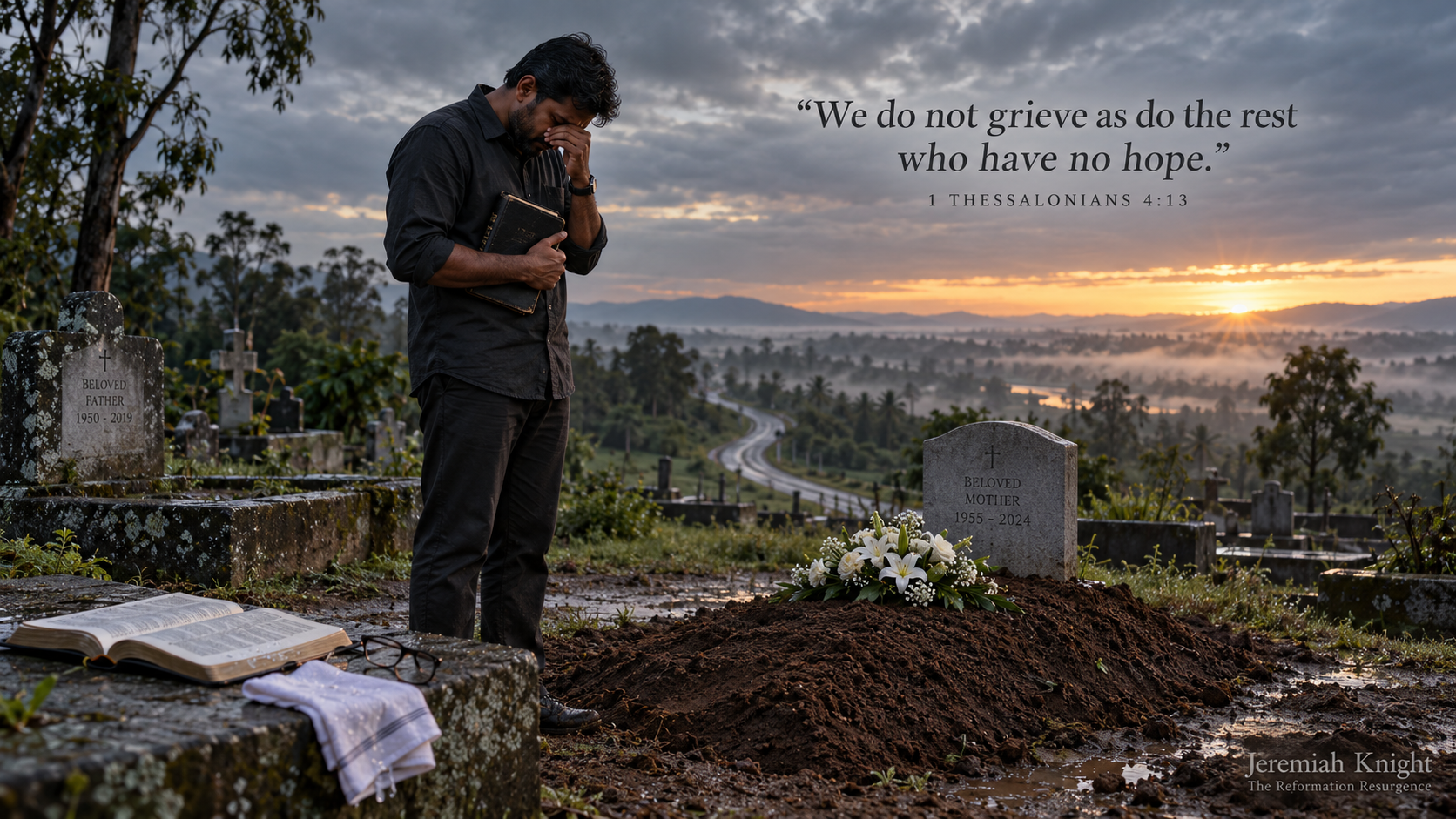

Eleven days ago, I buried my mother. She was feeling drowsy, and she fainted. I called the ambulance and carried her, and by the time we reached the hospital the doctors told me she was already gone. She passed away on the way, while I sat beside her begging God for one more hour. I am my parents only child. I buried my father years ago, and now I have buried my mother, and I stand in this world as an orphan.
Truth be told, from the day dad passed away my life has known only suffering, one wave after another with no relief in between. Debts that took years to clear. Loneliness in a city where I have no church family. This year alone I stood at the graves of a pastor who shaped me, a classmate I prayed over through her cancer, my school principal, and a man from the blind community I serve. And now mom. So when I ask this question, I am not asking it from a desk. I am asking it from the room where her bed still sits empty. What is your theology actually worth at a graveside?
Scripture says “It is better to go to a house of mourning than to go to a house of feasting, because that is the end of every man, and the living takes it to heart” (Ecclesiastes 7:2). Every theology on this earth eventually walks into that house of mourning, and the coffin examines all of them. You can hold almost any belief comfortably while the sun is out. The grave is where the systems are weighed. I have now stood there enough times to tell you honestly what each one weighs.
Take the theology that fills the biggest churches of our day, the one that promises health, wealth and breakthrough to every believer with enough faith. I have watched it work with my own eyes in my own country. In the healing crusades, when the sick go home unhealed, they are told their faith was lacking, that someone’s unbelief blocked the miracle. The sick man gets the blame for his own sickness. Now follow that teaching to its end. If sickness means weak faith, what does death mean? Death is the one sickness their stage never cures, and so the same system that roars over the sick falls completely silent at the graveside, because the only thing its logic can say there is too cruel to say out loud, that somebody’s unbelief let this happen. But the Bible never promises any such exemption. “It is appointed for men to die once and after this comes judgment” (Hebrews 9:27). Paul, who raised the dead, left Trophimus sick at Miletus (2 Timothy 4:20) and watched Epaphroditus come to the very edge of death (Philippians 2:27). If apostles buried their sick, the preacher who promises you exemption from the house of mourning is selling you something the Bible never stocked, and his theology will not walk through the funeral door with you. It stays outside, because inside, its whole premise lies dead in the coffin.
Then there is the theology that protects God by removing Him from your tragedy. God did not ordain your loss, it says. He does not decree what happens to you, man’s free will runs the story, and when death strikes, God had no hand in it, He only permits it and then works to bring something good out of it afterwards. The people who say this mean well, I will say that honestly. They want to guard God from being blamed for evil, and Scripture does say God cannot be tempted by evil and He Himself does not tempt anyone (James 1:13). I take that point fully, God is never the author of sin. But carry their comfort into the hospital corridor at 2 am and watch it come apart in your hands. If God did not ordain the night my mother died, then either that night happened outside His plan and He is now stitching good onto a tragedy He never intended, or He saw it coming from eternity, had full power to stop it, and stood back and let it run. The first gives me a God as surprised as I am. The second gives me everything hard about sovereignty with all the comfort removed. And even the verse this whole world quotes at funerals turns against them. “And we know that God causes all things to work together for good to those who love God, to those who are called according to His purpose” (Romans 8:28). God CAUSES all things to work together. You cannot direct what you do not rule. Take His sovereignty away and Romans 8:28 dies with it, and then there is nothing left to say at the grave at all.
Some go further still and teach that God Himself did not know the day was coming, that the future is open even to Him and He learns it as we do. Think of what that offers a weeping son. A God standing in the hospital corridor receiving the news alongside me, wiping His own tears, as blindsided as I am. That god can grieve with me but he could not have written my mother’s days, and he cannot promise me he will manage tomorrow any better than he managed last night. The living God speaks differently about Himself. “I am God, and there is no one like Me, declaring the end from the beginning, and from ancient times things which have not been done, saying, ‘My purpose will be established, and I will accomplish all My good pleasure’” (Isaiah 46:9-10). A god who is discovering the future cannot say one line of that verse.
In my land there is an older answer still, the one most of my own relatives hold, that death is karma collecting its dues, the soul paying for a past life and departing to pay again in the next one. It sounds philosophical until you sit in its house of mourning, where the mourners cannot even say where their loved one has gone, only that the wheel turns and the debt continues. There is no rest in it for the dead and no comfort in it for the living, because there is no grace in it anywhere, only accounts. The Bible cuts that wheel in one stroke. Men die once, and after this comes judgment (Hebrews 9:27). One life, one death, one Judge, and therefore one urgent question, am I ready to meet Him? And to the thief dying next to Him, with no time left to balance any account, the Lord Jesus said, “Truly I say to you, today you shall be with Me in Paradise” (Luke 23:43). Not a cycle. Paradise, that same day, by grace alone.
And there are the systems that keep the dead suspended. Millions grieve inside a theology that tells them their loved one is now in a place of purging fire, and that the family’s prayers, offerings and masses may shorten the sentence. I have debated the defenders of this teaching for years, and I ask one thing of it here. What does it give the mourner? Not rest, but a second job, grieving with one hand and ransoming with the other, never certain, never finished. Scripture gives the believer something that teaching cannot afford to give, certainty. “We are of good courage, I say, and prefer rather to be absent from the body and to be at home with the Lord” (2 Corinthians 5:8). Absent from the body, at home with the Lord. There is no third place in that verse, and when my mother closed her eyes in that ambulance she did not enter a queue. She entered His presence.
And I have not forgotten the loudest voice of our age, the one that says there is no God at all, that we are chemistry and accident, and that the funeral should be renamed a celebration of life. I have listened carefully to the comfort it offers. They live on in our memories, we are told. Think about what that actually means. The one we loved now exists nowhere except inside the heads of people who are also dying, and no honest heart can call that comfort. If death ends everything, then the ache in my chest when I pass mom’s bedroom is a chemical accident with no meaning, and grief itself is lying to us. But grief is not lying. “He has also set eternity in their heart” (Ecclesiastes 3:11), and that is why no one standing at a real graveside has ever felt that this is how things were meant to be. Death feels like an enemy because it is one, “The last enemy that will be abolished is death” (1 Corinthians 15:26). And close beside the atheist stands the kind soul who comforts every funeral with the words, they are in a better place now, whoever they were and whatever they believed. But a hope the Bible does not give is not hope. The Lord Jesus, the most compassionate man who ever walked this earth, is the very one who warned that the gate is small and the way is narrow that leads to life, and few are those who find it (Matthew 7:13-14), and that no one comes to the Father except through Him (John 14:6). The graveside is the last place on earth to hand someone a comfort that will not hold.
Now here is where I must be careful, because someone will say, so your answer is simply that God controls everything, and plenty of religions say that too. They do. There are millions who hold an iron fate, who answer every funeral with the words, it was written. And I will grant them this much, they are closer to the truth about power than the systems above. But bare sovereignty is not comfort either. An absolute will that has never pledged itself to love you is something to submit to, never something to rest in. You can bow before raw fate but you cannot weep on its shoulder. What a graveside needs is not just a sovereign God. It needs a sovereign FATHER, and only the gospel has one. “He who did not spare His own Son, but delivered Him over for us all, how will He not also with Him freely give us all things?” (Romans 8:32). The decree that runs my life was signed in the blood of His Son for me. That is the difference between fate and fatherhood, and it is the whole difference in the world.
And see who in the Bible speaks the strongest words about this sovereignty. Not the comfortable. The sufferers. Lamentations was written in the ashes of Jerusalem with the bodies still unburied, and from inside that horror the weeping prophet says, “Who is there who speaks and it comes to pass, unless the Lord has commanded it? Is it not from the mouth of the Most High that both good and ill go forth?” (Lamentations 3:37-38). Job buried all ten of his children in one day, and that same day he fell to the ground and worshiped and said, “The LORD gave and the LORD has taken away. Blessed be the name of the LORD” (Job 1:21), and the next verse guards him, “Through all this Job did not sin nor did he blame God” (Job 1:22). Joseph looked at the brothers who sold him and said, “you meant evil against me, but God meant it for good” (Genesis 50:20). God MEANT it, the same event, their evil, His good purpose, running together from the start. And the cross settles it forever. Jesus was “delivered over by the predetermined plan and foreknowledge of God” and nailed to a cross by the hands of godless men (Acts 2:23). The worst crime in history was at the same time the eternal plan of God for our salvation. If His decree covers the murder of His own Son, it covers my mother’s last breath in that ambulance, and it covers whatever you are carrying tonight.
God has never been shy about this claim. “See now that I, I am He, and there is no god besides Me. It is I who put to death and give life” (Deuteronomy 32:39). Death is not a power running loose in His world, it reports to Him. “In Your book were all written the days that were ordained for me, when as yet there was not one of them” (Psalm 139:16). Not one sparrow “will fall to the ground apart from your Father” (Matthew 10:29). So my mother did not slip through God’s fingers on that road to the hospital. She finished the last day written for her, and the God who wrote it is the God who saved her soul, and she closed her eyes here and opened them looking at Christ. I begged the doctors to do something and they could not. Men ran out of power that night. God did not. And this still humbles me, the whole past year I was writing a book on God’s sovereignty over suffering, chapter after chapter, not knowing He was using my own pen to prepare my own heart for this very night. If He had not, I would have been destroyed. Instead I can say with the psalmist, “If the LORD had not been my help, my soul would soon have dwelt in the abode of silence” (Psalm 94:17).
So weigh your own theology now, whoever you are and whatever country you are reading this in, because one day the phone will ring in your house too, and that night your theology will be all you have. The one that promised you exemption will accuse you. The one that removed God from your tragedy will leave you alone in it. The one whose god did not see it coming will weep uselessly beside you. The wheel of karma will hand you a bill, the suspended dead will hand you a second one, the empty universe will offer you a memory, and blind fate will tell you to be quiet and bear it. Only one truth can sit with you in that room and hold you, that the God who wrote your days is the Father who gave His Son for you, that your sorrow passed through His hands with a purpose older than the world, and that because Christ has risen, we will “not grieve as do the rest who have no hope” (1 Thessalonians 4:13). My flesh and my heart failed eleven days ago, and they fail again every time I pass her bedroom, but “God is the strength of my heart and my portion forever” (Psalm 73:26). Settle this before the phone rings. The God who ordained the cross for your salvation is the God who ordains your sorrows for your good and His glory, and He has never once lost control of a single moment of your life.
He, who has ears to hear, let him hear.