
There is a kind of poverty the world fears more than death itself. It is the loss of control, the loss of self-definition, the loss of everything that once made a person feel secure. Scripture does not deny that fear. Instead, it confronts it and then overturns it. The life God calls His people into does not begin with accumulation. It begins with surrender. Not partial surrender. Not symbolic surrender. A real emptying that feels like loss long before it ever feels like gain.
From the very beginning, God has worked this way. When He called Abram, He did not hand him a map filled with certainty. He called him out of familiarity and into promise. Genesis 12:1 records the command clearly. Leave your country, your relatives, and your father’s house. Everything that once defined Abram’s safety had to be laid down. The blessing followed the loss. Not before it.
This pattern continues throughout Scripture because it reflects the nature of faith itself. Faith is not trusting God while holding onto control. Faith is trusting God after control has been surrendered. Hebrews 11:8 tells us that Abram obeyed and went out not knowing where he was going. That is not weakness. That is strength shaped by obedience. God does not fill clenched hands. He fills empty ones.
Jesus makes this principle unavoidable when He speaks of the grain of wheat in John 12:24. Unless a grain of wheat falls into the earth and dies, it remains alone. But if it dies, it bears much fruit. Death comes before fruitfulness. Loss comes before abundance. There is no shortcut around this truth. Anything that refuses to die remains alone, unproductive, and self-contained.
This is why Scripture speaks so often about dying with Christ. Romans 6:6 explains that our old self was crucified with Him so that we would no longer be enslaved to sin. The gospel does not reform the old man. It executes him. The believer does not become alive by protecting the old identity but by losing it entirely. The life that emerges is not built on self-preservation but on union with Christ.
Many resist this truth because they confuse loss with punishment. They assume that if God is taking something away, He must be displeased. Yet Scripture shows the opposite. God removes what competes with Him. Hebrews 12:11 reminds us that discipline feels painful rather than pleasant, yet later it yields the peaceful fruit of righteousness. God empties us not to harm us but to make room for what we could never produce on our own.
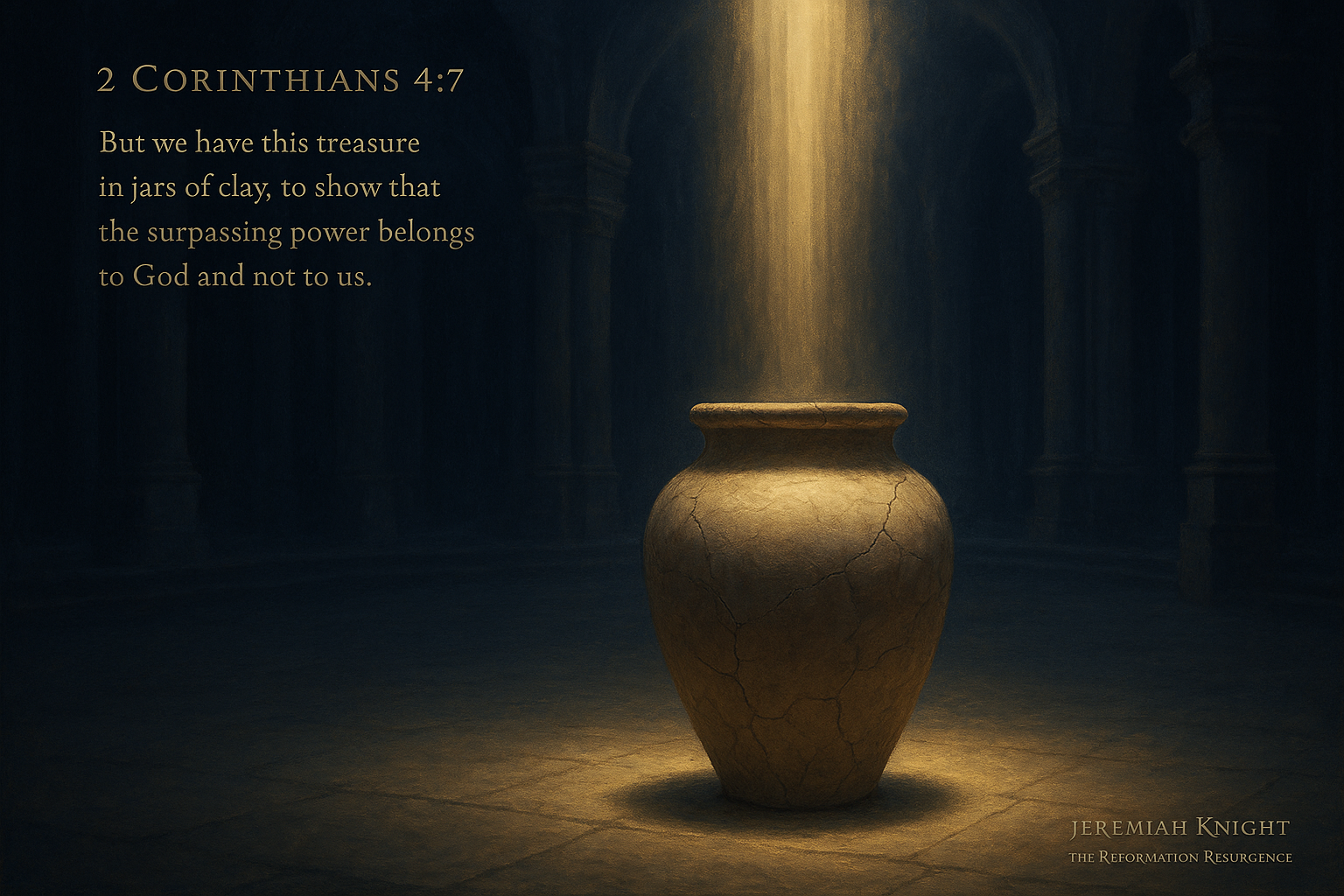
Paul understood this deeply. In Second Corinthians 4:7 he describes believers as jars of clay carrying treasure. The weakness of the vessel highlights the value of what it contains. Strength is not found in appearing full. It is found in being dependent. When the vessel cracks, the light becomes visible. God does not glorify the container. He glorifies the treasure within.
This truth exposes the emptiness of modern Christianity that promises fullness without loss. A gospel that never asks a person to die is not the gospel Christ preached. Jesus was clear in Luke 14:33 that anyone who does not renounce all that he has cannot be His disciple. This is not a call to misery. It is a call to freedom. The things we cling to most tightly are often the very things that imprison us.
When a believer begins to let go, something unexpected happens. Peace grows. Contentment deepens. Fear loosens its grip. Paul speaks of this mystery in Second Corinthians 6:10 when he says that believers are sorrowful yet always rejoicing, poor yet making many rich, having nothing yet possessing all things. This is not contradiction. It is transformation. The heart that has lost everything finds it no longer needs anything besides Christ.
True fullness is never self-generated. It is received. Ephesians 3:19 speaks of being filled with all the fullness of God. That fullness does not coexist with pride. It does not share space with self-reliance. God fills those who know they are empty. The world runs from emptiness. The Christian learns to bring it honestly before God.
In the end, the greatest lie is that loss diminishes us. Scripture reveals that loss is often the doorway into true life. What dies was never meant to last. What remains is eternal. When the believer finally loosens their grip on identity, achievement, reputation, and control, they discover a wealth that cannot be touched by circumstance.
This is the quiet paradox of the Christian life. We become rich by losing what we thought we needed. We live by dying to what once ruled us. We become full only after we stop trying to fill ourselves. And in that empty space, God Himself takes residence, not as an idea, but as life, strength, and unshakeable hope.
He, who has ears to hear, let him hear.