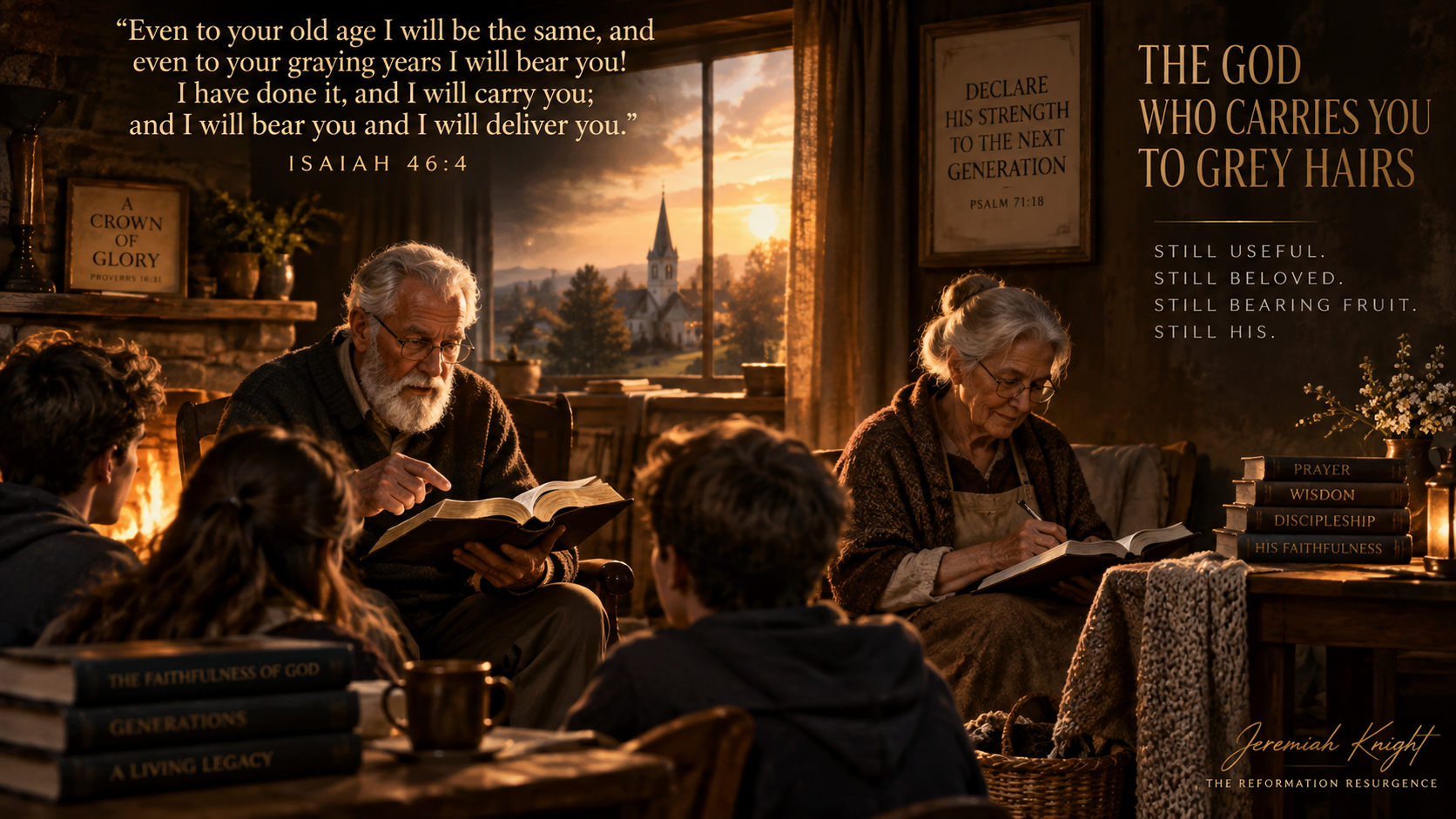

There is a fear that visits almost every believer past a certain age, and hardly anyone talks about it from the pulpit. It is not chiefly the fear of dying. It is the fear of becoming useless. Of being set aside. Of watching the church move on with younger voices and louder music while you sit further and further back, no longer asked, no longer needed, and quietly wondering whether God has finished with you too.
If that is you, let me say something plainly before anything else. God has not finished with you. And the world's contempt for age is not His.
We live in a culture that worships youth and hides the old. It fills the screens with the young, retires people from usefulness at a fixed number, and moves its parents into institutions where they will not be seen. Even the church has absorbed this. Look at who fills the platforms and who fills the back rows. Scripture speaks a different language altogether. "A gray head is a crown of glory; it is found in the way of righteousness" Proverbs 16:31. Not a burden. A crown. God commanded honour for the aged in the same breath as reverence for Himself, "you shall rise up before the grayheaded and honor the aged, and you shall revere your God" Leviticus 19:32. So the first thing to settle is that the loss of respect you feel is a symptom of a diseased culture, not a verdict from heaven.
The Bible does not pretend the fear is unreasonable. It gives it a voice. Psalm 71 is written by an old man, and he says exactly what many of you have said in the dark, "do not cast me off in the time of old age; do not forsake me when my strength fails" Psalm 71:9. Read that again slowly. A man of God, late in life, afraid of being cast off, and Scripture records the fear without shame. Then it records the answer he found. "O God, You have taught me from my youth, and I still declare Your wondrous deeds. And even when I am old and gray, O God, do not forsake me, until I declare Your strength to this generation, Your power to all who are to come" Psalm 71:17 and 18. Notice what he asks to be kept alive for. Not comfort. To declare God's strength to the next generation. He has not retired from usefulness. He has found the work that only the old can do.
And God does not leave the old to comfort themselves. He speaks directly, in the first person. "Listen to Me, O house of Jacob, and all the remnant of the house of Israel, you who have been borne by Me from birth and have been carried from the womb; even to your old age I will be the same, and even to your graying years I will bear you! I have done it, and I will carry you; and I will bear you and I will deliver you" Isaiah 46:3 and 4. Sit with those verbs. Borne. Carried. I will bear you. He carried you as an infant when you could not walk, and He promises to carry you in old age when you cannot walk again. There is no stage of life in which the child of God is set down, "the eternal God is a dwelling place, and underneath are the everlasting arms" Deuteronomy 33:27. And the idols in that same chapter are the point of contrast. Isaiah has just described pagan gods being loaded onto animals and hauled away because they cannot move themselves, Isaiah 46:1 and 2. Idols must be carried by their worshippers. Our God carries His. That is the difference between every false religion and the true one, and God stated it to old people.
Here is a verse worth writing on the wall of every believer past seventy. "The righteous man will flourish like the palm tree, he will grow like a cedar in Lebanon. Planted in the house of the Lord, they will flourish in the courts of our God. They will still yield fruit in old age; they shall be full of sap and very green" Psalm 92:12 to 14. Still yield fruit in old age. Full of sap and very green. That is not a person waiting to die. It is a tree in full production, and God says that is what the righteous look like at the end. The fruit changes, certainly. The fruit of youth is strength and speed. The fruit of age is wisdom, patience, prayer, steadiness, and a life that has proved God faithful across decades. That fruit cannot be produced by anyone under fifty. The young know the promises. The old have watched them kept.
Look at how often God waited until people were old before He used them for the thing they are remembered for. Abraham was seventy five when God called him and a hundred when Isaac was born, Genesis 21:5. Sarah was ninety when she bore the son of promise, Genesis 17:17, and laughed at the impossibility of it before she held him. Moses was eighty when he stood before Pharaoh, Exodus 7:7, after forty years tending another man's sheep in a desert. Caleb was eighty five when he asked for the hill country the giants still held, "I am still as strong today as I was in the day Moses sent me; as my strength was then, so my strength is now, for war" Joshua 14:11. Daniel was in his eighties when he was thrown to the lions and received his greatest visions. Elizabeth was advanced in years and long past hope when she carried the forerunner of Christ, Luke 1:7 and 36. Anna was very old and had served in the temple with fasting and prayer for decades when she was given the sight of the infant Messiah, Luke 2:36 to 38. John wrote Revelation as an old exile on Patmos. Paul called himself the aged when he wrote Philemon, verse 9, and wrote his final letters from prison awaiting execution. God did not use these people despite their age. In several cases He waited for it. There is a usefulness that only comes when a person has been stripped of their own strength and has nothing left to offer but what God supplies. Paul learned it and said so, "most gladly, therefore, I will rather boast about my weaknesses, so that the power of Christ may dwell in me" 2 Corinthians 12:9. Old age is the season when that becomes the whole of life rather than a lesson within it.
And consider whose gift our Lord singled out for praise above every other in the temple that day. Not the wealthy men dropping large sums into the treasury. A poor widow, almost certainly old, with two small copper coins. "Truly I say to you, this poor widow put in more than all the contributors to the treasury" Mark 12:43. More than all. The world would have called her contribution negligible and never noticed her. The Son of God called it the greatest gift in the building, and He weighs the small faithful offering of an old saint whom nobody sees on a scale the world does not own.
So let me be practical, because the fear of uselessness needs answering with actual work. Pray. This is not the consolation prize. It is the front line. Anna's whole ministry was prayer and fasting, and Luke thought it worth recording forever. Paul begged the churches to pray for him because he knew what it accomplished, Ephesians 6:19. The old saint who can no longer stand to teach can sit and intercede, and heaven does not rank the two as we do. Some of the most powerful people in your congregation cannot climb the stairs to the platform. Teach the young. Paul's instruction to Titus assumes the old will do this, "older men are to be temperate, dignified, sensible, sound in faith, in love, in perseverance. Older women likewise... so that they may encourage the young women" Titus 2:2 to 4. That is a job description for both. The young are drowning in noise and starving for someone who has walked with God for fifty years and can tell them what actually happened. Declare what you have seen. You have watched God provide when the money was gone and keep you through losses that should have broken you. Say so. Write it down. Tell your grandchildren. That witness dies with you if you do not. And finish well. The most valuable thing an old believer can give a watching church is the sight of someone who kept the faith to the end, "I have fought the good fight, I have finished the course, I have kept the faith" 2 Timothy 4:7. Young people have seen plenty of beginnings. They have seen very few finishes. Show them one.
Now let me speak to the fear underneath the fear, the one most of you will not say aloud. It is not really that you are useless. It is that you are becoming a burden. That your children rearrange their lives around your appointments, that someone else now drives you, that you need help with things you once did without thinking. Hear Scripture on this, because it does not treat your dependence as shameful. Ruth would not leave Naomi, "where you go, I will go, and where you lodge, I will lodge" Ruth 1:16, and God wrote it into the line of the Messiah. Our Lord, in the middle of dying for the sins of the world, looked down from the cross and arranged for His mother's care, "behold, your mother!" John 19:27, and John took her into his own home from that hour. The dependence of the old is not a failure. It is the very thing that gives the young their opportunity to obey the fifth commandment, and Paul says such care is "acceptable in the sight of God" 1 Timothy 5:4. Your need is somebody else's calling. Let them answer it.
There is another grief in old age that nobody names, and it is the loneliness of outliving your generation. By seventy most believers have buried a spouse, brothers, sisters, and the friends they walked with for fifty years. The phone rings less. The people who remember your youth are gone. Scripture knows this grief and answers it. "God makes a home for the lonely" Psalm 68:6. "For my father and my mother have forsaken me, but the Lord will take me up" Psalm 27:10. Every person who knew you may pass, and the One who knew you before you were formed in the womb, Psalm 139:16, remains exactly where He was. And those you buried in Christ are not lost to you. Paul would not let the Thessalonians grieve as men without hope, "we who are alive and remain will be caught up together with them" 1 Thessalonians 4:17. Together with them. The company you have lost is being kept for you.
I will not pretend that every part of this is glorious, because Scripture does not pretend either. Solomon describes old age without flattery, the keepers of the house trembling, the grinders ceasing because they are few, the light fading, Ecclesiastes 12:3 and 4. Paul says the outer man is decaying, 2 Corinthians 4:16. The body wears out and there is real grief in that, and God does not ask you to smile through it. But hear the whole of Paul's sentence. "Though our outer man is decaying, yet our inner man is being renewed day by day" 2 Corinthians 4:16. Two things at once. The body declining and the soul growing, and in the believer the second outpaces the first. The old saint is often nearer to God than ever before precisely because everything else has been stripped away, and the world calls that decline while heaven calls it preparation. And the ending is not the end. "For we know that if the earthly tent which is our house is torn down, we have a building from God, a house not made with hands, eternal in the heavens" 2 Corinthians 5:1. Every ache is a reminder that this body was always temporary and the one coming is not.
Now a word to the old reader who is not a believer, because you may be the most important person reading this. You have lived long, and you have not come to Christ, and perhaps you have quietly assumed it is too late, that a whole life spent without Him cannot be turned in its last chapter. Hear what our Lord said about the men hired at the eleventh hour, when the day was nearly over. They received the full wage, the same as those who had worked from morning, Matthew 20:9. And hear what He said to a dying criminal who had wasted every year he had and came to Him with nothing but a plea, "today you shall be with Me in Paradise" Luke 23:43. The last hour is still an hour. "Seek the Lord while He may be found; call upon Him while He is near" Isaiah 55:6. Old age is God's final mercy of time to you, and it is running. Do not let the grey hair that could have been a crown become a headstone over a soul that waited too long.
And to the younger among us, hear this too. The command has not lapsed. "Honor your father and your mother" Exodus 20:12 has no age limit on either end. A church that sidelines its old has cut itself off from its own memory and its own wisdom. Go and sit with them. Ask what they have seen. Put them in front of the young, not behind them.
So, to the believer with grey hair who has been wondering whether God is done with you. He is not. He has said so Himself, in the first person, and He has never once broken His word. "Even to your old age I will be the same, and even to your graying years I will bear you" Isaiah 46:4. You were carried in. You will be carried home. And between the two there is fruit still to be borne, prayers still to be prayed, a generation still to be told, and a race still to be finished well in front of people who need to see it done.
He who has ears to hear, let him hear.