There is a fear that sits underneath every other fear a human being has, and almost nobody talks about it. We build entire lives around not thinking about it. We fill our hours, chase our ambitions, manage our health, and quietly arrange our existence so that the subject never has to come up. But it comes up anyway, usually at night, usually when we are too tired to defend ourselves against it. One day I will die.
Scripture says something remarkable about this fear, and it is one of the most overlooked statements in the New Testament. It says that Christ became a man specifically to deal with it, and that the fear of death has been holding the human race in slavery.
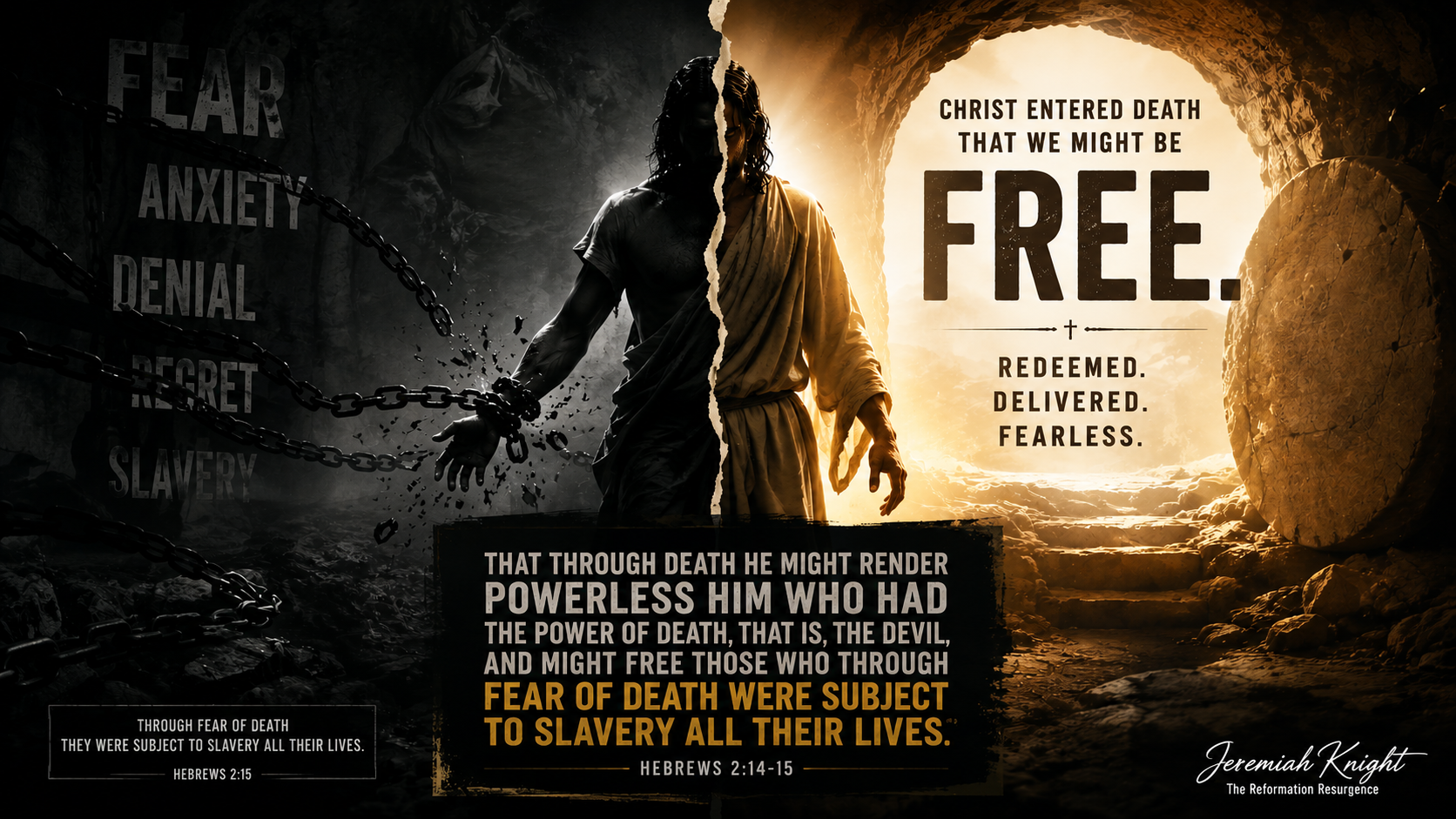
"Therefore, since the children share in flesh and blood, He Himself likewise also partook of the same, that through death He might render powerless him who had the power of death, that is, the devil, and might free those who through fear of death were subject to slavery all their lives" Hebrews 2:14 and 15.
Read that last phrase again. Subject to slavery all their lives. Not occasionally troubled. Enslaved, and enslaved for the whole duration of a life. The writer is telling us that the fear of death is not a small anxiety at the edge of human experience but a chain running through the middle of it, and that most people never realise they are wearing it.
Think about how that slavery actually works, because it is subtler than terror. It works through avoidance. A man cannot bear to think about his end, so he fills every silence with noise and every empty hour with distraction. It works through accumulation, as we build monuments to ourselves in careers and possessions and reputations, hoping something will outlast us. It works through denial, in an industry devoted to keeping us looking young and a culture that hides the dying in institutions so we do not have to watch. And it works through compromise, because a man who is terrified of dying can be made to do almost anything to preserve himself. Every tyrant in history has known this. Threaten a man's life and you own him, unless he has already settled the question of his death.
And the fear is not irrational. This is where the world's approach fails completely, because the world tries to talk us out of a fear that has an entirely reasonable basis. Death is not natural in the way we are told. It is an intruder. It entered by sin, "therefore, just as through one man sin entered into the world, and death through sin, and so death spread to all men, because all sinned" Romans 5:12, and Scripture calls it an enemy, "the last enemy that will be abolished is death" 1 Corinthians 15:26. The revulsion we feel standing beside a coffin is not weakness. It is the recognition that something is wrong here, and something is.
But there is a deeper reason the fear is rational, and no amount of positive thinking can touch it. It is not merely the dying that terrifies us. It is what comes after. "And inasmuch as it is appointed for men to die once, and after this comes judgment" Hebrews 9:27. The conscience knows this even when the mouth denies it, and every man carries some awareness that he will have to give an account, "for we must all appear before the judgment seat of Christ" 2 Corinthians 5:10. Paul puts his finger precisely on the mechanism, "the sting of death is sin, and the power of sin is the law" 1 Corinthians 15:56. Death stings because sin is real, and sin has weight because the law of God stands behind it. Take away sin and death becomes a doorway. Leave sin in place and it remains an executioner.
This is why the world's comforts are so thin at a graveside. He is in a better place. She lives on in our memories. Death is just a part of life. Nobody actually believes these things when the coffin is in front of them, and they help no one at three in the morning. And the religions of the world do no better. Karma offers endless cycles and no assurance. Islam offers a scale and a hope. Every system built by men leaves the individual carrying his own record into the dark, which is exactly the thing that makes the dark terrifying.
Now hear what Christ did about it, because the gospel does not merely comfort us regarding death. It disarms it.
He did not send a message about death. He entered it. "He Himself likewise also partook of the same" Hebrews 2:14. The eternal Son took flesh and blood precisely so that He could die, which is a staggering thought, that God became man in order to be able to do the one thing God cannot do. He went into the grave, and He did it deliberately, "no one has taken it away from Me, but I lay it down on My own initiative" John 10:18.
And when He died, He was not defeated. He was disarming an enemy from the inside. He rendered powerless the one who had the power of death, and He did it by removing the weapon, which was our guilt. The certificate of debt that stood against us was nailed to His cross, Colossians 2:14, and having done that, "when He had disarmed the rulers and authorities, He made a public display of them, having triumphed over them" Colossians 2:15. Satan's grip on us was never brute force. It was the legal claim of our sin. Pay the debt and the claim evaporates.
Then He walked out of the tomb, and everything changed for everyone who is in Him. "But now Christ has been raised from the dead, the first fruits of those who are asleep" 1 Corinthians 15:20. First fruits, which means His resurrection is the opening portion of a harvest still to come. He is not an exception. He is the pattern.
And so, Paul, standing at the end of the great resurrection chapter, does something no philosopher has ever managed. He mocks death to its face. "O death, where is your victory? O death, where is your sting?" 1 Corinthians 15:55. It has a sting no longer, because the thing that made it sting has been removed, "but thanks be to God, who gives us the victory through our Lord Jesus Christ" 1 Corinthians 15:57.
Look at what this did to the men who believed it. Paul, who had every reason to cling to his life, wrote from prison that he could not decide which he preferred, "for to me, to live is Christ and to die is gain... having the desire to depart and be with Christ, for that is very much better" Philippians 1:21 and 23. Depart and be with Christ. He is describing his own execution as a gain and an improvement. He tells the Corinthians the same thing plainly, "to be absent from the body and to be at home with the Lord" 2 Corinthians 5:8. Stephen, with stones already striking him, saw heaven opened and fell asleep praying for his killers, Acts 7:56 to 60. These men were not brave by temperament. They had simply stopped being slaves, because the thing every tyrant uses to control men no longer had any purchase on them.
That is the freedom Hebrews 2:15 is describing, and it is worth grasping how practical it is. The believer who has settled the question of his death is free in a way nothing else can produce. He can tell the truth when truth is expensive. He can refuse a bribe, walk away from a compromise, preach in a hostile place, and stand alone, because the worst thing anyone can do to him is send him home. The martyrs of Revelation overcame "because of the blood of the Lamb and because of the word of their testimony, and they did not love their life even when faced with death" Revelation 12:11.
Let me be honest about something, though, because pretending helps nobody. Freedom from the fear of death does not always mean the absence of every natural dread. Our Lord Himself, in Gethsemane, was in such agony that His sweat became like drops of blood, Luke 22:44, and He said, "My soul is deeply grieved, to the point of death" Matthew 26:38. He was facing something infinitely worse than physical death, the wrath of God against sin, but the point stands that Scripture never demands a stoic face. Believers may still feel the shrinking of flesh, and the promise is not that we will feel nothing but that we will not walk through it alone. "Even though I walk through the valley of the shadow of death, I fear no evil, for You are with me" Psalm 23:4. Notice the ground of the courage. Not the absence of the valley. His presence in it.
And notice too that death has been renamed for the believer. Again and again the New Testament calls it sleep, "Christ has been raised from the dead, the first fruits of those who are asleep" 1 Corinthians 15:20, and of Stephen, "he fell asleep" Acts 7:60. Sleep is not annihilation and it is not permanent. It is a word for something you wake from, and it implies a morning. There is a day fixed when "the Lord Himself will descend from heaven with a shout... and the dead in Christ will rise first" 1 Thessalonians 4:16, and this very body, sown perishable, will be raised imperishable, 1 Corinthians 15:42. Then the last enemy is finished forever, "He will swallow up death for all time, and the Lord God will wipe tears away from all faces" Isaiah 25:8.
But I would be unfaithful if I stopped without saying the other half, because this freedom is not automatic and it does not belong to everyone. Everything I have written is true of those who are in Christ. For the man outside of Him, death is not sleep and the fear is not irrational, because the sting is still in it and the account is still unsettled, and "he who does not obey the Son will not see life, but the wrath of God abides on him" John 3:36. Do not let anyone soothe you with comfort that is not yours. The right response to a rational fear is not to suppress it but to remove its cause, and there is only one place that has ever been done. "I am the resurrection and the life; he who believes in Me will live even if he dies, and everyone who lives and believes in Me will never die" John 11:25 and 26. He said that standing outside a tomb, minutes before He emptied it.
So the question is not whether you will die. That is settled, and no one has ever negotiated their way out of it. The question is whether the sting has been removed, and it is removed in one place only, at a cross where the debt was paid and beside an empty tomb where the payment was proven accepted.
Settle it now, while you are reading this and not while you are dying. Because the man who has settled it is free in a way the world cannot understand, unafraid of the one thing everyone else spends a lifetime avoiding, able to live boldly precisely because he has already faced the worst and found a Saviour waiting on the other side of it.
He who has ears to hear, let him hear.