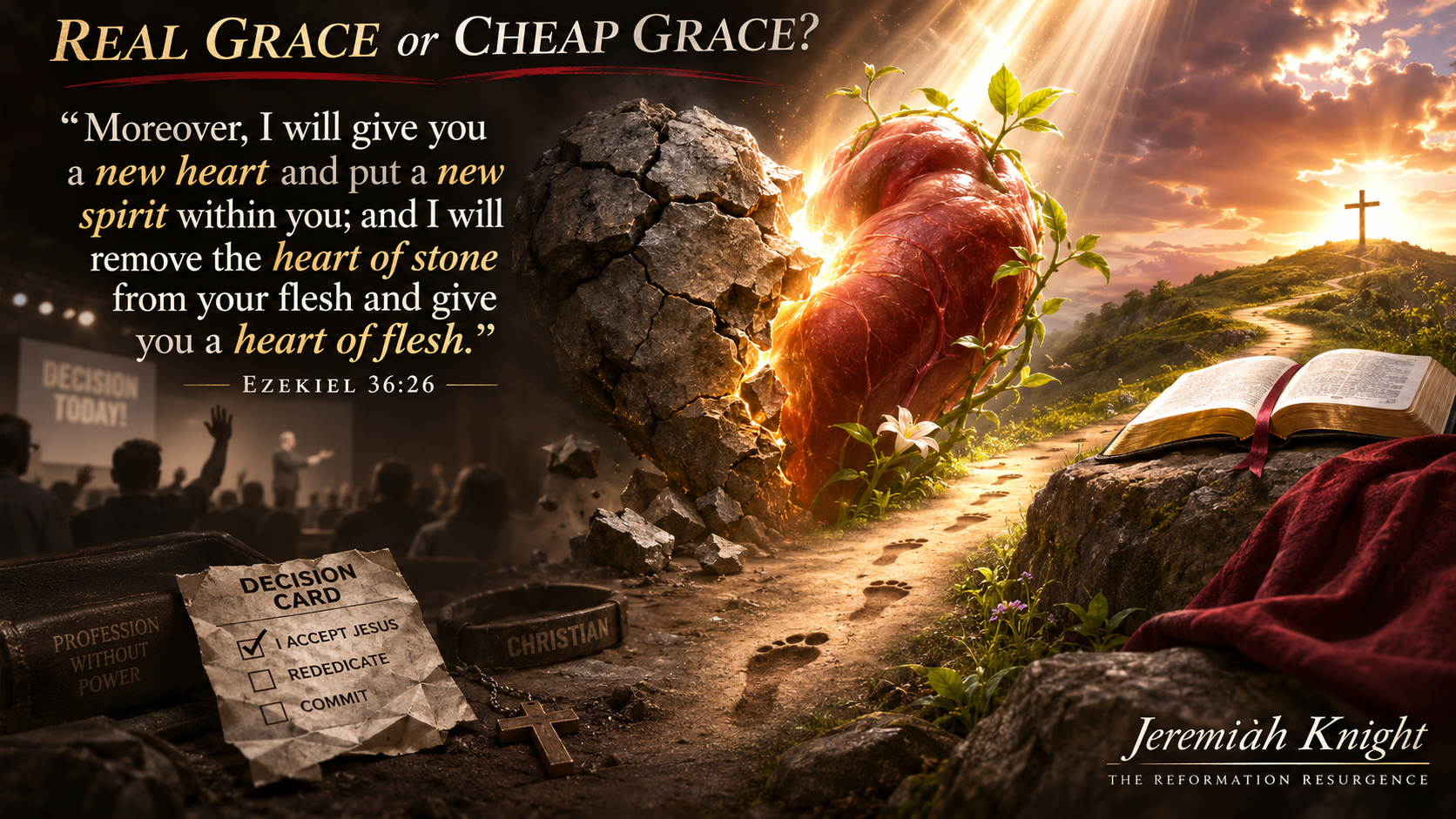

ANY GOSPEL WHICH PROMISES TO SAVE PEOPLE WITHOUT ALSO TRANSFORMING THEM IS INVITING EASY BELIEVISM.
Walk into many churches around the world and you will hear some version of the same thing. “Just repeat this prayer after me.” “Raise your hand if you want Jesus in your heart.” “Come forward, sign this card, and you are saved forever.” Then the person goes home, and nothing changes. The same lust, the same lies, the same drinking, the same bitterness, the same love for money, the same life with no hunger for God. Years later someone asks about their soul and they say, “Oh, I’m fine, I prayed the prayer when I was twelve.” And some preacher somewhere has told them that is enough. Honestly, this is one of the most dangerous lies in the church today, because it sends people to hell with a smile on their faces.
Let us be clear first about what I am NOT saying. I am not saying that praying is wrong, or that joining a church is wrong. Paul says, “if you confess with your mouth Jesus as Lord, and believe in your heart that God raised Him from the dead, you will be saved” (Romans 10:9). Calling on the Lord is real, and the church is God’s family. We are also not saying that we are saved by our good works. We are saved “by grace... through faith; and that not of yourselves, it is the gift of God; not as a result of works, so that no one may boast” (Ephesians 2:8-9). Nothing we do adds one drop to what Christ did on the cross.
But read the very next verse, because most people stop too early. “For we are His workmanship, created in Christ Jesus for good works, which God prepared beforehand so that we would walk in them” (Ephesians 2:10). We are saved by grace alone, through faith alone, in Christ alone, and the faith that saves is never alone. The same grace that forgives us also makes us new. If grace forgives a man and leaves him exactly as he was, it is not the grace of the Bible.
What does God do when He saves someone?
When God saves a sinner, He does not only change their record in heaven. He changes the sinner. Listen to His promise through Ezekiel. “Moreover, I will give you a new heart and put a new spirit within you; and I will remove the heart of stone from your flesh and give you a heart of flesh. I will put My Spirit within you and cause you to walk in My statutes, and you will be careful to observe My ordinances” (Ezekiel 36:26-27). Look at who does the work. God gives the new heart, God puts His Spirit within, and God CAUSES them to walk in His ways. “Therefore if anyone is in Christ, he is a new creature; the old things passed away; behold, new things have come” (2 Corinthians 5:17).
JUSTIFICATION and SANCTIFICATION are two different things, and we must keep them distinct. Justification is God declaring a sinner righteous because of Christ’s righteousness counted to him, once and forever. Sanctification is God making that person holy, little by little, for the rest of his life. We must never mix them up, because the moment we make our holiness the ground of our justification, we have lost the gospel. But we must never pull them apart either, because God never does. Paul wrote to the Corinthians about the kind of people who will not inherit the kingdom of God, and then he said, “Such were some of you; but you were washed, but you were sanctified, but you were justified in the name of the Lord Jesus Christ and in the Spirit of our God” (1 Corinthians 6:11). Washed, sanctified and justified, all in the same breath, because all of it is God’s work in the same person. “And these whom He predestined, He also called; and these whom He called, He also justified; and these whom He justified, He also glorified” (Romans 8:30). God does not lose anyone along the way. THOSE WHO ARE JUSTIFIED WILL BE SANCTIFIED.
What does grace actually teach us?
Many people think grace means God doesn’t really care how we live anymore. Paul expected that very question. “What shall we say then? Are we to continue in sin so that grace may increase? May it never be! How shall we who died to sin still live in it?” (Romans 6:1-2). Grace never gives us room to sin. It is the very power God uses to break sin’s hold on us, “For sin shall not be master over you, for you are not under law but under grace” (Romans 6:14). Listen to how Paul describes it.
“For the grace of God has appeared, bringing salvation to all men, instructing us to deny ungodliness and worldly desires and to live sensibly, righteously and godly in the present age, looking for the blessed hope and the appearing of the glory of our great God and Savior, Christ Jesus, who gave Himself for us to redeem us from every lawless deed, and to purify for Himself a people for His own possession, zealous for good deeds.” (Titus 2:11-14)
Grace INSTRUCTS us to deny ungodliness. Christ died to redeem us “from every lawless deed” and to purify a people “zealous for good deeds.” So when someone says, “I’m saved by grace, so it doesn’t matter how I live,” they are proving they do not understand grace at all. Real grace cost God His own Son, and it changes the person it saves. IF YOU THINK BEING A CHRISTIAN IS NOTHING MORE THAN SAYING A PRAYER OR JOINING A CHURCH, THEN YOU HAVE CONFUSED REAL GRACE WITH CHEAP GRACE.
What kind of faith saves?
James asks a question that many preachers today are afraid to ask. “What use is it, my brethren, if someone says he has faith but he has no works? Can that faith save him?” (James 2:14). And he answers, “Even so faith, if it has no works, is dead, being by itself” (James 2:17). Then he says something that should shake us. “You believe that God is one. You do well; the demons also believe, and shudder” (James 2:19). The demons believe the right facts about God. They know Jesus is the Son of God better than most church members do. But they hate Him. A faith that agrees with the facts and never bows the knee is the faith of demons.
James is not contradicting Paul. Paul fights against people who think works earn salvation. James fights against people who think faith can sit there and do nothing. Both say the same thing from different sides. True faith is “faith working through love” (Galatians 5:6).
Look at Simon in Samaria. The Bible says, “Even Simon himself believed; and after being baptized, he continued on with Philip” (Acts 8:13). He believed, he was baptized, and he stayed close to the evangelist. On paper he looked like a convert. But when he tried to buy the power of the Holy Spirit with money, Peter told him, “For I see that you are in the gall of bitterness and in the bondage of iniquity” (Acts 8:23). He had the profession, but his heart had never been changed.
Where does easy believism come from?
At the root of all of this is a wrong idea of how a person is saved. If the new birth is something WE do, by making a decision, walking an aisle or saying the right words, then of course saying the words is enough, and nobody should expect much to change. But the Bible says the children of God “were born, not of blood nor of the will of the flesh nor of the will of man, but of God” (John 1:13). Jesus said, “The wind blows where it wishes and you hear the sound of it, but do not know where it comes from and where it is going; so is everyone who is born of the Spirit” (John 3:8). The new birth is God’s work from start to finish. “So then it does not depend on the man who wills or the man who runs, but on God who has mercy” (Romans 9:16). “But God, being rich in mercy, because of His great love with which He loved us, even when we were dead in our transgressions, made us alive together with Christ” (Ephesians 2:4-5). When God raises the dead, the dead do not stay the way they were. A man who has truly been made alive will breathe, and a soul that has truly been born of God will show that new life. Easy believism comes from man centered evangelism, where the preacher tries to produce what only the Holy Spirit can give.
Can someone accept Jesus as Savior but not as Lord?
This teaching is everywhere. It says there are two kinds of Christians. Some have accepted Jesus as Savior and will go to heaven, and others have also made Him Lord and live for Him. The first group is called “carnal Christians,” and the idea is that you can be saved and keep living like the world. People point to 1 Corinthians 3, where Paul tells the church, “you are still fleshly. For since there is jealousy and strife among you, are you not fleshly, and are you not walking like mere men?” (1 Corinthians 3:3). But Paul is rebuking believers for acting in a childish way, and he expects them to change. These are the same people he says were “washed... sanctified... justified” (1 Corinthians 6:11). He never tells them it is fine to stay that way.
Scripture gives us only two kinds of people. “For those who are according to the flesh set their minds on the things of the flesh, but those who are according to the Spirit, the things of the Spirit... and those who are in the flesh cannot please God. However, you are not in the flesh but in the Spirit, if indeed the Spirit of God dwells in you” (Romans 8:5, 8-9). Jesus cannot be cut in half. Peter preached that “God has made Him both Lord and Christ” (Acts 2:36). We confess “Jesus as Lord” to be saved (Romans 10:9), and Paul says, “as you have received Christ Jesus the Lord, so walk in Him” (Colossians 2:6). Nobody receives a Savior who is not also their Lord.
Isn’t this salvation by works?
Some will say we are adding works to the gospel. We are not. God justifies the ungodly by faith alone. “But to the one who does not work, but believes in Him who justifies the ungodly, his faith is credited as righteousness” (Romans 4:5). Works are never the ROOT of our salvation. They are the FRUIT of it. A tree does not become an apple tree by growing apples. It grows apples because it is an apple tree. “So every good tree bears good fruit, but the bad tree bears bad fruit” (Matthew 7:17).
Others point to the thief on the cross. He never got baptized, never joined a church, never did a single good work, and Jesus still said, “Truly I say to you, today you shall be with Me in Paradise” (Luke 23:43). That is true, and it is glorious. But look at what happened to that man in a few hours on a cross. He had been mocking Jesus with the other criminal (Matthew 27:44). Then he turned and rebuked him, “Do you not even fear God, since you are under the same sentence of condemnation? And we indeed are suffering justly, for we are receiving what we deserve for our deeds; but this man has done nothing wrong.” And he said, “Jesus, remember me when You come in Your kingdom!” (Luke 23:40-42). He feared God, confessed his own guilt, defended Christ in front of everyone, and called Him King. Even with nails in his hands, the change showed.
What did Jesus say about following Him?
Jesus never once lowered the price to get a bigger crowd. He turned to the multitudes following Him and said, “Whoever does not carry his own cross and come after Me cannot be My disciple” (Luke 14:27), and “none of you can be My disciple who does not give up all his own possessions” (Luke 14:33). When the rich young ruler walked away sad, Jesus let him go (Mark 10:22). He told the parable of the soils, where some receive the word “with joy; yet he has no firm root in himself, but is only temporary” (Matthew 13:20-21). Not every joyful response is a saving one.
And He said this to people who called Him Lord. “Why do you call Me, ‘Lord, Lord,’ and do not do what I say?” (Luke 6:46). “Not everyone who says to Me, ‘Lord, Lord,’ will enter the kingdom of heaven, but he who does the will of My Father who is in heaven will enter” (Matthew 7:21). The apostles preached the same way. Paul told Agrippa he preached that people “should repent and turn to God, performing deeds appropriate to repentance” (Acts 26:20). REPENTANCE belongs to saving faith, and Jesus began His ministry saying, “repent and believe in the gospel” (Mark 1:15).
Who is responsible for this?
Truth be told, a lot of the blame belongs to the pulpit. When preachers count hands instead of watching for fruit, when they tell people they are saved because they said certain words, when they never preach repentance, holiness or the cost of following Christ, they are doing what God condemned through Jeremiah. “They have healed the brokenness of My people superficially, Saying, ‘Peace, peace,’ But there is no peace” (Jeremiah 6:14). Giving false assurance to an unchanged sinner is the cruelest thing a preacher can do. The Bible says plainly, “Pursue peace with all men, and the sanctification without which no one will see the Lord” (Hebrews 12:14).
Does this mean a Christian has to be perfect?
No, and we need to say that just as strongly. Some tender believers will read this and start to doubt everything because they still struggle with sin. “If we say that we have no sin, we are deceiving ourselves and the truth is not in us” (1 John 1:8). Paul himself said, “Not that I have already obtained it or have already become perfect, but I press on” (Philippians 3:12). Sanctification is slow. There are falls and there are setbacks, and some sins take years to fight. The difference between a believer and an unbeliever is not that one never sins and the other does. The believer HATES his sin, fights it, confesses it and keeps coming back to Christ. The unbeliever is comfortable with it. And the whole work is God’s, “for it is God who is at work in you, both to will and to work for His good pleasure” (Philippians 2:13). “He who began a good work in you will perfect it until the day of Christ Jesus” (Philippians 1:6).
Many people say, “Once saved, always saved,” and what they often mean is, “I prayed once, so I am safe no matter how I live.” That is not what the Bible teaches. The Bible teaches that God keeps His people to the end. Jesus said, “My sheep hear My voice, and I know them, and they follow Me; and I give eternal life to them, and they will never perish” (John 10:27-28). Notice that His sheep FOLLOW Him. We “are protected by the power of God through faith” (1 Peter 1:5), and the faith He keeps alive keeps going. “For we have become partakers of Christ, if we hold fast the beginning of our assurance firm until the end” (Hebrews 3:14).
So let us examine ourselves honestly. “Test yourselves to see if you are in the faith; examine yourselves!” (2 Corinthians 13:5).
Do we hate our sin, or do we just hate getting caught?
Do we love God’s Word, or do we only open it on Sunday?
Do we love God’s people? “We know that we have passed out of death into life, because we love the brethren” (1 John 3:14).
Do we obey Him? “By this we know that we have come to know Him, if we keep His commandments” (1 John 2:3).
When we fall, do we run back to Christ, or do we shrug and carry on?
If the answers frighten you, don’t run to another prayer or another altar call. Run to CHRIST Himself. Repent of your sin, cast yourself on His mercy, and ask Him for a new heart. He has promised, “the one who comes to Me I will certainly not cast out” (John 6:37). And if you see His work in you, even small and weak, thank Him and keep pressing on. He saves His people to make them “conformed to the image of His Son” (Romans 8:29).
“but like the Holy One who called you, be holy yourselves also in all your behavior; because it is written, ‘YOU SHALL BE HOLY, FOR I AM HOLY.’” (1 Peter 1:15-16)
He who has ears to hear, let him hear.