
Today a reader raised a concern with me, and it is a good one. He said the teaching called once saved always saved is dangerous because it gives people a license to sin. A man repeats a prayer after a pastor, or he grows up in a Christian home, and he thinks he is saved for life. After that he lives any way he likes, and he still believes he is going to heaven.
I agree with him fully. That teaching is dangerous, and it has sent many people to hell with a smile on their face. I am thankful he brought it up, because many people think this is what the Bible means when it says God keeps His people. It is a cheap copy of what the Bible teaches. The real doctrine has an older name, the perseverance of the saints, and the two are far apart.
Here is the question that separates them. Can a man be kept by Christ and not follow Christ?
What the cheap version says
The cheap version says salvation is a decision you made on a certain day. You prayed, you raised your hand, you signed a card. After that, nothing you do matters. You can live for money, sleep with whoever you want, never open the Bible, never love the church, and heaven is still yours because of that one day.
Jesus spoke about people like this. "Not everyone who says to Me, 'Lord, Lord,' will enter the kingdom of heaven, but he who does the will of My Father who is in heaven will enter" (Matthew 7:21). These people had more than a prayer. They prophesied and cast out demons in His name. And what does He say to them? "I never knew you; depart from Me, you who practice lawlessness" (Matthew 7:23).
Read that carefully. He does not say, "I knew you once and then lost you." He says, "I never knew you." They were never His. Paul describes the same kind of person. "They profess to know God, but by their deeds they deny Him" (Titus 1:16). And John says, "The one who says, 'I have come to know Him,' and does not keep His commandments, is a liar, and the truth is not in him" (1 John 2:4).
So the cheap version fails at the very first step. It promises safety to people Christ says He never knew.
What the Bible teaches
Jude writes his letter "to those who are the called, beloved in God the Father, and kept for Jesus Christ" (Jude 1). A few verses before the end he tells the same people, "keep yourselves in the love of God" (Jude 21). So in one short letter believers are kept by God, and believers are told to keep themselves.
There are two truths there. God keeps His people so that none of them is lost. And the people He keeps go on believing and following Christ to the end. The cheap version takes the first truth and throws away the second. Those who say a true believer can lose his salvation take the second and throw away the first. The Bible holds both.
God keeps His people
Start with what Jesus said about His own mission. "This is the will of Him who sent Me, that of all that He has given Me I lose nothing, but raise it up on the last day" (John 6:39). The Father gave a people to the Son. The Father's will is that the Son lose none of them. So if one true believer is finally lost, Christ has failed to do the will of His Father. I cannot believe that about the Son of God, and neither should you.
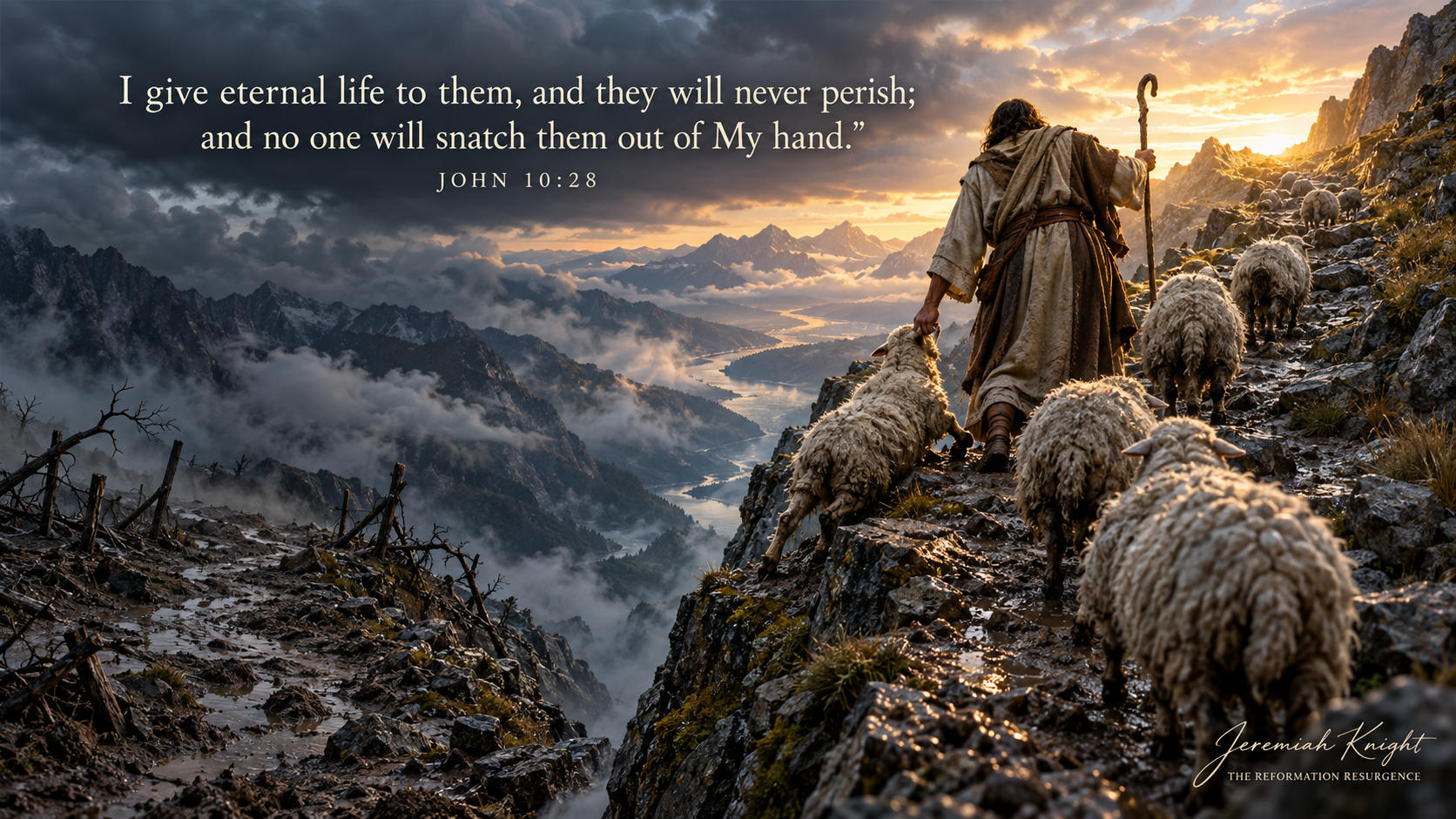
He says it again about His sheep. "I give eternal life to them, and they will never perish; and no one will snatch them out of My hand. My Father, who has given them to Me, is greater than all; and no one is able to snatch them out of the Father's hand" (John 10:28-29). Some say, "No one else can snatch me, but I can walk out myself." But Jesus said, "they will never perish." If a sheep walks out and perishes, that promise is broken. And life that ends after ten years was never eternal life.
Paul lays out the whole plan in one verse. "These whom He predestined, He also called; and these whom He called, He also justified; and these whom He justified, He also glorified" (Romans 8:30). Count the people at the start and count them at the end. It is the same number. Nobody drops out between justified and glorified. Paul even writes "glorified" in the past tense, about people still alive on earth, because with God it is already settled.
The same truth runs all through the Bible. "He who began a good work in you will perfect it until the day of Christ Jesus" (Philippians 1:6). Believers are "protected by the power of God through faith for a salvation ready to be revealed in the last time" (1 Peter 1:5). They are "sealed in Him with the Holy Spirit of promise, who is given as a pledge of our inheritance" (Ephesians 1:13-14). And Christ "is able also to save forever those who draw near to God through Him, since He always lives to make intercession for them" (Hebrews 7:25).
That last verse is worth slowing down for. Why did Peter's faith survive the night he denied Jesus three times? Jesus told him before it happened. "Simon, Simon, behold, Satan has demanded permission to sift you like wheat; but I have prayed for you, that your faith may not fail" (Luke 22:31-32). Peter's courage failed and Peter's promises failed. His faith did not fail, because Christ prayed for him. Every believer has that same Priest praying for him today.
The saints keep going
Now the other half. How does God keep His people? Look at the promise of the new covenant. "I will make an everlasting covenant with them that I will not turn away from them, to do them good; and I will put the fear of Me in their hearts so that they will not turn away from Me" (Jeremiah 32:40).
God promises two things there. He will not turn away from them. And He will put His fear in their hearts so that they will not turn away from Him. He keeps them by changing them. This is why the cheap version is impossible. God does not keep a man safe while leaving his heart in love with sin. The keeping happens inside the man.
So the Bible speaks plainly about continuing. "The one who endures to the end, he will be saved" (Matthew 24:13). "If you continue in My word, then you are truly disciples of Mine" (John 8:31). "For we have become partakers of Christ, if we hold fast the beginning of our assurance firm until the end" (Hebrews 3:14). "Pursue peace with all men, and the sanctification without which no one will see the Lord" (Hebrews 12:14).
Someone will ask why God gives warnings if His people cannot be lost. The answer is that the warnings are one of the ways He keeps them. Take for example Paul on the ship in the storm. God had promised him, "there will be no loss of life among you, but only of the ship" (Acts 27:22). Then the sailors tried to escape, and Paul said, "Unless these men remain in the ship, you yourselves cannot be saved" (Acts 27:31). The promise was certain, and the warning was the means God used to fulfil it. The men listened, they stayed, and all of them lived.
Paul puts both sides together in two verses. "Work out your salvation with fear and trembling; for it is God who is at work in you, both to will and to work for His good pleasure" (Philippians 2:12-13). We work, and the reason we work is that God is working in us.
What about those who fall away?
All of us know someone who once sang, prayed and served, and today wants nothing to do with Christ. John answers directly. "They went out from us, but they were not really of us; for if they had been of us, they would have remained with us; but they went out, so that it would be shown that they all are not of us" (1 John 2:19). Their leaving did not undo a real salvation. It showed there had never been one.
Jesus said this would happen. In the parable of the soils, some "receive the word with joy; and these have no firm root; they believe for a while, and in time of temptation fall away" (Luke 8:13). There was joy and there was a kind of belief, but there was no root. Judas is the clearest case. He preached, he travelled with Christ for three years, and nobody at the table suspected him. Yet Jesus said long before the betrayal, "Did I Myself not choose you, the twelve, and yet one of you is a devil?" (John 6:70).
Peter describes such people in a hard verse. "A dog returns to its own vomit," and, "A sow, after washing, returns to wallowing in the mire" (2 Peter 2:22). The sow was washed on the outside. It was still a sow. A sheep may fall into the mud, but it will not make its home there.
The verses people use against this
Those who believe salvation can be lost bring five passages more than any others.
Hebrews 6:4-6 speaks of those who "have once been enlightened and have tasted of the heavenly gift and have been made partakers of the Holy Spirit," and then have fallen away. Look at what the writer does not say. He never says they were justified, forgiven or born again. He describes people who stood very close to the truth and saw its power, the way Israel saw the Red Sea open and still died in unbelief in the wilderness (Hebrews 3:16-19). Judas tasted those powers too. Then the writer turns to the true believers and says, "But, beloved, we are convinced of better things concerning you, and things that accompany salvation" (Hebrews 6:9). So the things in verses 4 and 5 can be present without salvation. Also notice that the passage says it is "impossible to renew them again to repentance." Those who say salvation can be lost almost always say it can be found again. This passage gives them no help.
Hebrews 10:26 says, "For if we go on sinning willfully after receiving the knowledge of the truth, there no longer remains a sacrifice for sins." The man here received "the knowledge of the truth." He heard it and understood it, and then he turned his back on the only sacrifice there is. The chapter ends by putting true believers in another group. "But we are not of those who shrink back to destruction, but of those who have faith to the preserving of the soul" (Hebrews 10:39).
John 15:6 says, "If anyone does not abide in Me, he is thrown away as a branch and dries up." Jesus said this on the night Judas walked out (John 13:30). Judas was a branch joined to Christ outwardly for three years, and he never bore fruit. Of the true branches Jesus says, "I chose you, and appointed you that you would go and bear fruit, and that your fruit would remain" (John 15:16). Fruit is how the real branch is known. "My Father is glorified by this, that you bear much fruit, and so prove to be My disciples" (John 15:8).
Galatians 5:4 says, "You have been severed from Christ, you who are seeking to be justified by law; you have fallen from grace." Paul is not talking about a believer who sinned too much. He is talking about people who were leaving grace as the way of being made right with God and going back to law keeping. To fall from grace here is to leave the gospel of grace for a gospel of works. And even to them Paul says, "I have confidence in you in the Lord that you will adopt no other view" (Galatians 5:10).
Revelation 3:5 says, "He who overcomes will thus be clothed in white garments; and I will not erase his name from the book of life." People read this as a threat, but it is a promise. Jesus says what He will never do. And who is the one who overcomes? John tells us. "For whatever is born of God overcomes the world" (1 John 5:4). Everyone born of God overcomes, so no one born of God is erased.
Read in their own context, these passages warn people inside the church who are near Christ without being in Christ. They agree with everything else we have seen.
What about believers who fall into sin?
This doctrine does not say a Christian never sins, and it does not say a Christian cannot fall badly. David committed adultery and arranged a murder. Peter denied his Lord with curses. Both were true believers when they did it.
The difference shows in what happened afterward. Peter "went out and wept bitterly" (Luke 22:62) and came back to Christ. David wrote Psalm 51. Judas felt remorse too, but he never came back to the One he had betrayed. Solomon describes the pattern. "For a righteous man falls seven times, and rises again, but the wicked stumble in time of calamity" (Proverbs 24:16). The true believer falls, sometimes badly, and God brings him back to repentance.
God does not leave His children alone in their sin. "For those whom the Lord loves He disciplines, and He scourges every son whom He receives" (Hebrews 12:6). And then the frightening part. "But if you are without discipline, of which all have become partakers, then you are illegitimate children and not sons" (Hebrews 12:8). A man who can sin for years in peace, with no conviction and no chastening from God, should not call that security.
David himself wrote the best description of a believer's falls. "When he falls, he will not be hurled headlong, because the LORD is the One who holds his hand" (Psalm 37:24).
Does this give a license to sin?
Paul heard this objection in his own day. "Are we to continue in sin so that grace may increase? May it never be! How shall we who died to sin still live in it?" (Romans 6:1-2). His answer is that the believer has died to sin. Something happened to him. He has a new nature. "No one who is born of God practices sin, because His seed abides in him" (1 John 3:9).
Grace itself teaches the opposite of license. "For the grace of God has appeared, bringing salvation to all men, instructing us to deny ungodliness and worldly desires and to live sensibly, righteously and godly in the present age" (Titus 2:11-12). The people who use grace as permission are named in the Bible too. Jude calls them "ungodly persons who turn the grace of our God into licentiousness" (Jude 4).
So if a man hears that Christ keeps His people and thinks, "Good, now I can sin freely," he has told us something about his heart. A child of God hears the same truth and wants to live for the One who holds him.
A word to two kinds of readers
Some of you are living in sin and resting on a prayer you prayed years ago. That prayer cannot save you, and neither can your parents' faith or your baptism certificate. Paul's command is for you. "Test yourselves to see if you are in the faith; examine yourselves!" (2 Corinthians 13:5). Do you hear His voice? Do you follow Him? If the answer is no, come to Christ today, truly, for the first time.
Others of you love Christ, hate your sin, and still lie awake afraid that you will not make it. You look at your weak faith and your many failures and you wonder if He will let you go. He will not. He said, "the one who comes to Me I will certainly not cast out" (John 6:37). Your hold on Him is weak, but you are safe because of His hold on you. The fight you are fighting against your sin is itself a sign that He is at work in you.
Jude closes his letter with these words. "Now to Him who is able to keep you from stumbling, and to make you stand in the presence of His glory blameless with great joy, to the only God our Savior, through Jesus Christ our Lord, be glory, majesty, dominion and authority, before all time and now and forever. Amen" (Jude 24-25).
He who has ears to hear, let him hear.