
A Provisionist told me that I avoid every narrative in the Bible where God relents. He meant passages like the one where God is sorry, He made Saul king, or the one where He spares Nineveh after saying He would destroy it. His point was that these stories show a God who reacts to people and changes course, and so God cannot have a fixed plan for all things.
He is right about one thing. Those passages are in the Bible, and I have no right to skip them. So let us go through them, all of them, and see what they teach.
Here is the question I want to keep in front of us. If God changes His mind the way we do, can I trust anything He has promised me?
The verses that say He relents
There are more of these than most people think. Before the flood, "The LORD was sorry that He had made man on the earth, and He was grieved in His heart" (Genesis 6:6). After the golden calf, "the LORD changed His mind about the harm which He said He would do to His people" (Exodus 32:14). About Saul, God says, "I regret that I have made Saul king, for he has turned back from following Me" (1 Samuel 15:11). And at Nineveh, "God relented concerning the calamity which He had declared He would bring upon them. And He did not do it" (Jonah 3:10).
Add to these Hezekiah, who was told he would die and was then given fifteen more years (2 Kings 20:1-6), and Amos, who prayed twice and twice "the LORD changed His mind about this" (Amos 7:3, 6).
The verses that say He does not
Now put these beside them. "God is not a man, that He should lie, nor a son of man, that He should repent; has He said, and will He not do it? Or has He spoken, and will He not make it good?" (Numbers 23:19). "For I, the LORD, do not change; therefore you, O sons of Jacob, are not consumed" (Malachi 3:6). With Him "there is no variation or shifting shadow" (James 1:17). "The counsel of the LORD stands forever, the plans of His heart from generation to generation" (Psalm 33:11). And God says of Himself, "I am God, and there is no one like Me, declaring the end from the beginning, and from ancient times things which have not been done, saying, 'My purpose will be established, and I will accomplish all My good pleasure'" (Isaiah 46:9-10).
So the Bible says both. Some people choose one set and explain away the other. We cannot do that with the Word of God. Both sets are true, and we have to find out how.
One chapter that says both
The best place to begin is 1 Samuel 15, because it says both things within a few verses. In verse 11 God says, "I regret that I have made Saul king." In verse 29 Samuel says, "the Glory of Israel will not lie or change His mind; for He is not a man that He should change His mind." And in verse 35 we read again, "the LORD regretted that He had made Saul king over Israel."
The same writer wrote all three verses in one sitting. He saw no contradiction. So whatever God's regret in verse 11 means, it cannot mean the thing verse 29 denies. And verse 29 tells us exactly what it denies. God does not change His mind as a man does.
How does a man change his mind? He learns something he did not know. Or he finds out he made a mistake. Or his mood changes. Or he discovers he cannot do what he planned. None of these can ever be true of God. "His understanding is infinite" (Psalm 147:5). He "works all things after the counsel of His will" (Ephesians 1:11).
Did God find out something new about Saul in chapter 15? No. Two chapters earlier Samuel had already told Saul, "The LORD has sought out for Himself a man after His own heart" (1 Samuel 13:14). Centuries earlier God had said through Jacob, "The scepter shall not depart from Judah" (Genesis 49:10), and Saul was from Benjamin. David was always the plan. So God's regret over Saul tells us that Saul's sin truly displeased Him, and that He was about to deal with Saul in a new way by removing him. It does not tell us God made a mistake.
The rule God gave us beforehand
God Himself has explained how to read these passages. He told Jeremiah at the potter's house, "At one moment I might speak concerning a nation or concerning a kingdom to uproot, to pull down, or to destroy it; if that nation against which I have spoken turns from its evil, I will relent concerning the calamity I planned to bring on it. Or at another moment I might speak concerning a nation or concerning a kingdom to build up or to plant it; if it does evil in My sight by not obeying My voice, then I will think better of the good with which I had promised to bless it" (Jeremiah 18:7-10).
Read that carefully. God says in advance that His warnings of judgment carry a condition, even when the condition is not spoken. If the people turn, He will relent. This is His fixed way of dealing with men. He always judges the unrepentant and He always shows mercy to those who turn. When a nation changes, His dealing with that nation changes, and the reason is that He Himself has stayed the same.
Take for example a man walking against a strong wind. If he turns around, the wind is now at his back and helps him along. The wind is blowing the same way as before, and only the man has turned.
There is one more thing to see here. The Bible separates God's warnings from God's oaths. A warning of judgment leaves room for repentance, as Jeremiah 18 says. But when God swears, nothing can alter it. "The LORD has sworn and will not change His mind, 'You are a priest forever according to the order of Melchizedek'" (Psalm 110:4). His promises to Abraham, to David and to Christ are of this kind. So are His promises to everyone who is in Christ.
Nineveh
Jonah preached, "Yet forty days and Nineveh will be overthrown" (Jonah 3:4). There is no "unless" in the sermon. But ask a simple question. If God meant to destroy the city no matter what, why send a prophet at all, and why give forty days? The warning itself was mercy.
The king of Nineveh understood this. "Who knows, God may turn and relent and withdraw His burning anger so that we will not perish" (Jonah 3:9). And Jonah had understood it before he ever boarded the ship. That is why he ran. "For I knew that You are a gracious and compassionate God, slow to anger and abundant in lovingkindness, and one who relents concerning calamity" (Jonah 4:2).
So, nobody in the story was surprised when God relented, and God least of all. Was the warning then a false one? No. It was completely true. Nineveh as it stood was forty days from destruction. The Nineveh that repented was another matter, just as Jeremiah 18 says. God's purpose from the start was to show mercy to that city, and the warning was the means He used to bring them to repentance.
Moses and the golden calf
This is the passage people press hardest. God says to Moses, "Now then let Me alone, that My anger may burn against them and that I may destroy them; and I will make of you a great nation" (Exodus 32:10). Moses prays, and "the LORD changed His mind" (Exodus 32:14).
Was God truly about to wipe out Israel and begin again with Moses? Think about what that would have meant. Moses was from the tribe of Levi (Exodus 2:1). God had already promised that the ruler would come from Judah (Genesis 49:10). If all Israel died and only the family of Moses remained, that promise would have failed, and with it the line of Christ. God cannot break His word. So, destroying Israel was never His plan.
Then why did He say it? Look at the words "let Me alone." God was telling Moses that a mediator could stand in the way, and Moses stepped in. He did not argue that Israel deserved mercy. He held God to His own promise. "Remember Abraham, Isaac, and Israel, Your servants to whom You swore by Yourself" (Exodus 32:13). The Psalm explains it. "Therefore He said that He would destroy them, had not Moses His chosen one stood in the breach before Him, to turn away His wrath from destroying them" (Psalm 106:23).
God planned to spare Israel, and He planned to do it through the prayer of a mediator. The anger was real, because their sin deserved death. The mercy was real too. And the whole scene points us to a greater Mediator, who "always lives to make intercession" for His people (Hebrews 7:25).
Hezekiah's fifteen years
Isaiah told the king, "Set your house in order, for you shall die and not live" (2 Kings 20:1). Hezekiah wept and prayed, and God added fifteen years to his life.
Had God fixed one date for his death and then moved it? David says, "in Your book were all written the days that were ordained for me, when as yet there was not one of them" (Psalm 139:16). Hezekiah's days were written before he was born, all of them, including the fifteen.
And here is a detail that is easy to miss. Hezekiah's son Manasseh was twelve years old when he became king (2 Kings 21:1). That means Manasseh was born during those fifteen extra years. And Manasseh is in the family line of Jesus Christ (Matthew 1:10). If Hezekiah had died that day, the line would have been cut. So those years were in God's plan from the beginning. The sickness was truly deadly and the warning was true. God used it to bring the king to prayer, and He used the prayer to give what He had always intended to give.
God grieved in His heart
What about Genesis 6:6, where God is sorry He made man? Did the fall take Him by surprise? It did not. Christ "was foreknown before the foundation of the world" (1 Peter 1:20), and the names of His people were written "from the foundation of the world in the book of life of the Lamb who has been slain" (Revelation 13:8). So the plan of salvation was in place before Adam ever sinned.
So Genesis 6:6 is not God admitting an error. It tells us how God regards sin. He is not a stone. Human wickedness is hateful to Him, and He wants us to know it. The Bible often speaks of God in the way we speak of ourselves so that we can understand Him. It speaks of His arm and His eyes. He asks Adam, "Where are you?" (Genesis 3:9), and He did not ask because He had lost him. These ways of speaking are true and they teach us about Him, but they must be read alongside the plain statements, such as "Even before there is a word on my tongue, behold, O LORD, You know it all" (Psalm 139:4).
"Now I know" and "it never entered My mind"
Two more passages are often used to say God learns. After Abraham raised the knife over Isaac, the angel of the LORD said, "now I know that you fear God, since you have not withheld your son, your only son, from Me" (Genesis 22:12). Did God not know until then? He had already promised that the covenant would continue through Isaac (Genesis 17:19), so He knew Isaac would come down from that mountain alive. The chapter opens by telling us what was happening. "God tested Abraham" (Genesis 22:1). The test brought Abraham's faith out into the open, and God's words declare what the test had shown. It is the same when God says of Sodom, "I will go down now, and see" (Genesis 18:21). The Judge of all the earth was showing Abraham that He never condemns without full knowledge.
The other passage is about child sacrifice. God says of Judah, "They have built the high places of Topheth... to burn their sons and their daughters in the fire, which I did not command, and it did not come into My mind" (Jeremiah 7:31). Some say this means God never imagined they would do it. But God had forbidden this exact sin by name centuries earlier (Leviticus 18:21, Deuteronomy 18:10). He knew it well. The verse means it never came into His mind to command such a thing. It was no part of the worship He asked for.
Then does prayer change anything?
Some will say, "If God's plan is fixed, why pray?" The stories we have just read give the answer. Moses prayed and Israel was spared. Hezekiah prayed and lived. God did not give those things apart from prayer. He gave them through prayer.
God ordains the end and He ordains the way to it. He promised to restore Israel and then said, "This also I will let the house of Israel ask Me to do for them" (Ezekiel 36:37). Daniel read in Jeremiah that the exile would last seventy years, and the promise sent him to his knees (Daniel 9:2-3). Jesus said, "your Father knows what you need before you ask Him" (Matthew 6:8), and in the very next verse He taught us to pray.
So prayer does not inform God or improve His plan. It is the way He has chosen to give what He planned to give. That is why James can say, "You do not have because you do not ask" (James 4:2), and "The effective prayer of a righteous man can accomplish much" (James 5:16).
A God who learns as He goes
There is a teaching today, sometimes called open theism, that says God does not know what free people will choose and so He adjusts as events unfold. The relenting passages are its favourite texts.
But the God of the Bible challenges the idols on this very point. "Let them bring forth and declare to us what is going to take place... declare the things that are going to come afterward, that we may know that you are gods" (Isaiah 41:22-23). Knowing the future is the mark of the true God. He named Cyrus long before Cyrus was born (Isaiah 44:28). Jesus told Peter he would deny Him three times before the rooster crowed, and that involved the free choices of Peter and of the people who questioned him. A God who is guessing cannot make promises like these.
Did God change when the Son became man?
Someone may ask about the incarnation. "The Word became flesh, and dwelt among us" (John 1:14). The Son of God took a human nature to Himself. He did not stop being God, and nothing was taken away from what He always was. "Jesus Christ is the same yesterday and today and forever" (Hebrews 13:8). It is the same with the change from the old covenant to the new. God had planned it and announced it long before. "Behold, days are coming," declares the LORD, "when I will make a new covenant" (Jeremiah 31:31). What looks to us like a change was the next step in a plan He had from the beginning.
Why this matters to us
Go back to the question. If God changes His mind as men do, can I trust what He has promised?
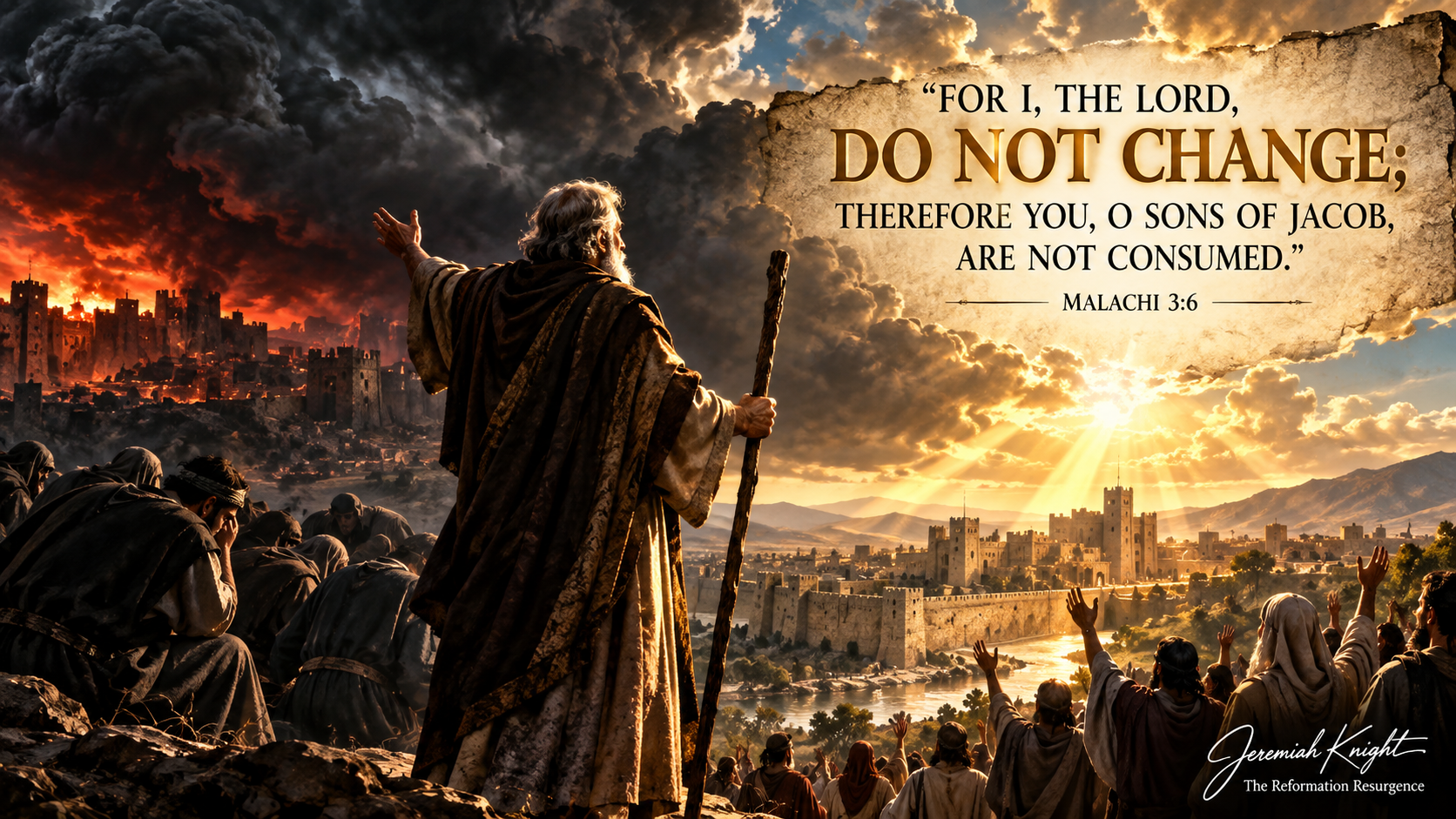
No, I could not. If He could learn something new about me tomorrow and think differently of me, I would have no peace. I give Him reasons every day. But look again at Malachi. "For I, the LORD, do not change; therefore you, O sons of Jacob, are not consumed" (Malachi 3:6). The reason we are still standing is that He does not change. His mercy to His people rests on His own oath, "so that by two unchangeable things in which it is impossible for God to lie, we who have taken refuge would have strong encouragement" (Hebrews 6:18). "For the gifts and the calling of God are irrevocable" (Romans 11:29).
So does God change His mind? In His nature, His knowledge, His purpose and His promises, never. In the way He deals with people when they turn from sin or turn to it, yes, and He does so exactly as He said He would in Jeremiah 18. That is part of His unchanging purpose.
This has two sides, and both are for us. If you are living in sin and comfortable in it, His warnings will not fade with time. He has not softened and He will not forget. But the door Nineveh went through is still open. "Return to the LORD your God, for He is gracious and compassionate, slow to anger, abounding in lovingkindness and relenting of evil" (Joel 2:13). He has promised to receive everyone who turns to Him through Christ, and He will not go back on that promise either.
And if you belong to Christ, rest in this. The God who set His love on you has never once changed His mind about anything He purposed, and He will not change it about you. "The LORD's lovingkindnesses indeed never cease, for His compassions never fail. They are new every morning; great is Your faithfulness" (Lamentations 3:22-23).
To God alone be the glory.
He who has ears to hear, let him hear.