
A reader wrote and asked me to write about forgiveness. The reader said we now live in a world where nobody has to forgive anyone. Cut people off, go "no contact," call everyone toxic, and if your parents hurt you, you are free to disrespect them for the rest of your life.
I agree, and it troubles me as well. Honestly, what worries me most is that this way of thinking has walked straight into the church. Christians who sing about grace on Sunday hold grudges for twenty years, and some of them do not speak to their own father or mother. Some of them have been hurt very badly, and the Bible speaks to them too. But many have simply been offended, and they have learned from the world that being offended gives them the right to cut people off.
Here is the question I want us to face. Can a man who has been forgiven by God refuse to forgive?
It starts with what God forgave
Before we talk about what others owe us, we have to remember what we owed God. "If You, LORD, should mark iniquities, O Lord, who could stand? But there is forgiveness with You, that You may be feared" (Psalm 130:3-4). Every one of us came to God with a debt we could never pay. We were not His friends who made a few mistakes. "We were enemies" (Romans 5:10).
And what did God do with that debt? He forgave us "all our transgressions, having canceled out the certificate of debt consisting of decrees against us, which was hostile to us; and He has taken it out of the way, having nailed it to the cross" (Colossians 2:13-14). Think about what that cost Him. Forgiveness always costs the one who forgives. When someone wrongs you and you forgive, you carry the loss yourself and do not make them pay. God carried our loss in the body of His own Son. "The LORD has caused the iniquity of us all to fall on Him" (Isaiah 53:6).
Every Christian needs to begin here. If we do not see how much we have been forgiven, we will always think other people's sins against us are bigger than ours against God.
The command is plain
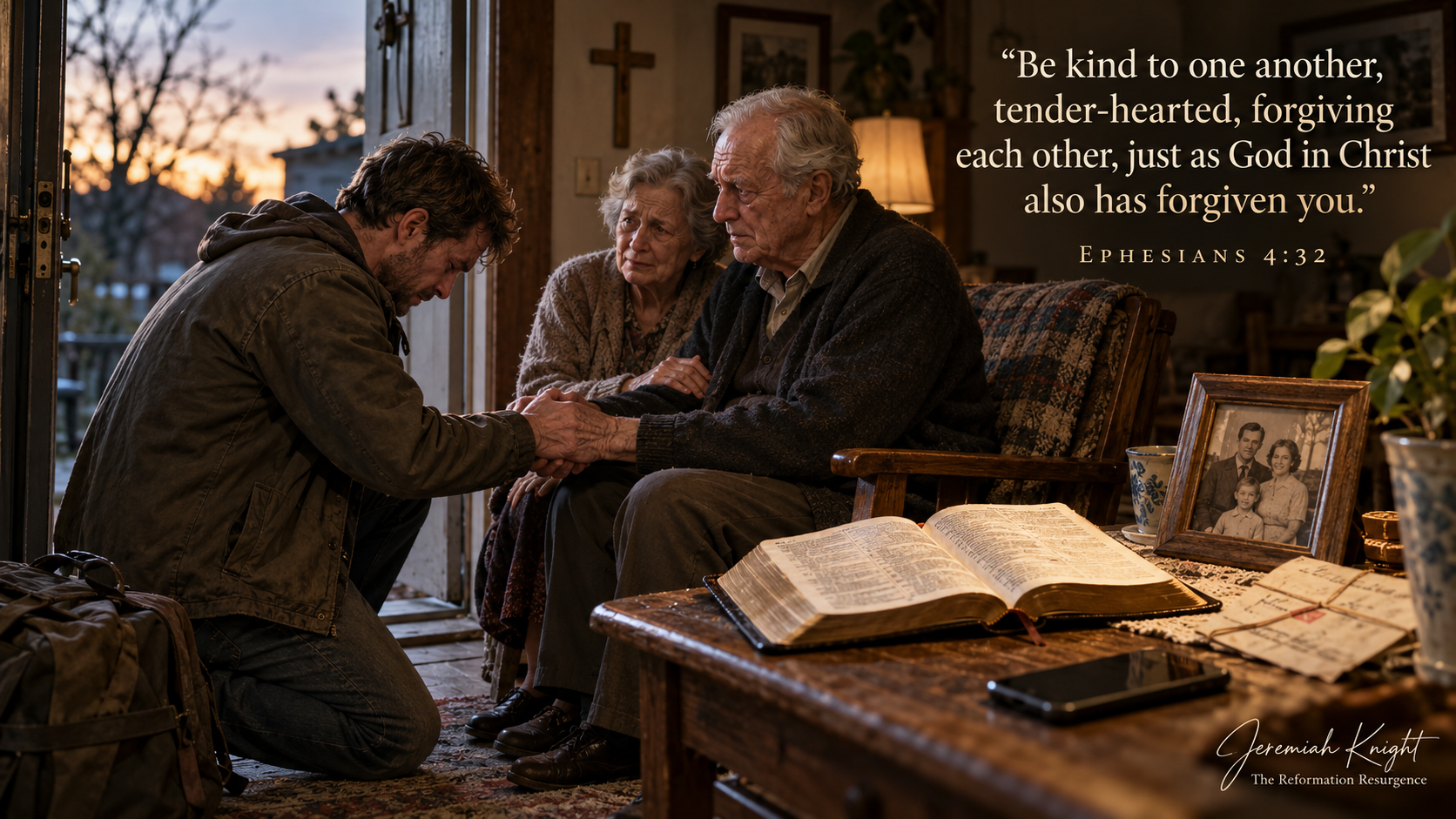
The Bible does not offer forgiveness as a suggestion for people who feel ready. It commands it. "Be kind to one another, tender-hearted, forgiving each other, just as God in Christ also has forgiven you" (Ephesians 4:32). "Bearing with one another, and forgiving each other, whoever has a complaint against anyone; just as the Lord forgave you, so also should you" (Colossians 3:13). Notice the measure. We forgive the way the Lord forgave us.
Jesus put it in the prayer He taught us, "And forgive us our debts, as we also have forgiven our debtors" (Matthew 6:12). Then He added the most frightening words on this subject in the whole Bible. "For if you forgive others for their transgressions, your heavenly Father will also forgive you. But if you do not forgive others, then your Father will not forgive your transgressions" (Matthew 6:14-15).
That does not mean we earn God's forgiveness by forgiving others. We are saved by grace alone. It means a heart that has truly received mercy will show mercy. A man who stubbornly refuses to forgive, year after year, should ask himself whether he has ever understood the gospel at all.
Seventy times seven
Peter once tried to put a limit on it. "Lord, how often shall my brother sin against me and I forgive him? Up to seven times?" Peter thought he was being generous. Jesus said, "I do not say to you, up to seven times, but up to seventy times seven" (Matthew 18:21-22). In other words, stop counting.
Then He told the story of a servant who owed his king ten thousand talents. That is a debt no man could pay in many lifetimes. The king forgave all of it. The same servant went out, found a fellow servant who owed him a hundred denarii, a few months of wages, grabbed him by the throat and threw him in prison. The king called him back. "You wicked slave, I forgave you all that debt because you pleaded with me. Should you not also have had mercy on your fellow slave, in the same way that I had mercy on you?" (Matthew 18:32-33). And Jesus ended with this. "My heavenly Father will also do the same to you, if each of you does not forgive his brother from your heart" (Matthew 18:35).
What others have done to us is real. Some of it is serious. But it is the hundred denarii. What we did to God is the ten thousand talents.
What forgiveness is
To forgive is to cancel the debt. You decide that the person will not have to pay you back, and you give up your right to get even. "Never pay back evil for evil to anyone... Never take your own revenge, beloved, but leave room for the wrath of God, for it is written, 'Vengeance is Mine, I will repay,' says the Lord" (Romans 12:17, 19).
That is the key. Forgiveness does not mean pretending nothing happened. Joseph looked his brothers in the face and said, "you meant evil against me" (Genesis 50:20). He called it what it was. Then he handed the judgment to God and treated them with kindness. "So therefore, do not be afraid; I will provide for you and your little ones" (Genesis 50:21).
Jesus did the same on the cross. "While being reviled, He did not revile in return; while suffering, He uttered no threats, but kept entrusting Himself to Him who judges righteously" (1 Peter 2:23). And from that cross He prayed, "Father, forgive them; for they do not know what they are doing" (Luke 23:34). Stephen, while the stones were still hitting him, cried out, "Lord, do not hold this sin against them!" (Acts 7:60).
So forgiveness is something we do in our hearts before God, even before the other person says sorry. "Whenever you stand praying, forgive, if you have anything against anyone" (Mark 11:25). We let go of the debt and the bitterness, and we leave the person in God's hands.
What forgiveness is not
Forgiving someone is not the same as trusting them again. Jesus said, "If your brother sins, rebuke him; and if he repents, forgive him" (Luke 17:3). The relationship is restored when there is repentance. Trust is rebuilt over time. Joseph forgave his brothers, but before he told them who he was, he tested them to see whether they had changed (Genesis 42 to 44).
Look at David and Saul. Saul tried to kill David again and again. David would not touch him, would not curse him, and honoured him as the LORD's anointed. But he did not move back into Saul's house. "So David went on his way, and Saul returned to his place" (1 Samuel 26:25). Paul left Alexander the coppersmith to the Lord and still told Timothy, "Be on guard against him yourself" (2 Timothy 4:14-15).
So if you are being beaten, threatened or abused, forgiving that person does NOT mean you must stay under the same roof and let it continue. God has given governing authorities to punish evil (Romans 13:4), and it is right to go to them. The Bible itself warns, "Do not associate with a man given to anger; or go with a hot-tempered man, or you will learn his ways and find a snare for yourself" (Proverbs 22:24-25). You can forgive from your heart and still keep yourself and your children safe.
But be honest with yourself. Most of the people being cut off today are not dangerous. They are annoying, or proud, or old fashioned, or they said something hurtful years ago. For these things the Bible gives us another way. "A man's discretion makes him slow to anger, and it is his glory to overlook a transgression" (Proverbs 19:11). "Love covers a multitude of sins" (1 Peter 4:8). Love "does not take into account a wrong suffered" (1 Corinthians 13:5). Some things should be talked about privately and honestly (Matthew 18:15). Many more things should simply be covered.
Your father and your mother
The reader was right to mention parents. The command is still there for every son and daughter. "Honor your father and mother (which is the first commandment with a promise), so that it may be well with you, and that you may live long on the earth" (Ephesians 6:2-3).
God did not attach a condition to it. He did not say to honour them if they were good parents. Take for example Noah. After the flood he got drunk and lay uncovered in his tent. His son Ham saw it and went out and told his brothers. But Shem and Japheth "took a garment and laid it upon both their shoulders and walked backward and covered the nakedness of their father" (Genesis 9:22-23). The father sinned. Two sons covered him, and one son exposed him. Shem and Japheth were blessed for what they did (Genesis 9:26-27).
Jesus was angry with the religious leaders who found a holy sounding excuse to stop caring for their parents. They said their money was "Corban," given to God, and so their parents got nothing. Jesus said they were "invalidating the word of God" by their tradition (Mark 7:10-13). The modern version of Corban is a set of new words that make it sound wise to abandon your parents. Paul says believers must "make some return to their parents; for this is acceptable in the sight of God" (1 Timothy 5:4). And "if anyone does not provide for his own, and especially for those of his household, he has denied the faith and is worse than an unbeliever" (1 Timothy 5:8).
Honouring your parents does not mean you must obey them when they tell you to sin (Acts 5:29). As an adult you have left your father and mother to build your own home (Genesis 2:24). And as we have seen, it does not mean you must stay under abuse. But it does mean you speak of them with respect, you do not mock them, you care for them in their old age, and you forgive them. They will stand before God for how they raised you. You will stand before God for how you treated them.
When we are the ones who did the wrong
So far we have talked about forgiving others. But every one of us has also hurt someone. Jesus said that if we come to worship and remember that a brother has something against us, we must "leave your offering there before the altar and go; first be reconciled to your brother, and then come and present your offering" (Matthew 5:23-24). He did not say "if you have something against him." He said if HE has something against you. Do not wait for the other person to come to you. Go first, admit what you did without excuses, and ask for forgiveness.
People ask whether forgiving means forgetting. God says, "I will forgive their iniquity, and their sin I will remember no more" (Jeremiah 31:34). God does not lose His memory. It means He will never bring that sin up against us again. That is what we do too. We may still remember what happened, but we stop keeping it ready to throw back in someone's face.
People also ask what to do when the other person refuses to repent. Jesus gave steps, first privately, then with one or two others, then before the church, and if the person still refuses, "let him be to you as a Gentile and a tax collector" (Matthew 18:15-17). There are times when a relationship cannot be restored because one side will not turn. But make sure the wall is on their side and not yours. "If possible, so far as it depends on you, be at peace with all men" (Romans 12:18).
Finally, people often say, "I have forgiven others, but I cannot forgive myself." The Bible never tells us to forgive ourselves. It tells us to believe God when He forgives us. "If we confess our sins, He is faithful and righteous to forgive us our sins and to cleanse us from all unrighteousness" (1 John 1:9). If the Judge of all the earth has declared you forgiven in Christ, you have no right to keep sentencing yourself.
The poison of bitterness
People who refuse to forgive think they are punishing the other person. Usually the other person does not even know. The one who suffers is the one who holds on. "See to it that no one comes short of the grace of God; that no root of bitterness springing up causes trouble, and by it many be defiled" (Hebrews 12:15). Bitterness does not stay in one heart. It spreads to children, to friends and to the whole church.
That is why Paul says, "Let all bitterness and wrath and anger and clamor and slander be put away from you, along with all malice" (Ephesians 4:31). Put away means put it down and leave it there.
And here is something the world will never tell you. Everyone is "toxic." "There is none righteous, not even one" (Romans 3:10). That includes the person reading this and the person writing it. If God dealt with us the way we want to deal with the people who hurt us, none of us would have a hope.
How can I forgive?
Some of you are reading this and thinking, "You do not know what was done to me. I cannot forgive it." You are right that you cannot do it in your own strength. But God does not leave you to your own strength. "It is God who is at work in you, both to will and to work for His good pleasure" (Philippians 2:13).
Start at the cross. Look again at how much you have been forgiven, until the debt others owe you looks small beside it. Then pray for the person who hurt you, by name, because Jesus said, "love your enemies and pray for those who persecute you" (Matthew 5:44). It is very hard to keep hating someone you are honestly praying for. And when the old anger comes back tomorrow, forgive again. Seventy times seven sometimes means seventy times seven in the same week, for the same wound.
A word to all of us
If you have been cut off from someone over pride or an old offense, go and make it right while there is time. Pick up the phone. Visit your mother. Write to your father. You do not know how many days either of you has left.
I know this from my own life. Before my dad fell sick, he and I had a fight, and I stopped talking to him. Then he was taken to the ICU. He needed open heart surgery, and they kept him sedated. I never got to speak a SINGLE word to him again.
When I went to the hospital to collect my dad's body, the nurses asked me whether I was his son. When I said yes, they told me that he had talked only about me. He wanted to see me married. He wanted to play with his grandchildren. I had stopped talking to him, and he was lying in that bed talking about my wedding and my children. Whatever was between us did not matter to him in the end, and it should never have mattered to me. I will carry that regret for the rest of my life. So, if there is someone you have stopped speaking to, please do not wait the way I did. You may never get to say sorry, and you may only find out what they felt about you from a stranger.
If you have been truly harmed, God sees it, and He will judge it rightly. Forgive from your heart, leave the vengeance to Him, and stay safe. That is not weakness. It is trusting God to do what only He can do.
And if you have never received God's forgiveness yourself, you have no power to forgive anyone. Come to Christ first. "In Him we have redemption through His blood, the forgiveness of our trespasses, according to the riches of His grace" (Ephesians 1:7). Once you know what He has forgiven you, you will find you can forgive others.
To God alone be the glory.
He who has ears to hear, let him hear.