

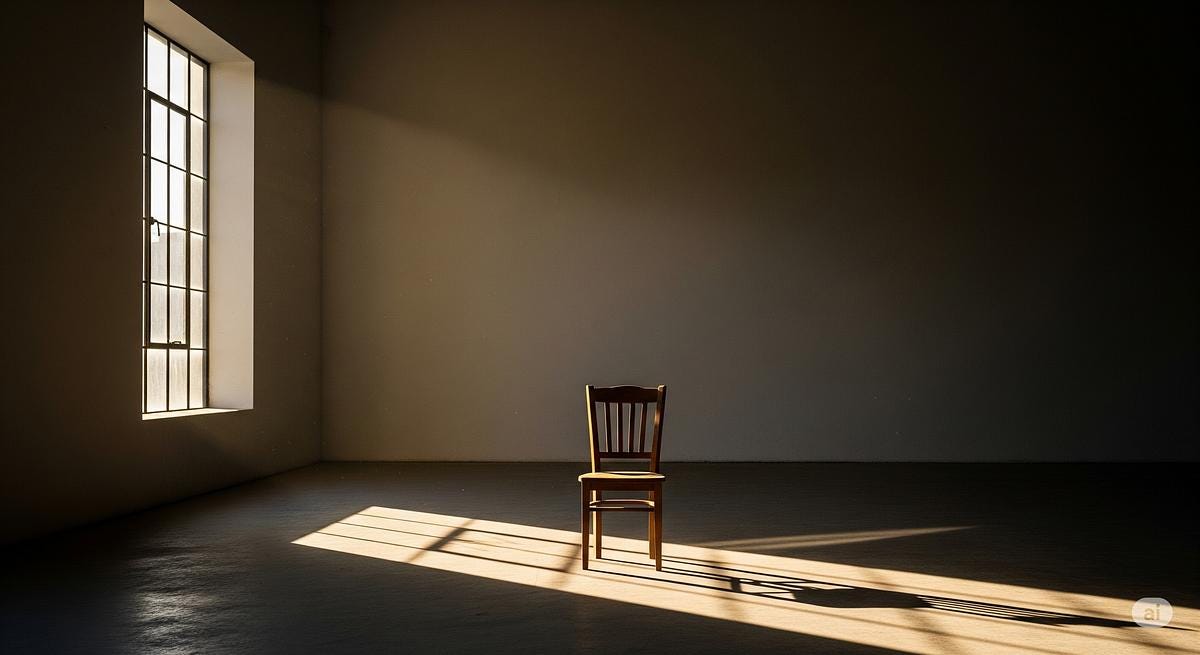
 One day, the rooms you occupied will hold other conversations. The streets you walked will carry other footsteps. And somewhere, without anyone announcing it, the world will have learned to function without your presence.
There is a strange thing about imagining your own death.
You can imagine the hospital room. The last breath. The silence that follows. You can imagine the people who might cry, the calls that would be made, the arrangements that would need to happen.
But there is something much harder to imagine.
The morning after.
The sun will rise. Someone will complain about the weather. A shopkeeper will open a shop. A child will be late for school. Traffic will gather where it always gathers. Somewhere, a person will fall in love, and somewhere else, another will decide that they have had enough.
The world will continue.
Not because it is cruel. Not because your life was insignificant. It will continue because the world has never depended on the continued existence of any one person.
And perhaps that is where the real difficulty begins.
The uncomfortable truth about being important
Most of us live with an unspoken assumption that our presence is more permanent than it is.
We become part of routines. We occupy rooms. We have conversations that seem ordinary because we assume there will be more of them. Someone expects our call. Someone knows how we take our tea. Someone has grown accustomed to hearing our footsteps.
Our presence becomes part of the architecture of other people’s lives.
Then we imagine its removal.
The chair remains, but nobody sits in it. The phone number remains, but nobody answers. The conversation that was supposed to happen next week never happens.
For a while, the absence is visible.
But time does something peculiar. The people who loved us begin to build new routines around the space we left. The fourth cup is no longer placed on the table. The calls become less frequent. The stories are told less often. Eventually, even the people who remember us will have days in which they do not think about us.
This is not an accusation against the living. It is not evidence that love was shallow.
It is simply one of the conditions of being alive: people must continue living, even when someone they love cannot.
And the world outside that circle of grief may never notice that anything happened.
But does being forgotten mean we never mattered?
Here, the question becomes more difficult.
We often comfort ourselves with the idea that we survive through memory. That something of us remains in the people we touched, the work we produced, the children we raised, the ideas we introduced.
There is truth in this. Our actions can continue to shape lives long after we are gone.
But there is a distinction worth making.
Being remembered is not the same as surviving.
A person may remember your voice, but the memory is happening in their mind, not yours. Your influence may continue, but influence is not a continuing point of view. The world may carry traces of your existence without you being there to experience any of it.
This does not make those traces worthless. It makes them different from the thing we often hope they will be.
Perhaps we want more than to have mattered. Perhaps we want to remain the person to whom things matter.
We want to see what happens next. We want to know whether the people we love are safe. We want to hear the next song, witness the next morning, correct the things people get wrong about us.
We do not merely want the world to remember that we existed.
We want to still be here.
And that desire is not easily answered by telling someone that they will live forever in the memories of others.
This is one of the questions explored in The Shape of Our Disappearance: A Philosophy of Death, and the Life We Leave Behind, by PHI. The book examines the difference between personal survival, memory, and influence, and asks what remains when the person who once experienced the world is no longer here.
READ THE BOOK
The problem is not that life ends. It is that we live as though it does not.
Consider how much of life is postponed.
The conversation with a parent. The apology. The journey. The work we keep saying we will begin when circumstances improve. The person we intend to visit when there is more time.
We arrange our lives around an imaginary abundance of tomorrows.
This is not necessarily foolish. Planning for the future is part of being human. We cannot live every day as though it were our last, and a life spent constantly anticipating death would be a life made smaller by the very thing it fears.
But there is a difference between planning for tomorrow and quietly assuming that tomorrow belongs to us.
We know that our time is limited. Yet the knowledge rarely enters our ordinary decisions with the force it should.
Perhaps that is why death is such a difficult subject. It is not simply an event we fear. It is a fact that challenges the way we organise almost everything.
What deserves our attention? What do we owe one another? What is worth postponing? What does it mean to love someone when neither of you can guarantee how long you will remain?
And if there is no promise that we will get another chance, what should we do with the chances we have?
There is no easy consolation here
It would be comforting to conclude that death makes everything beautiful, that impermanence gives every moment its meaning, or that the universe has arranged some grand purpose for our brief existence.
But comfort is not the same as an answer.
Some people believe in an afterlife. Others believe consciousness ends with the brain. Some find meaning in religion, others in relationships, work, curiosity, or the simple experience of being alive. These are not interchangeable positions, and they deserve more than easy dismissal.
The honest question is not whether we can manufacture a comforting answer.
It is whether we can examine the possibilities without pretending to know more than we do.
That is what philosophy should be willing to do: not decorate uncertainty, but enter it.
And perhaps, after all the arguments about death, the most important question is not what the world will look like after we disappear.
It is what we are doing with the world while we are still in it.
Because one day, the conversations will continue without us.
The streets will fill again. The light will fall across unfamiliar rooms. Someone will make plans for a future they assume they will reach.
And somewhere, the life that was once yours will have become part of the past.
What, then, should it mean to be alive?
THE BOOK
THE SHAPE OF OUR DISAPPEARANCE
A Philosophy of Death, and the Life We Leave Behind
By PHI
A philosophical examination of death, nonexistence, consciousness, immortality, grief, memory, love and the obligations we have to one another while we are here.
It does not promise an easy answer to death. It asks a harder question: what becomes of the life we are living when we stop pretending it will last forever?
PHI, Philosophy for those who feel before they understand.