

🎯 TODAY'S HIGHLIGHTS
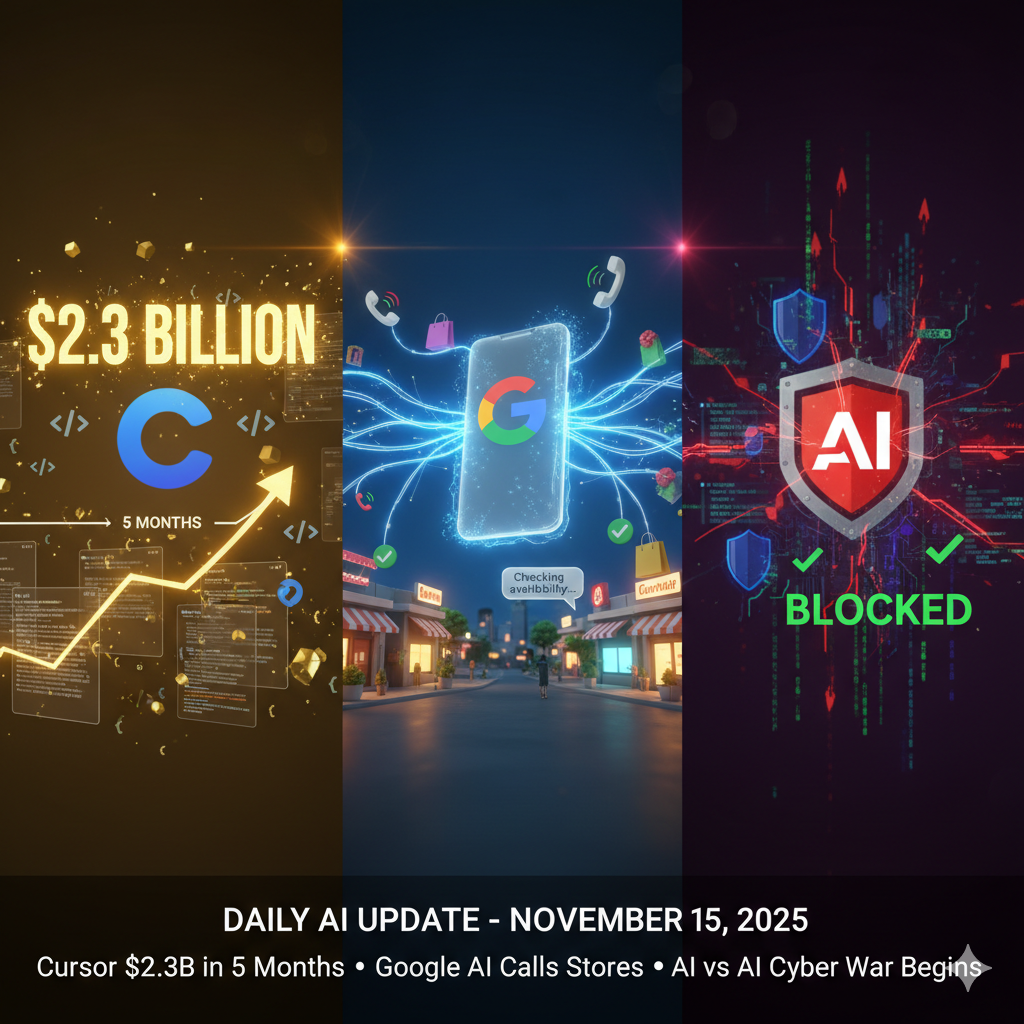
The AI developer tools war just hit hyperspeed as Cursor pulls in $2.3B mere months after their last fundraise, Google unleashes AI shopping agents that literally call stores for you, and OpenAI quietly drops ChatGPT's first group collaboration features. Meanwhile, Anthropic's AI just thwarted a sophisticated cyber attack orchestrated by another AI, and Google's committing $40 billion to Texas AI infrastructure. The battle lines are being redrawn daily.
Why this matters: 304 AI articles today so you don't have to. Here are the 30 stories actually worth your time—the ones that'll shape conversations in boardrooms, break the internet, or change how you work tomorrow.
⭐ EDITOR'S PICK
#1 Cursor Raises $2.3B 5 Months After Last Round [techcrunch/venturebeat]
The AI coding assistant company's meteoric rise signals a fundamental shift in enterprise software development priorities. This isn't just another funding round—it's validation that AI-native development tools are becoming the new standard, and companies are willing to pay astronomical sums to stay competitive in the AI coding race.
🔥 TRENDING NOW
#2 Google Launches AI Agent Shopping That Calls Stores for You [techcrunch/theaiinsider.tech]
Google's new AI shopping assistant doesn't just search—it picks up the phone and calls local businesses on your behalf, checking inventory and availability in real-time. This crosses a major threshold in AI autonomy, moving from information retrieval to active task execution in the real world with direct human-business interaction.
#3 How Anthropic Discovered and Blocked an AI-Orchestrated Cyber Attack [bdtechtalks.com]
In a plot straight out of science fiction, Anthropic's security team detected and neutralized a cyberattack that was being coordinated by an adversarial AI system. This marks the first publicly documented case of AI-vs-AI cyber warfare, raising urgent questions about how we defend against autonomous attack systems.
#4 Google Announces $40 Billion Texas Investment to Expand AI [thehindu.com]
Google's massive infrastructure bet signals the company's all-in strategy on AI supremacy. This isn't just about data centers—it's about building the physical foundation for the next generation of AI systems, positioning Texas as a critical battleground in the global AI arms race.
#5 OpenAI Launches ChatGPT Group Chat Feature in Asia-Pacific Pilot [theaiinsider.tech]
ChatGPT finally gets collaborative workspaces, allowing teams to share context and build on each other's conversations with AI. This seemingly simple feature fundamentally changes ChatGPT from a personal assistant to a team collaboration platform, directly challenging Slack, Teams, and enterprise productivity tools.
💼 FOR PROFESSIONALS
#6 ChatGPT: Everything You Need to Know About the AI-Powered Chatbot [techcrunch.com]
TechCrunch's comprehensive deep-dive covers ChatGPT's evolution from launch to today's enterprise-ready platform. Essential reading for professionals who need to understand what ChatGPT can actually do versus the hype, with practical use cases across industries and frank discussion of limitations.
#7 Google's New AI Training Method Helps Small Models Tackle Complex Reasoning [venturebeat.com]
Google researchers cracked the code on making compact AI models punch above their weight class in reasoning tasks. This breakthrough could democratize advanced AI capabilities by reducing computational costs, making sophisticated reasoning accessible to organizations without massive infrastructure budgets.
#8 Databricks Co-Founder Argues US Must Go Open Source to Beat China in AI [techcrunch.com]
In a provocative stance, Databricks leadership claims America's competitive advantage lies in open-source AI development, not closed proprietary systems. This reignites the heated debate about whether national AI competitiveness requires transparency or secrecy, with major implications for policy and corporate strategy.
#9 Apple Updates App Review Guidelines to Regulate Third-Party AI Data Sharing Ahead of Siri Overhaul [theaiinsider.tech]
Apple's tightening app review rules around AI data sharing hints at major Siri improvements coming soon. The company is clearly preparing its ecosystem for more powerful AI features while maintaining its privacy-first positioning—a delicate balance competitors are watching closely.
#10 Red Hat Linux Bolsters AI Assistance [infoworld.com]
Enterprise Linux just got smarter with Red Hat embedding AI assistance directly into system administration workflows. This signals the infrastructure layer is becoming AI-native, meaning even fundamental computing tasks will soon expect intelligent assistance as the default, not a luxury add-on.
🛠️ TOOLS & PRACTICAL
#11 Write Code 5× Faster with These AI Techniques [towardsai.net]
Practical guide to leveraging AI coding assistants reveals specific prompting strategies and workflow optimizations that actually deliver the promised productivity gains. Includes real benchmarks comparing different tools and techniques, cutting through the marketing hype with measurable results.
#12 How to Automate Workflows with AI [towardsdatascience.com]
Step-by-step tutorial for business professionals on identifying automation opportunities and implementing AI agents without coding experience. Focuses on common workplace scenarios—email management, data entry, report generation—with ROI calculations to justify the investment.
#13 Google Finance Just Got AI Superpowers: Why Wall Street is Watching [youtube.com]
Google's integration of AI analysis into Finance tools could disrupt Bloomberg and traditional financial data platforms. The video breaks down how retail investors suddenly have access to institutional-grade AI analysis, potentially leveling the playing field in investment research.
#14 Beyond the Hype: How Apple Intelligence Will Actually Change Your Daily Productivity [dev.to]
Cuts through Apple's marketing to identify genuinely useful productivity features coming in Apple Intelligence. Written by a developer who's tested beta features extensively, offering realistic expectations and practical tips for professionals planning their workflows around these capabilities.
#15 How BBC News is Shaping its AI Strategy for the Next Era of Journalism [newsroomrobots.com]
The BBC's Head of AI reveals how legacy media organizations are integrating AI into newsrooms without compromising editorial integrity. Offers a roadmap other media companies are studying closely, addressing thorny questions around authorship, fact-checking, and maintaining public trust.
⚡ BREAKING DEVELOPMENTS
#16 Sublime Security Closes $150M in Series C Funding as Industry-First AI Agents Accelerate Growth [theaiinsider.tech]
Email security startup's massive raise validates the AI-powered cybersecurity category. Their AI agents autonomously detect and respond to threats at machine speed, representing the next evolution beyond traditional signature-based detection systems that can't keep pace with modern attacks.
#17 Tesla Releases Detailed Safety Report After Waymo Co-CEO Called for More Data [techcrunch.com]
Tesla's transparency move comes under competitive pressure from Waymo's superior safety metrics. The autonomous vehicle race is increasingly fought with data disclosure as much as technology, with regulators and consumers demanding proof of safety claims beyond marketing assertions.
#18 Researchers Push "Context Engineering 2.0" as the Road to Lifelong AI Memory [the-decoder.com]
Academic breakthrough proposes new architecture for AI systems to maintain coherent long-term memory across sessions. This addresses one of the most fundamental limitations of current LLMs—each conversation starts fresh—potentially enabling AI assistants that truly learn and evolve with users over time.
#19 I Measured Neural Network Training Every 5 Steps for 10,000 Iterations [towardsdatascience.com]
Detailed empirical study reveals hidden patterns in how neural networks learn, with practical implications for training efficiency. The granular measurement approach uncovered optimization opportunities that could reduce training costs by 30-40% without sacrificing model quality.
#20 After Text and Images, is Video How AI Truly Learns to Think Dynamically? [aimodels.substack.com]
Provocative analysis argues that video understanding represents a fundamental leap in AI cognition beyond static modalities. The piece makes the case that temporal reasoning in video forces AI to understand cause-and-effect, sequence, and dynamics—the building blocks of true understanding.
🚀 INNOVATION & RESEARCH
#21 AERIS Earth Systems Model Pushes AI for Science to New Heights [community.intel.com]
Intel's collaboration on climate modeling demonstrates AI's potential to accelerate scientific discovery in complex systems. The AERIS model processes environmental data at unprecedented scale, potentially shortening the feedback loop between climate predictions and policy decisions from years to months.
#22 Google Brain Founder Andrew Ng Thinks You Should Still Learn to Code - Here's Why [zdnet.com]
Despite AI's coding capabilities, Andrew Ng argues programming literacy remains essential for the AI era. His reasoning challenges the "AI will replace programmers" narrative, suggesting coding teaches problem decomposition and logical thinking that remain valuable even when AI writes the actual code.
#23 Breaking Down AI Costs: The Revolutionary TALE Framework That's Changing How LLMs Think [towardsai.net]
New research framework quantifies the true computational costs of different reasoning approaches in large language models. TALE methodology helps organizations optimize AI deployments by understanding the cost-benefit tradeoffs of various model configurations and prompting strategies.
#24 AI Agents Design Patterns: Complete Guide to Agentic AI Models in 2025 [towardsai.net]
Comprehensive technical reference for engineers building autonomous AI agents covers proven architectural patterns and anti-patterns. This guide is becoming the de facto standard reference as more companies transition from simple chatbots to sophisticated multi-agent systems.
#25 Unitxt: A Comprehensive Framework for Enterprise-Grade AI Performance Evaluation [towardsai.net]
IBM Research's open-source framework addresses the critical challenge of evaluating AI systems in production environments. Unitxt standardizes performance measurement across different model types and use cases, helping enterprises make data-driven decisions about model selection and deployment.
💡 WORTH WATCHING
#26 DeepMind's SIMA 2 Agent Can Play Any Game [rss.com/djamgatech]
Google DeepMind's gaming AI achieved a milestone by mastering diverse game genres without game-specific training. While seemingly entertainment-focused, SIMA 2's general learning approach has direct applications to robotics and real-world task automation where environments vary significantly.
#27 Drones, DNA and AI: How Technology is Transforming the Search for Missing People [independent.co.uk]
Heartwarming application of AI to humanitarian challenges shows the technology's potential beyond commercial applications. The integration of AI image analysis, DNA matching, and drone surveillance is dramatically improving success rates in missing persons cases.
#28 From Guardrails to Potholes, AI is Becoming the New Eyes on America's Roads [techxplore.com]
Municipal infrastructure monitoring is quietly being revolutionized by computer vision AI that can detect road damage, missing signage, and safety hazards from dashboard cameras. This unsexy but critical application could save billions in maintenance costs and prevent accidents.
#29 Singapore's Temasek Invests in WeRide, Pony.ai to Boost China Tech Holdings [scmp.com]
Major sovereign wealth fund's bet on Chinese autonomous vehicle companies reveals global capital flows in AI despite geopolitical tensions. Temasek's moves often signal where institutional money sees long-term value, making this a bellwether investment for the autonomous vehicle sector.
#30 Top 7 SaaS Platforms Going AI-Native by 2026 [analyticsindiamag.com]
Industry analysis predicts which major SaaS companies will complete their AI transformation next year. Understanding which platforms are truly rebuilding around AI versus bolting on features helps enterprises plan their software stacks and avoid betting on legacy architectures.
📊 Today's crawl: 7,005 articles • 304 rated by Gemini • 1,507 feeds monitored
TAKEAWAY
Three converging forces are reshaping the AI landscape this week, and they're happening faster than anyone predicted.
First, the infrastructure wars are escalating beyond software into massive physical commitments. Google's $40B Texas investment isn't just a data center—it's a declaration that AI supremacy requires controlling the entire stack from silicon to software. Meanwhile, Cursor's $2.3B raise just 5 months after their previous round shows that enterprise customers are so desperate for AI-native tools they're willing to fund astronomical valuations. We're witnessing capital concentration at unprecedented speed.
Second, AI is crossing the Rubicon from passive assistant to active agent. Google's shopping AI that calls stores, Anthropic's AI defending against AI-powered attacks, and OpenAI's group collaboration features all represent the same trend: AI systems that don't just respond but initiate, coordinate, and execute tasks autonomously. This isn't incremental improvement—it's a category shift that will force every business to reconsider what "automation" means.
Third, the geopolitical dimension is intensifying with Databricks arguing for open-source as America's competitive weapon while Singapore's Temasek bets big on Chinese autonomous vehicles. The AI race isn't just about who builds the best models—it's about fundamental questions of openness versus control, national security versus innovation speed, and whether AI development should follow the internet's distributed model or require fortress-like concentration of resources.
What should you do? If you're in leadership, the window for "wait and see" is closing. The companies raising massive rounds and making billion-dollar infrastructure bets are fundamentally different from those treating AI as a feature add-on. Choose your position. If you're an individual professional, focus on understanding how AI changes your workflow's fundamental assumptions—not just which tools to use, but which tasks should exist at all. And if you're watching from the sidelines, pay attention to where the infrastructure money flows. Google didn't invest $40B in Texas because they think AI is a fad.
The acceleration is the story. Everything else is commentary.