

On October 9, 2026, Google officially rolled out its latest Gemini subscription and model tiering policy (Google Support #17004136). The developer community reacted almost instantly:
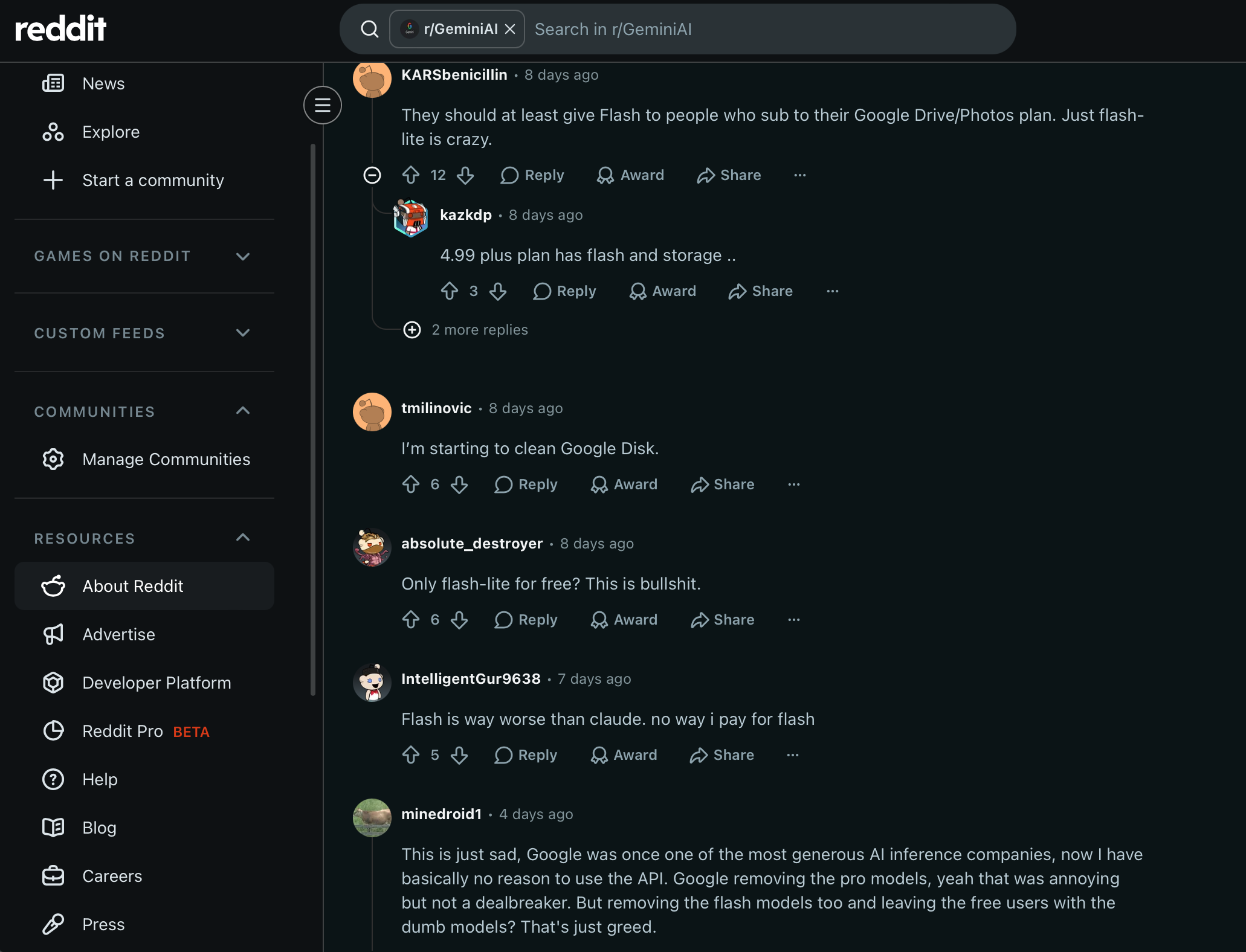
“Effective October 9, 2026, Free tier users are restricted to Flash Lite text models only.”
While free users felt the sudden limitation, the loudest backlash came from paying AI Plus subscribers.
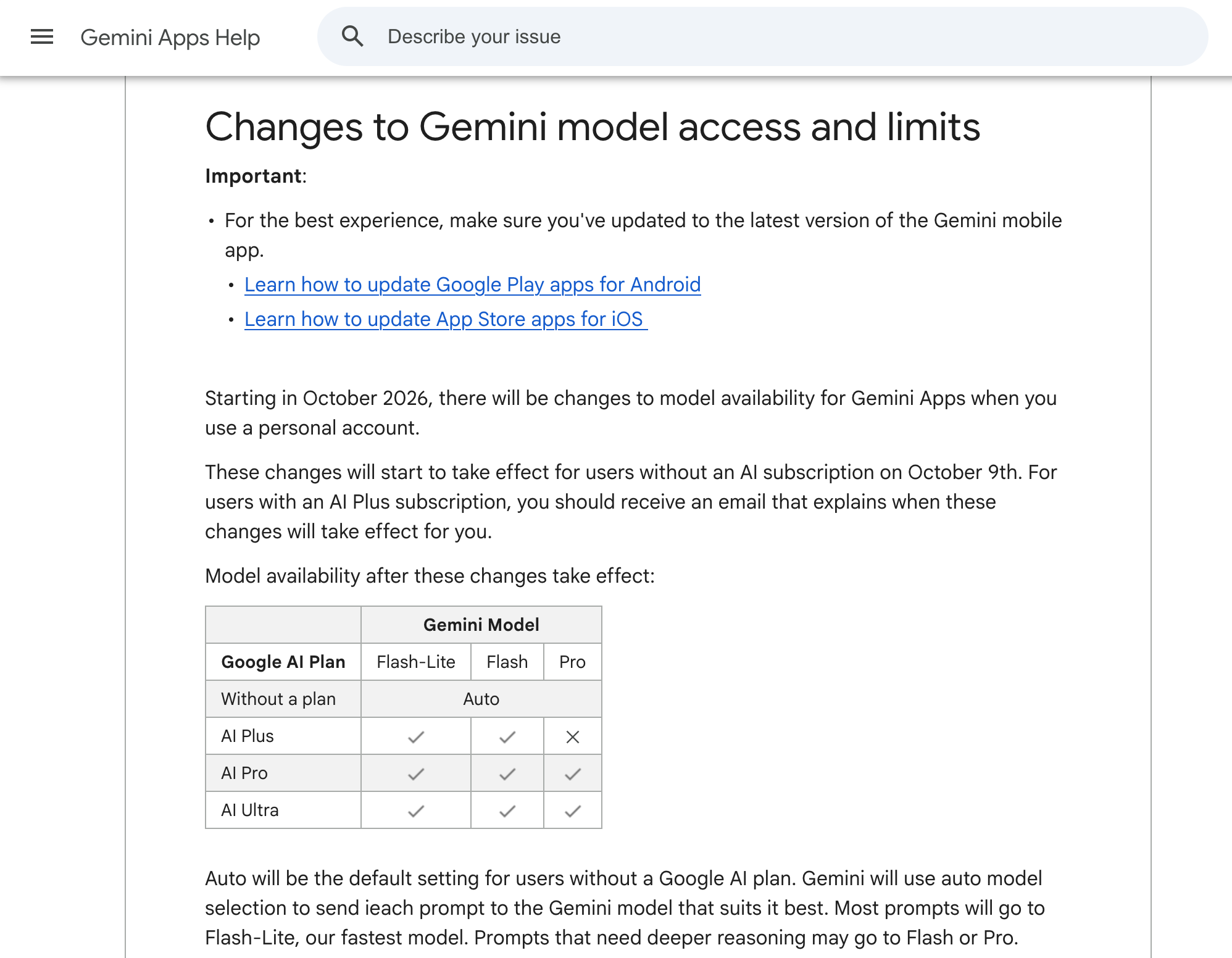
Many felt caught in a classic pricing squeeze: after the update, AI Plus offered little more than standard Flash over the free tier, while flagship Pro models were pushed entirely behind the $19.99/month paywall of AI Pro and AI Ultra. For anyone paying an entry-level subscription fee hoping for flagship reasoning, the perceived value proposition dissolved overnight. Screenshots of canceled subscriptions quickly took over social feeds.
In the latest v1.2.8 release of my lightweight desktop application, Gai, I also updated our model defaults to align with this policy.
Yet, having followed the Gemini ecosystem closely since the early Gemini 1.5 days up to Gemini 3, I see this shift through a very different lens: Do everyday workflows truly demand a $19.99 monthly commitment? Is the newly front-and-center Flash-Lite genuinely a crippled downgrade, or have we simply been evaluating it wrong?
1. Separate the Signals: Consumer Subscriptions vs. API Quotas
Before getting swept up in cancellation panic, it helps to distinguish between consumer web subscriptions and developer-level API access.
Google’s strategic signal here is crystal clear: tighten access to expensive flagship Pro models while widening the floodgates for ultra-fast, low-cost Flash-Lite.
Even if you have no interest in shelling out $20 a month for high-tier web plans, looking at your Google AI Studio dashboard (aistudio.google.com) under Gemini API Rate Limit as of October 9, 2026 reveals a surprisingly generous picture:
Google Antigravity: 100 free requests per day;
Gemini 3.5 Flash Lite: Up to 500 free requests per day;
Gemini 3.1 Flash Lite: An additional 500 free requests per day.
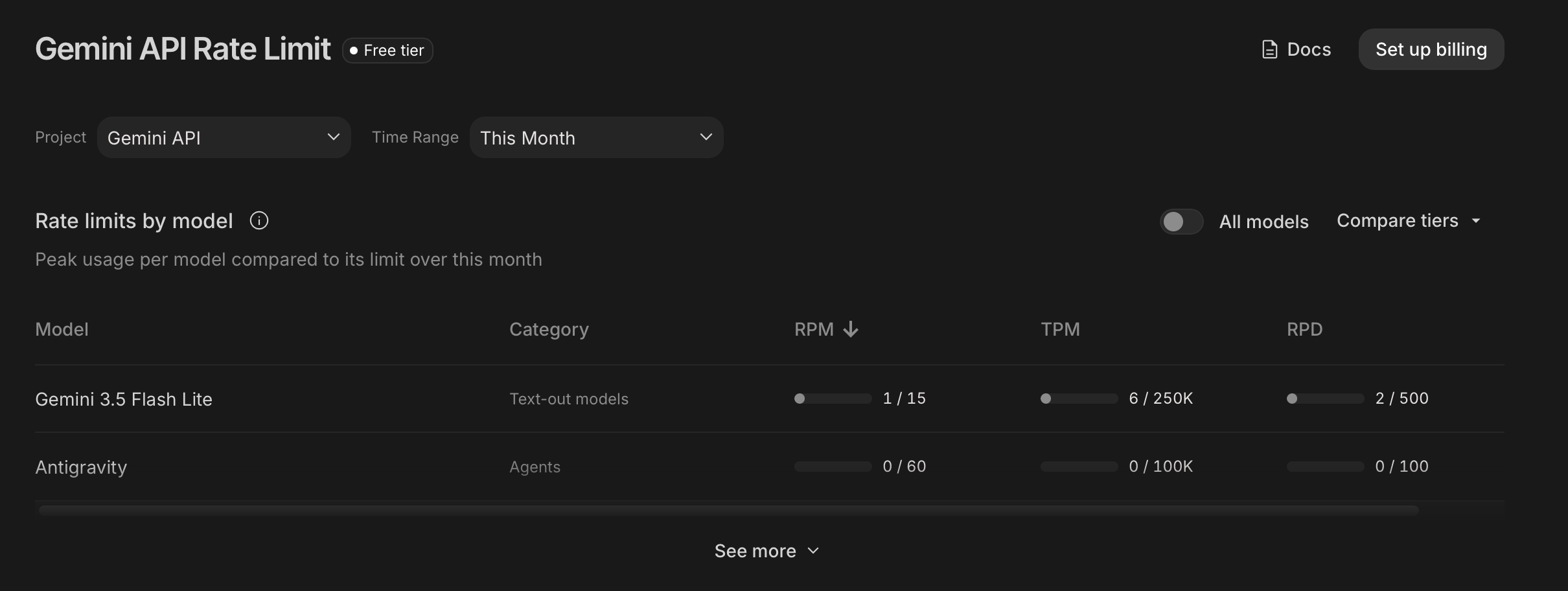
Unless your daily work involves full-codebase autonomous agent loops, a recurring daily allowance of hundreds of official API requests is ample. For a zero-cost tier provided directly by Google, that is remarkably hard to complain about.
2. The Three Tiers: When Does Antigravity Actually Justify AI Pro?
Much of the frustration stems from the psychological baggage of the word “Lite”—as though anything lacking a “Pro” badge is inherently degraded. But in terms of compute allocation and task complexity, Gemini’s three-tier hierarchy makes good engineering sense:
ProSeries (The Sledgehammer): Purpose-built for deep mathematical proofs, full-repo AST refactoring, and multi-step autonomous planning. The downside: the highest latency and highest token costs. It is a heavy instrument meant for zero-margin-for-error engineering challenges.FlashSeries (The Workhorse): The sweet spot between latency and capability. Fast, multimodal, and dependable—the natural default for everyday tasks of moderate complexity.Flash LiteSeries (The Speed Demon): Tuned for instant throughput, rapid Time-to-First-Token (TTFT), and minimal resource overhead. For tasks that do not demand complex multi-turn symbolic reasoning, the perceptual difference between Lite and standard Flash is surprisingly slim.
So who genuinely needs to upgrade to the $19.99/mo AI Pro / Ultra tier?
Developers who rely heavily on Google Antigravity as their primary daily programming companion.
Under Google’s subscription terms (Gemini Subscriptions), only AI Pro and AI Ultra explicitly guarantee enterprise-grade Antigravity support and commercial data privacy—meaning your proprietary code is excluded from model retraining datasets. The Free tier’s Antigravity access is strictly evaluative, meaning prompt contexts may legally be used to train future foundation models.
Unless you have strict code privacy compliance requirements or run intensive agentic programming loops, upgrading to Pro is simply paying a recurring premium for compute capacity you will rarely exhaust.
3. Using a Sledgehammer to Crack a Nut: The Overlooked Utility of Flash-Lite
In day-to-day productivity, people frequently fall into the trap of using a sledgehammer to crack a nut.
Tasking a Pro model with summarizing a 3,000-word email chain or parsing structured logs means waiting through prolonged TTFT delays and burning excessive compute on what is fundamentally straightforward pattern matching.
For routine, pattern-heavy daily workflows, the latest iterations of Flash-Lite (specifically 3.1 and 3.5) are not merely "adequate"—they often deliver a superior user experience:
Drafting & Copy Editing: Generating memos, refining phrasing, and adapting tone across correspondence. The output is fluent and coherent, easily rivaling standard Flash.
Structured Data Extraction: Classifying text, extracting named entities, and transforming raw information into clean JSON or Markdown tables in milliseconds.
Translation & Everyday Reference: Quick multilingual translation, grammar checking, and high-frequency knowledge lookups with near-instantaneous streaming output.
Rapid Summarization & Brainstorming: Condensing industry reports into executive bullet points or generating structured idea matrices on demand.
Mature AI adoption isn't about bragging about the largest parameter count; it’s about deploying the right compute tier to resolve tasks with sub-second latency and zero unnecessary overhead.
4. Bloatware Epidemic vs. Radical Restraint: The Philosophy Behind Gai v1.2.8
This balance between utility and restraint is precisely why I created Gai (Generative-AI tools for beginner), which recently launched its v1.2.8 update.
While v1.2.8 defaults Free tier usage to Flash Lite in compliance with Google's updated policy, underneath the hood it retains full access to Google’s complete model matrix (Flash 2.5/3.1/3.5–3.8, Flash Lite 2.5/3.1/3.5, Gemini 3.1 Flash Image, and Nano Nano Banana 2.1).
More importantly, it stands in conscious opposition to two widespread anti-patterns in modern desktop AI tooling:
Anti-Pattern 1: The Invasive System Takeover
Many modern desktop AI clients attempt to act as all-seeing "agents"—demanding blanket disk read/write permissions, monitoring background clipboards, and silently indexing personal directories without explicit user authorization.
Anti-Pattern 2: The Multi-Gigabyte Desktop Behemoth
Too many desktop AI tools arrive as massive installers weighing several hundred megabytes, unpacking into multi-gigabyte monsters that idle at high memory and CPU utilization. They behave less like desktop utilities and more like an attempt to rebuild an entire operating system inside your computer.
Gai takes an intentionally minimalist approach:
Genuinely Lightweight: The Windows installer weighs in at around 15 MB. It is a clean, native desktop companion that leaves a negligible footprint on your system.
Radical Simplification: In v1.2.8 ChangLog, we intentionally removed confusing hyperparameter controls like
temperatureandtop_p, standardized dynamic thinking to a clean Medium level, and refined contextual compression. Everyday users should not need to study prompt-engineering jargon just to get helpful answers.Sandboxed & Passively Invoked: Gai operates strictly within its designated sandbox. It acts only when you explicitly ask it to—never scanning, modifying, or uploading files outside its own workspace.
Bring Your Own Key (BYOK): No ads, no account paywalls, and zero vendor lock-in. By simply adding your own free Google Gemini API key in the settings, you can unlock Google's 500 daily requests of Flash Lite at zero cost.
5. Final Thoughts
Whether Google’s October 9 policy shift affects your daily work depends on what you actually ask your tools to do.
You do not need to panic-subscribe to $19.99/mo plans, nor do you need to walk away from modern AI in frustration. Understanding model tiers, utilizing Flash-Lite’s generous daily free quota, and pairing it with a 15 MB, privacy-first, zero-bloat client might just be the most rational path forward.
If you care about local file privacy and prefer clean tools over invasive bloatware, take a look at Gai: 🔗 Documentation & Getting Started: https://webpath.iche2.com/gaidoc/en/
How are you handling Google’s Oct 9 tier update? Are you staying on free Flash-Lite, switching to direct API keys, or upgrading to AI Pro? Join the discussion below!