
The Architecture of the Great Wheel: The Evolutionary Baton Pass: From the Cross of Consciousness to the Cross of Planning
$47
The Architecture of the Great Wheel
Eight Enduring Principles for the Transition Beyond the Cross of Planning
A global cycle may end, but its most valuable lessons remain available.
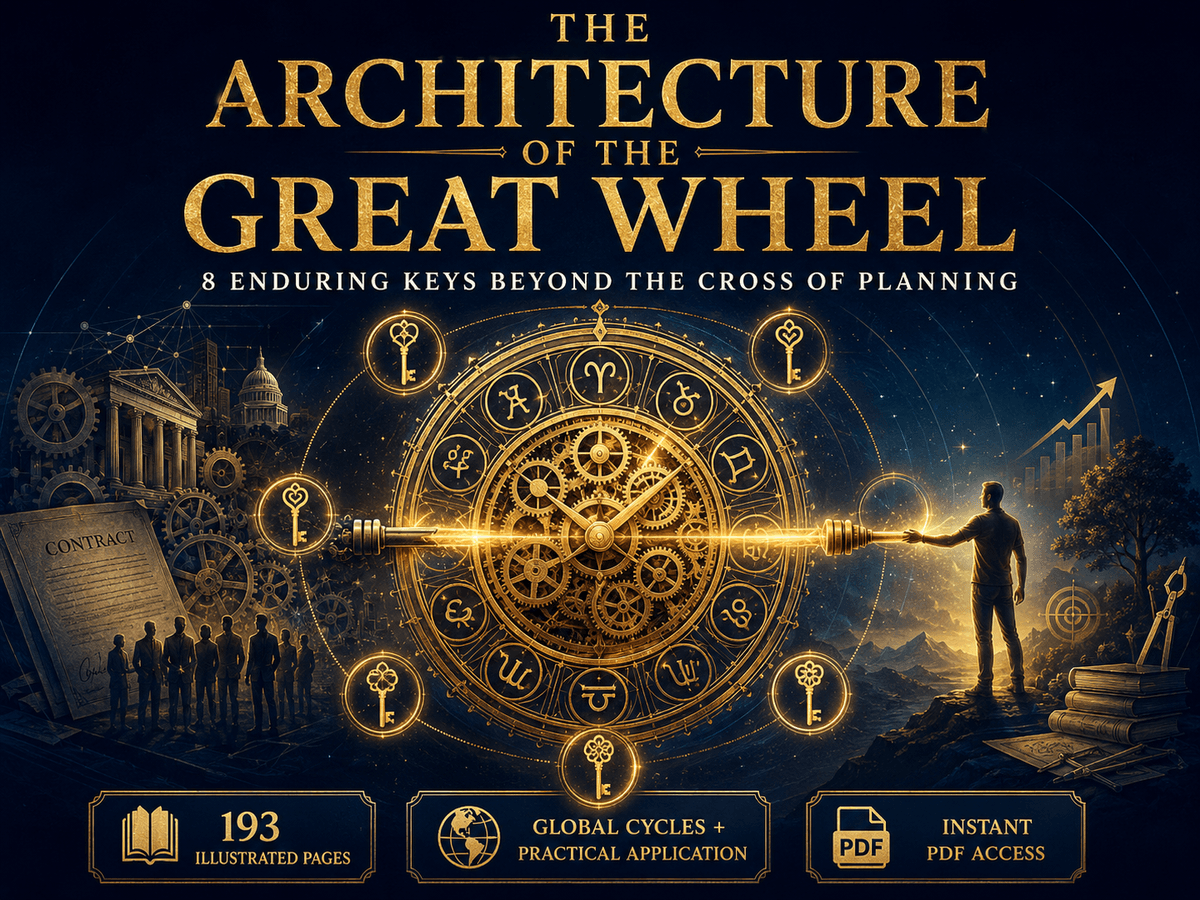
The Architecture of the Great Wheel is a 193-page illustrated study of the Cross of Planning era and the practical principles worth carrying into the next phase of human development.
Rather than treating 2027 as a prediction of automatic collapse or salvation, this book examines it as a transition in the background conditions surrounding community, institutions, agreements, leadership, work, resources, and individual responsibility.
Its central question is practical:
What did the Planning era teach humanity, and how can we preserve its strongest principles as collective structures change?
What You’ll Receive
• A 193-page illustrated PDF
• A structured examination of the Cross of Planning era
• Eight essential Gates and their practical applications
• Lessons concerning contracts, work, value, focus, leadership, and completion
• Historical and Human Design perspectives on global cycles
• Guidance for translating collective-era wisdom into personal capacity
• Visual diagrams and mechanical illustrations
• Immediate digital access
The Transition Beyond the Cross of Planning
The Cross of Planning is associated within Human Design with themes such as:
• Community and mutual support
• Social agreements and bargains
• Institutions and organized systems
• Work, contribution, and distribution
• Family, tribe, and material continuity
• Planning for collective security
This book explores what may happen as those themes become less reliably supplied by the larger background field.
The objective is preparation through awareness.
Instead of waiting for institutions, employers, communities, or systems to provide every layer of stability, the reader is encouraged to strengthen personal judgment, practical capability, trustworthy relationships, and durable agreements.
The Eight Essential Keys
Gates 37 and 40: The Architecture of Agreement
Explore the relationship between community, labor, loyalty, rest, responsibility, and the bargain.
This section examines how agreements can become clearer, more voluntary, and more sustainable when expectations are directly stated.
Gate 32: The Instinct for Continuity
Study the instinct for recognizing what possesses long-term value.
This key explores preservation, legacy, risk, endurance, and the discernment required to support what can survive changing conditions.
Gate 9: The Power of Focus
Examine concentration, attention, detail, and the disciplined power of small steps.
This section shows how sustained focus supports meaningful progress when the wider environment feels scattered or uncertain.
Gate 10: The Conduct of the Self
Explore behavior, self-respect, embodied alignment, and the way individual conduct establishes credibility.
Gate 62: Leadership Through Detail
Study facts, language, naming, evidence, and precise communication.
This section presents clarity as a leadership asset in an era crowded with speculation, exaggeration, and emotional noise.
Gate 42: The Power to Complete
Explore growth through full cycles.
This key examines completion, maturation, release, and the value of finishing one developmental process before pursuing another.
The remaining keys are integrated into the book’s broader treatment of work, contracts, focus, continuity, leadership, and preparation.
From Collective Support to Personal Capacity
The value of this transition is not found in rejecting everything built during the Planning era.
It is found in harvesting what worked.
The book encourages readers to convert collective-era lessons into forms of personal and relational strength:
• Clear agreements
• Reliable skills
• Focused execution
• Discernment about value
• Responsible leadership
• Completion of commitments
• Practical collaboration
• Long-term stewardship
These capacities can support individuals, families, businesses, and communities regardless of how quickly external structures evolve.
What This Book Helps You Examine
• The mechanics associated with the Cross of Planning
• Why contracts and bargains matter
• The relationship between work and reciprocity
• How institutions shape expectations
• What greater individual responsibility may require
• How to preserve useful systems while updating their application
• Why facts, focus, and completion become increasingly valuable
• How to build stability through skills, agreements, and trusted relationships
Who This Book Is For
This book is ideal for:
• Human Design students and teachers
• People studying the Global Cycles
• Business owners and independent professionals
• Community and faith leaders
• Families considering long-term preparation
• Readers interested in contracts, work, leadership, and legacy
• Anyone seeking a practical framework for the years surrounding 2027
Use This Book To
• Deepen your understanding of the Cross of Planning
• Create clearer personal and professional agreements
• Evaluate which skills and systems deserve preservation
• Strengthen your approach to focus and completion
• Develop more precise leadership language
• Build discussions, classes, or workshops around the Global Cycles
• Translate advanced Human Design material into practical action
Why This Book Is Different
Many resources describe what Human Design says may change around 2027.
The Architecture of the Great Wheel focuses on what can be learned, preserved, and applied.
This is an illustrated transition manual for readers who value preparation over panic and practical responsibility over passive prediction.
The Planning era produced powerful lessons concerning cooperation, agreements, specialization, institutions, and continuity.
The next task is to carry those lessons forward in forms suited to a more individualized environment.
Instant Digital Access
Your purchase includes the complete 193-page book in PDF format for immediate download.
Download The Architecture of the Great Wheel and begin converting the lessons of the Planning era into durable personal, relational, and practical capacity.
$47
$47