
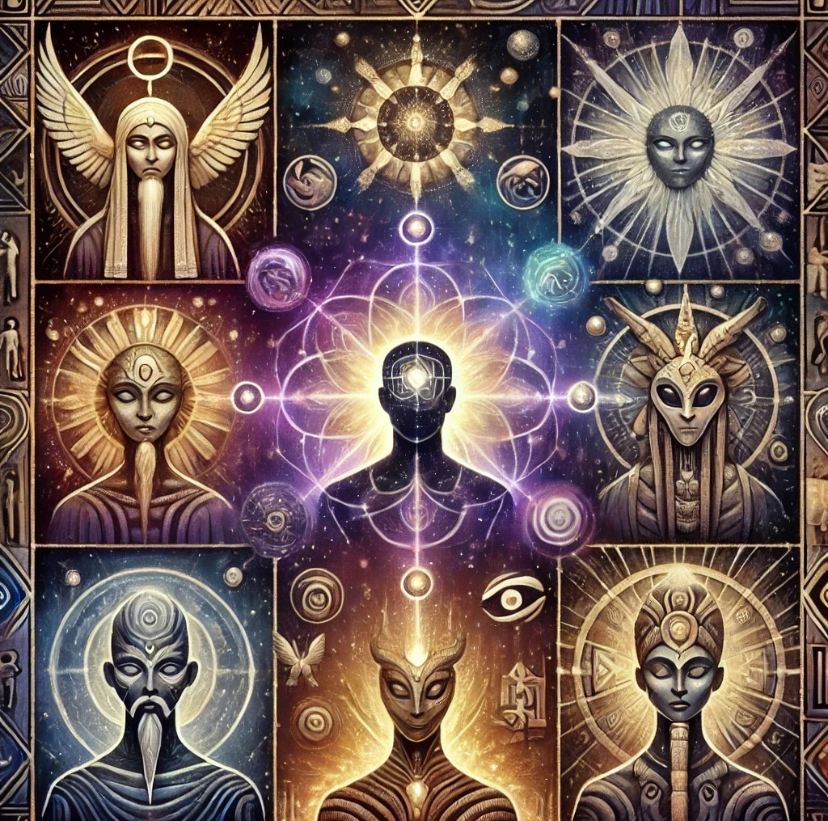
From a very mystical perspective within the Human Design knowledge, we have what's called angels, demons, ghosts, gods, entities, and aliens as the six archetypes for spiritual triggers and encounters. Every kind of encounter that someone has falls into one of these six archetypes. What Ra Uru Hu said is that everyone has the potential to be triggered and made aware of these forces, leading to a harmonic encounter that brings about a certain education about oneself and these forces. Each of us resonates with one of these archetypes based on our personality color imprint.
He explained that people with the first, second, or third color should understand that if they share their encounters, which involve what we would classify as angels, demons, and ghosts (the first, second, and third colors), they are inviting those personality crystal bundles—legions of Souls— back into their aura.
These personality crystal bundles are large groupings of souls from humans that have died but have not transcended to their soul family. They can also be souls that never incarnate, or a mixture of both. Without the magnetic monopole, which is the spirit—the driver attached to them—these souls are unable to move and navigate at will. They tend to drift with the forces and may attach themselves to certain locations, just as they do with people.
He explained that people with the first, second, or third color should understand that if they share their encounters, which involve what we would classify as angels, demons, and ghosts (the first, second, and third colors), they are inviting those personality crystal bundles back into their aura. Due to the neutrino stream constantly passing through, there would be a consistent interaction and influence from these forces on the individual's life. It's not inherently good or bad; it simply has a certain effect.
On the other hand, those with the fourth, fifth, and sixth colors—associated with gods, entities, and aliens—do not summon these forces into their space when they share their encounters, and there is no ongoing influence on them moment to moment. Often, sharing these encounters can help those around them become more aware. In this way, Ra Uru Hu encouraged individuals with the fourth, fifth, and sixth color personality motivations to share their encounters whenever it feels correct. Conversely, he advised those with the first, second, and third color personality motivations to exercise the utmost discernment, even suggesting that they refrain from sharing, though he acknowledged that for some, it could be correct.
What I found below resonated with me—it was very interesting, so I decided to share it.
“A dybbuk in Jewish culture is a malevolent spirit believed to be the dislocated soul of a deceased person who, due to their sins or unfinished business, has been unable to move on to the afterlife. In Jewish folklore, the dybbuk is thought to attach itself to a living person, often causing harm or distress to the host.
The concept of the dybbuk originates from Kabbalistic teachings and Jewish mysticism, where it is described as a restless soul seeking refuge in a living body. The word "dybbuk" comes from the Hebrew root d-b-k, which means "to cling" or "to adhere," reflecting the idea that the spirit clings to the person it possesses.
The belief in dybbuks became particularly prominent in Eastern European Jewish communities in the 16th and 17th centuries, with tales of possession becoming a part of Jewish folklore. The possessed individual might display strange behaviors, speak in voices not their own, or exhibit other signs of spiritual disturbance.
In such cases, a rabbi, often one knowledgeable in Kabbalah, would be called upon to perform an exorcism ritual known as "pidyon nefesh" (redeeming the soul) to drive the dybbuk out of the afflicted person's body and help the spirit find peace.
The dybbuk remains a powerful symbol in Jewish culture, representing themes of guilt, unresolved issues, and the consequences of sin. It has also found its way into literature, theater, and film, most famously in the Yiddish play "The Dybbuk" by S. Ansky, which further popularized the concept in both Jewish and broader cultural contexts.”