

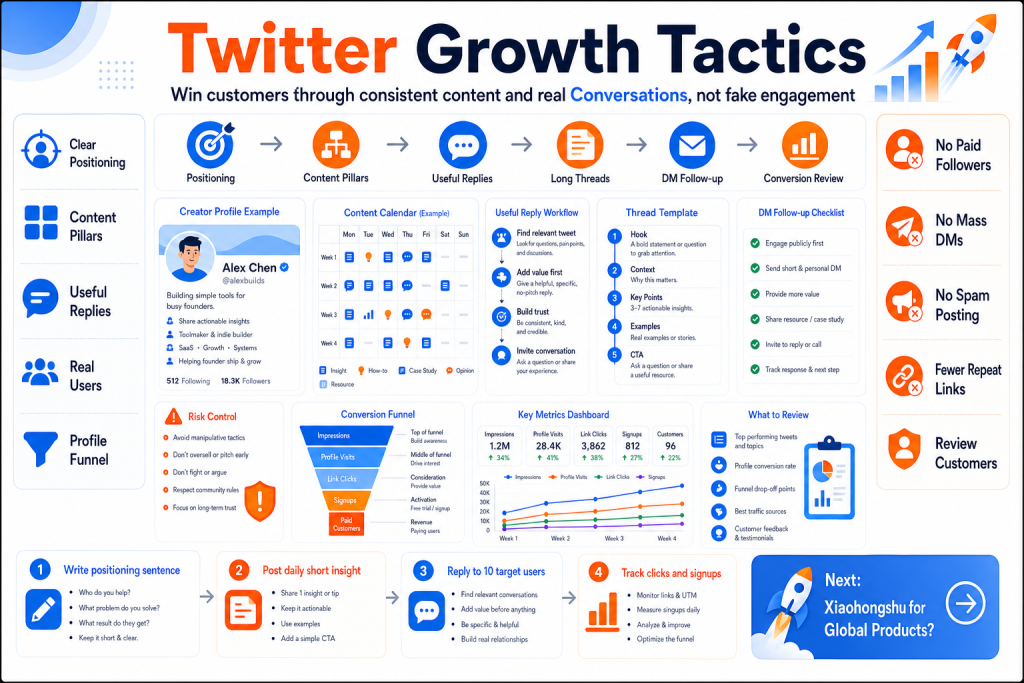
Twitter / X customer acquisition is not posting generic motivation every day.
It is not buying followers, engagement swapping, mass DMing, or hijacking trending hashtags.
For indie founders, X works best as a public notebook. You show how you solve problems, attract people with similar problems, and build trust with potential users.
When it works, it can create:
Early users
Product feedback
Partnerships
Content distribution
Personal brand
Sales leads
This article references official X materials:
You Are Not Only Growing an Account
Many founders define X growth as:
Followers
Likes
Reposts
Impressions
Viral posts
These metrics can help, but they are not the real goal.
The real goal is:
Be seen by target users
Be trusted by target users
Make target users want to try the product
Make target users willing to give feedback
Make target users remember you when the problem appears
If you have many followers but no one tries the product, growth is weak.
If you have fewer followers but weekly conversations, trials, and customers, the channel is working.
Write Your Positioning Sentence
Before posting, write one sentence:
I help [who] solve [problem] through [product or experience].Examples:
I help B2B founders find their first 100 customers with cold email.
I build a tool that helps job seekers tailor resumes to job descriptions.
I document how indie founders get early users from SEO and communities.
Clear positioning makes content easier to focus.
Your avatar, bio, pinned post, and topics should support that sentence.
Otherwise, visitors do not know who you are or why they should follow.
Use No More Than Three Content Pillars
Do not post everything.
Choose two or three pillars:
Product building process
User problems and cases
Industry playbooks
If you build an SEO tool, you can post about:
How you design keyword features
Common SEO mistakes users make
SEO case studies and tutorials for indie sites
Stable themes matter more than occasional viral posts.
Algorithms change. Audience memory comes from repeated clarity.
What Good Content Looks Like
For founders, useful content is usually concrete process, not abstract advice.
Post about:
A user pain point you found today
An onboarding step you changed and what happened
Why you removed a feature
How you wrote a landing page headline
What you learned from 20 user interviews
A free template and how to use it
Post less of:
Startups are hard but keep going
AI will change everything
Execution is everything
Improve 1% every day
These ideas are not always wrong. They are just low-density.
People follow you because you help them understand a specific problem.
Build a Content Funnel
X content has three layers:
Short posts: opinions, findings, cases, questions
Long posts: tutorials, postmortems, checklists, frameworks
External assets: articles, tools, templates, product pages
Short posts maintain presence.
Long posts build expertise.
External assets capture conversion.
Do not add a link to every post.
X’s account behavior best practices warn that repeatedly posting links without commentary can degrade search experience and may be considered spam behavior.
Better:
Explain the core value inside the post
Add links only when they extend the content
Make the link highly relevant
Avoid repeating the same link again and again
Replies Work Better Early
If you are starting from zero, standalone posts may get little reach.
Replying to target users and related creators is often better.
But replies are not a visibility hack.
Good replies:
Add a case
Give concrete steps
Point out an edge case
Share real data
Ask a sharp question
Make the original idea more specific
Weak replies:
Great post!
Totally agree!
Check my tool.
DM me.
X’s policies restrict repeated, unsolicited, high-volume replies, mentions, and direct messages.
So do not automate mass commenting.
You do not need more replies. You need replies with more signal.
Use DMs Carefully
DMs can create customers, but they can also feel like harassment.
Do not mass-send:
Hi, I built an amazing tool...
Can you try my app?
Would you like to book a call?
Better DMs usually follow a public interaction:
You mentioned an onboarding issue earlier. I have run into the same problem.
I put together a small checklist. Happy to send it if useful.
Principles:
Contribute publicly first
Follow up privately only when useful
Send a link only after clear interest
Do not pressure the person
If a DM sounds like a sales script, it usually will not work.
Avoid These Risks
X’s Authenticity policy prohibits inauthentic accounts, behaviors, or content that manipulate the platform or disrupt services.
Founders should avoid:
Creating multiple accounts to like or repost each other
Mass replies or mentions to strangers
Bulk unsolicited DMs
Hijacking trending hashtags for traffic
Posting many links without commentary
Copy-pasting identical posts
Posting and deleting the same content repeatedly
Buying engagement from third-party services
Running AI reply bots without required approval
These tactics may look like growth in the short term.
Long term, they damage trust and reduce the quality of your learning.
Fake engagement cannot tell you whether the product is valuable.
A 30-Day Execution Plan
Use this plan:
Days 1-3: write positioning, improve bio and pinned post
Days 4-7: list 50 target users and creators
Days 8-14: publish one short post daily and write 10 useful replies
Days 15-21: publish two long posts and create one template or checklist
Days 22-27: turn winning posts into articles, landing pages, or emails
Days 28-30: review follows, replies, clicks, signups, and conversations
Do not chase virality at the beginning.
Build a reliable rhythm first.
The hard part is not one viral post. It is making the right people repeatedly understand what problem you solve.
Turn Content Into Customers
Content is not automatically customer acquisition.
You need a path:
Put a clear product link in your bio
Use the pinned post to explain the problem you solve
Give a natural next step at the end of long posts
Answer specific questions in comments
Move high-intent conversations to DMs
Use the landing page to capture trials or signups
Use email to educate and convert
Do not turn every post into a sales page.
But when someone is interested, the next step should be easy to find.
That is the difference between content and acquisition.
What to Review
Do not only track likes.
Track:
Which topics bring follows
Which topics bring replies
Which topics bring profile visits
Which posts bring clicks
Which clicks become signups
Which conversations become customers
Which phrases should be reused on the landing page
Some posts get few likes but create high-quality DMs.
Some posts get many likes but no conversion.
You are looking for business signal, not noise.
A Simple Content Template
Reuse this:
I noticed a problem:[specific situation]
The common mistake is:
[wrong approach]
A better approach:
[step 1]
[step 2]
[step 3]
I am using this to improve: [product / page / workflow]
This works for short posts and can expand into long posts.
The key is to be specific, honest, and useful.
Summary
X acquisition is about trust and distribution, not fake engagement
Define positioning and publish around two or three content pillars
Replies are more useful than standalone posts early on
Give value in the post before adding links
DMs should follow public interaction and clear interest
Avoid mass replies, copypasta, paid engagement, and unauthorized automation
Review signups, conversations, and customers, not only likes
Next, we will cover whether Xiaohongshu works for global products.