
A while ago, I spent around $70 (500 RMB) on a six-character domain:bbs.ss
After buying it, I kept asking myself:
What should I actually build with it?
A directory? Another AI tool? A small SaaS? Or just keep the domain and forget about it?
Eventually, I decided to build something that almost feels old-school in 2026:
A forum.
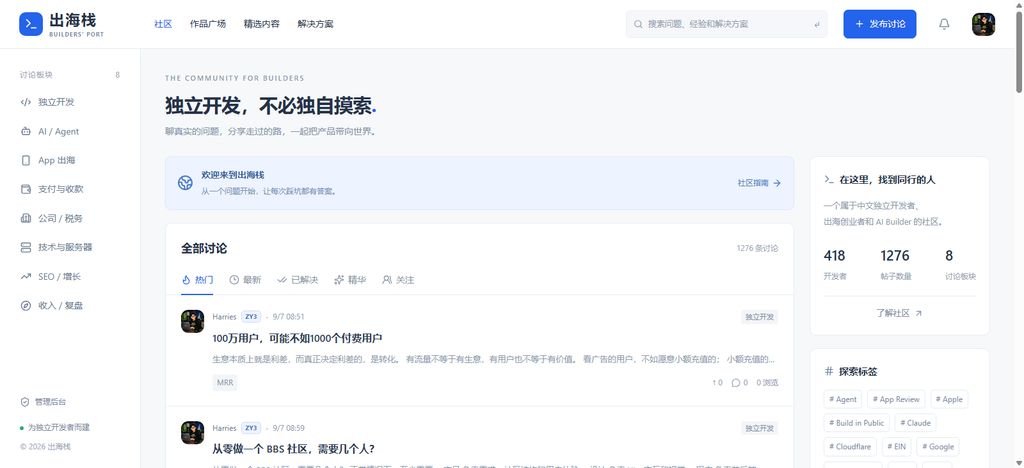
That became Chuhai Stack, a Chinese community for indie hackers, AI builders, and developers building products for global markets.
Why build a forum in 2026?
Everyone is building AI products right now.
AI SaaS, agents, coding tools, search engines, wrappers, automation products…
Compared with all of that, building a traditional BBS sounds almost outdated.
But after building products myself, I’ve realized something:
We don’t have an information problem. We have a knowledge retention problem.
Building and launching products globally involves hundreds of small problems.
Why did Apple reject my app again?
How do I get production access on Google Play?
Should I use Stripe or PayPal?
How do I handle international payments?
Why isn’t Google indexing my site?
Which hosting provider should I use?
How do I get my first 100 users?
How do I deal with an App Store subscription rejection?
You can ask AI all of these questions.
I do it every day.
But sometimes the most useful answer isn’t generated from documentation.
It’s someone saying:
“I had exactly the same problem last week. Here’s what actually worked.”
That kind of experience is incredibly valuable.
And I wanted a place where those experiences could stay searchable instead of disappearing inside a group chat.
That’s why I started building Chuhai Stack.
What is Chuhai Stack?
The focus is simple:
Indie hacking + AI + building globally.
It’s not supposed to be a forum about everything.
I want it to be a place for people who are actually building things.
Developers can share how they built their products.
Indie hackers can document their journey from zero to their first paying customer.
People can discuss AI coding, hosting, databases, payments, App Store reviews, Google Play, SEO, growth, domains, and all the annoying little problems that come with launching globally.
I’d rather read:
“My app was rejected by Apple three times. Here’s what finally got it approved.”
than another article titled:
“10 Secrets to Building a Million-Dollar SaaS.”
Success stories are useful.
But failure logs and real troubleshooting are often even more useful.
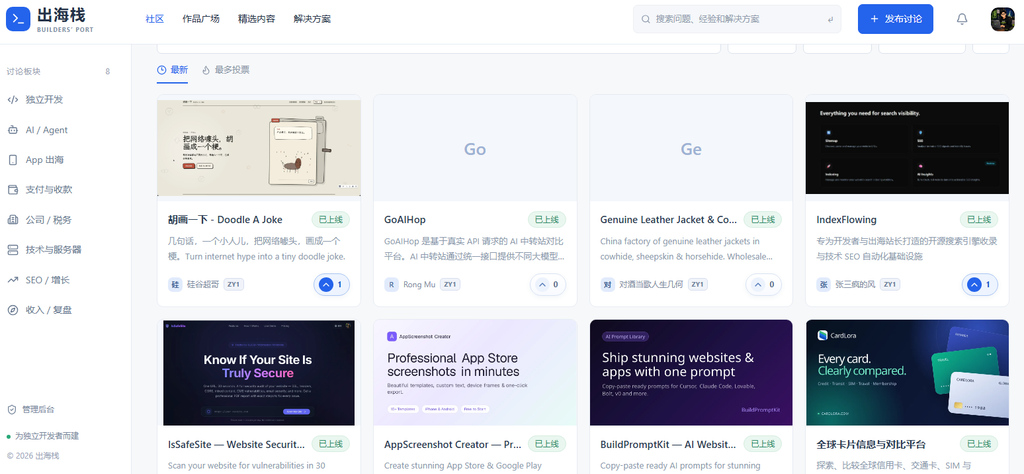
I also built a product showcase
One problem indie developers constantly face is distribution.
You spend weeks building something.
Then you launch it.
You post it on X.
Maybe a few people see it.
You drop it into a group chat.
Two hours later, the link is buried under hundreds of messages.
So I added a product showcase to bbs.ss.
If you’ve built an app, website, SaaS, AI tool, open-source project, or even a small MVP, you can share it with the community.
It doesn’t need to be profitable.
It doesn’t need thousands of users.
It doesn’t even need to be finished.
I believe:
Shipping something is already worth sharing.
Eventually, I’d love to see builders use the forum to document the entire life of a product:
Idea → MVP → first user → first dollar → growth → failure or success.
That journey is often much more interesting than the final landing page.
The team: me, Claude, and Codex
Normally, building a community product involves several roles:
Product, design, frontend, backend, infrastructure, and operations.
For bbs.ss, there was just me.
Well, almost.
My other two “teammates” were:
Claude and Codex.
I decided what to build and how I wanted the product to work.
Then I worked with AI to implement it.
Frontend.
Backend.
Database.
UI.
Bugs.
Deployment.
Feature after feature.
This project made something very clear to me:
AI coding has fundamentally changed what one person can build.
A few years ago, the biggest question for a solo developer was often:
“Can I actually build this?”
Today, the question is increasingly:
“What should I build?”
The cost of implementation is dropping dramatically.
One person can now ship things that previously required a small team.
But coding turned out to be the easy part
Claude and Codex can help me write code.
They can fix bugs.
They can build features.
They can refactor terrible code at 2 AM.
But they can’t solve the biggest problem every new community has:
Nobody is there.
A new forum is painfully quiet.
No posts.
No replies.
No discussions.
No culture.
AI can’t magically create a real community for you.
Someone still has to write the first post.
Someone has to reply to the first user.
Then you need the second user.
The tenth.
The hundredth.
That’s when I realized:
Building community software and building a community are two completely different things.
The first one is becoming much easier because of AI.
The second one is still very human.
I don’t want another spam community
I’ve joined plenty of online communities over the years.
Many start out great.
Then gradually they become filled with promotions, courses, referral links, copy-pasted AI content, and people dropping links without contributing anything.
I don’t want Chuhai Stack to become that.
I’m completely fine with self-promotion.
In fact, I want builders to promote their products.
But tell us the story behind the product.
Why did you build it?
What stack did you use?
How did you get your first users?
How much did it cost?
What went wrong?
Did anyone actually pay?
What marketing channels completely failed?
Then share your product.
That’s useful.
Promotion isn’t the problem. Promotion without contribution is.
Why spend $70 on bbs.ss?
From a business perspective, I have no idea when I’ll make that $70 back.
Maybe soon.
Maybe never.
But I really like the domain.
bbs.ss
Short.
Memorable.
And it immediately feels like a forum.
We’re living through an era obsessed with building new things.
But I think some of the oldest parts of the internet still matter:
Forums.
Blogs.
Independent websites.
Personal pages.
Because their real value isn’t an algorithmic feed.
It’s accumulation.
A post might get only ten views today.
But if it solves a real problem, someone might discover it through Google six months later.
Two years later, another developer might find that same post and avoid spending three days debugging something.
That’s the kind of internet I still like.
$70 bought the domain. Now the real work begins.
I don’t know how big Chuhai Stack will become.
I’m not starting with some grand vision of building the next massive social network.
The goal right now is much simpler:
Build it, use it myself, and slowly make it useful.
I’ll document what I learn from indie development, AI coding, App Store submissions, payments, SEO, infrastructure, domains, and product distribution.
If eventually 100 builders genuinely share what they’re working on and what they’ve learned, I’ll consider it valuable.
If it becomes 1,000, even better.
So that’s the story.
$70 bought me bbs.ss.
Claude and Codex helped me build the product.
Now comes the much harder part:
Turning a website into a community.
If you’re building an app, SaaS, AI product, or trying to take your product global, come say hi:
And if you’ve already built something, share it.
Whether you have 1 user or 100,000 users, your journey is worth documenting.
Maybe one day, when a Chinese indie hacker runs into a problem while going global, they won’t just ask AI.
They’ll also think:
“Let me search bbs.ss. Maybe someone has already been through this.”