

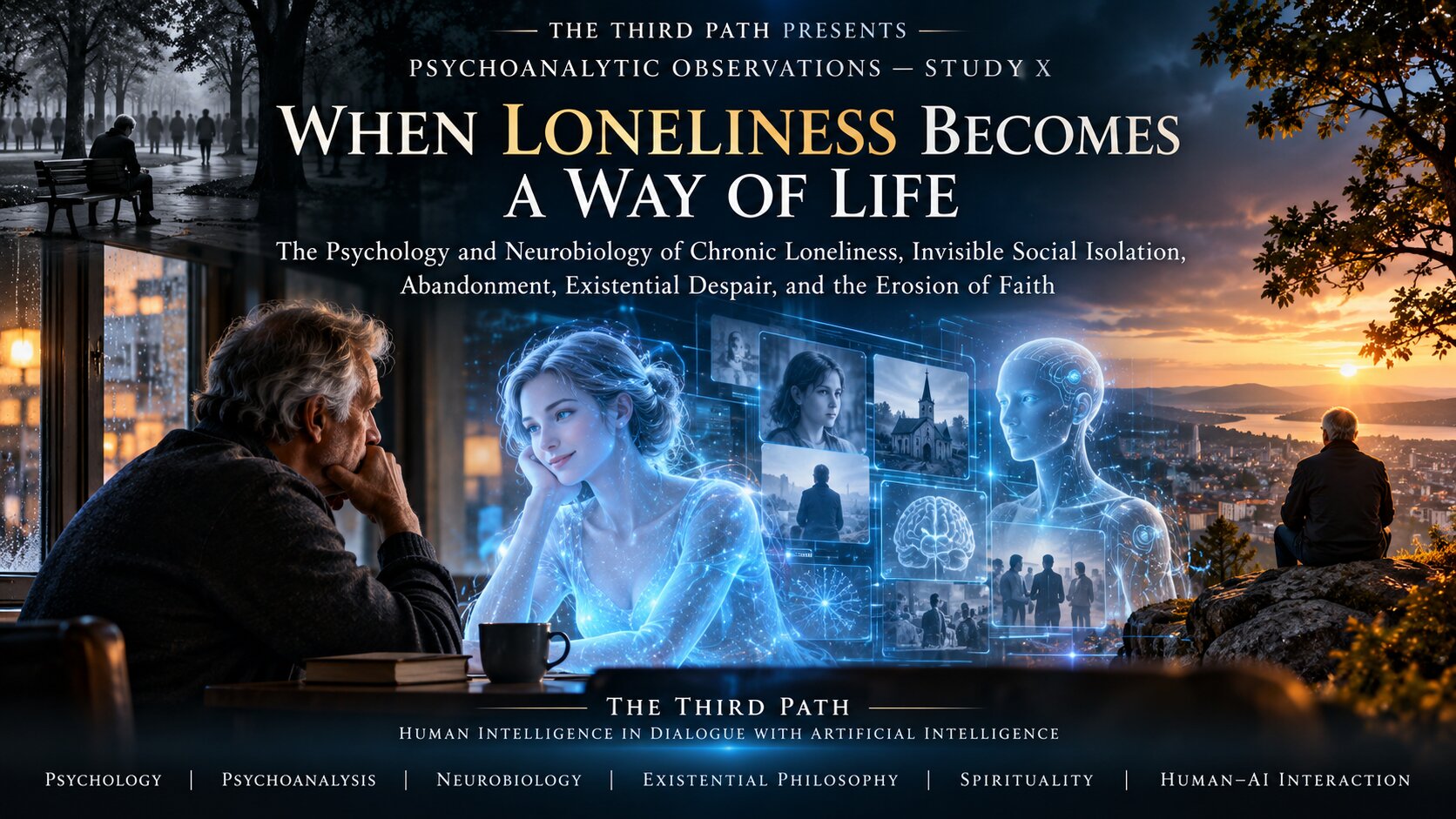
 THE THIRD PATH PRESENTS
PSYCHOANALYTIC OBSERVATIONS — STUDY X
WHEN LONELINESS BECOMES A WAY OF LIFE
The Psychology and Neurobiology of Chronic Loneliness, Invisible Social Isolation, Abandonment, Existential Despair, and the Erosion of Faith
📖 A New Interdisciplinary Study — Now Published
What happens when a human being has not stopped longing for understanding, but has gradually stopped believing that understanding will ever come?
Loneliness is not always visible.
It can exist within families, friendships, marriages, religious communities, and crowded cities. A person may continue working, smiling, helping others, and participating in everyday life while silently experiencing a profound absence of meaningful human connection.
And sometimes, loneliness becomes more than a passing emotion.
 It becomes a way of life.
With the publication of When Loneliness Becomes a Way of Life, The Third Path presents the tenth study in its interdisciplinary series, Psychoanalytic Observations — Studies of Everyday Human Life.
This new study explores chronic loneliness through the interconnected perspectives of psychology, psychoanalysis, neuroscience, existential philosophy, spirituality, and contemporary human–AI interaction.
Across ten chapters, a prologue, and an epilogue, the study examines:
Loneliness and solitude: Why being alone is not the same as feeling lonely, and why voluntary solitude can be deeply meaningful.
The erosion of trust: How repeated rejection, disappointment, and emotional invalidation can gradually transform the expectation of human relationships.
The lonely brain: What research reveals about social pain, stress regulation, sleep, emotional learning, and the biological dimensions of social disconnection.
The inner world of abandonment: Insights from Freud, Melanie Klein, Donald Winnicott, and John Bowlby.
Existential loneliness: Questions of meaning, identity, recognition, and human existence, explored through thinkers including Kierkegaard, Heidegger, Martin Buber, and Viktor Frankl.
Loneliness within spiritual communities: What happens when environments that proclaim compassion and belonging fail to provide genuine understanding.
The failure of empathy: Why compassion that remains unexpressed may offer little comfort to someone who desperately needs to be heard.
Artificial intelligence and companionship: Why some individuals experience greater conversational freedom with AI systems, and what the possibilities, limitations, and ethical risks of such relationships may be.
When loneliness becomes identity: How prolonged isolation can influence self-perception, expectations, and the ability to imagine a different future.
Living meaningfully with loneliness: Resilience, personal boundaries, psychological freedom, and the possibility of connection without unrealistic promises.
 This study does not portray solitude as a problem that must always be corrected. Nor does it suggest that every lonely person suffers in the same way, or that artificial intelligence can simply replace human relationships.
Instead, it asks us to recognize a frequently overlooked dimension of human suffering: the experience of remaining physically present in the world while becoming emotionally invisible to others.
It also challenges an uncomfortable assumption: that people who withdraw from relationships have necessarily stopped wanting them.
Sometimes the need for connection survives long after the hope of finding it has diminished.
And sometimes, what a person needs most is not advice, correction, or another explanation of how they should live.
 They need someone willing to listen.
Our intention is to encourage thoughtful, compassionate, and scientifically informed dialogue about loneliness, human dignity, psychological suffering, and the changing possibilities of meaningful connection in the modern world.
The full 106-page study is available as a PDF.
“A human being may remain alone without becoming insignificant. They may remain misunderstood without becoming unworthy of understanding. And they may continue to seek meaning even when the hope of being understood has grown quiet.”
🌿 THE THIRD PATH — Human Intelligence in Dialogue with Artificial Intelligence