

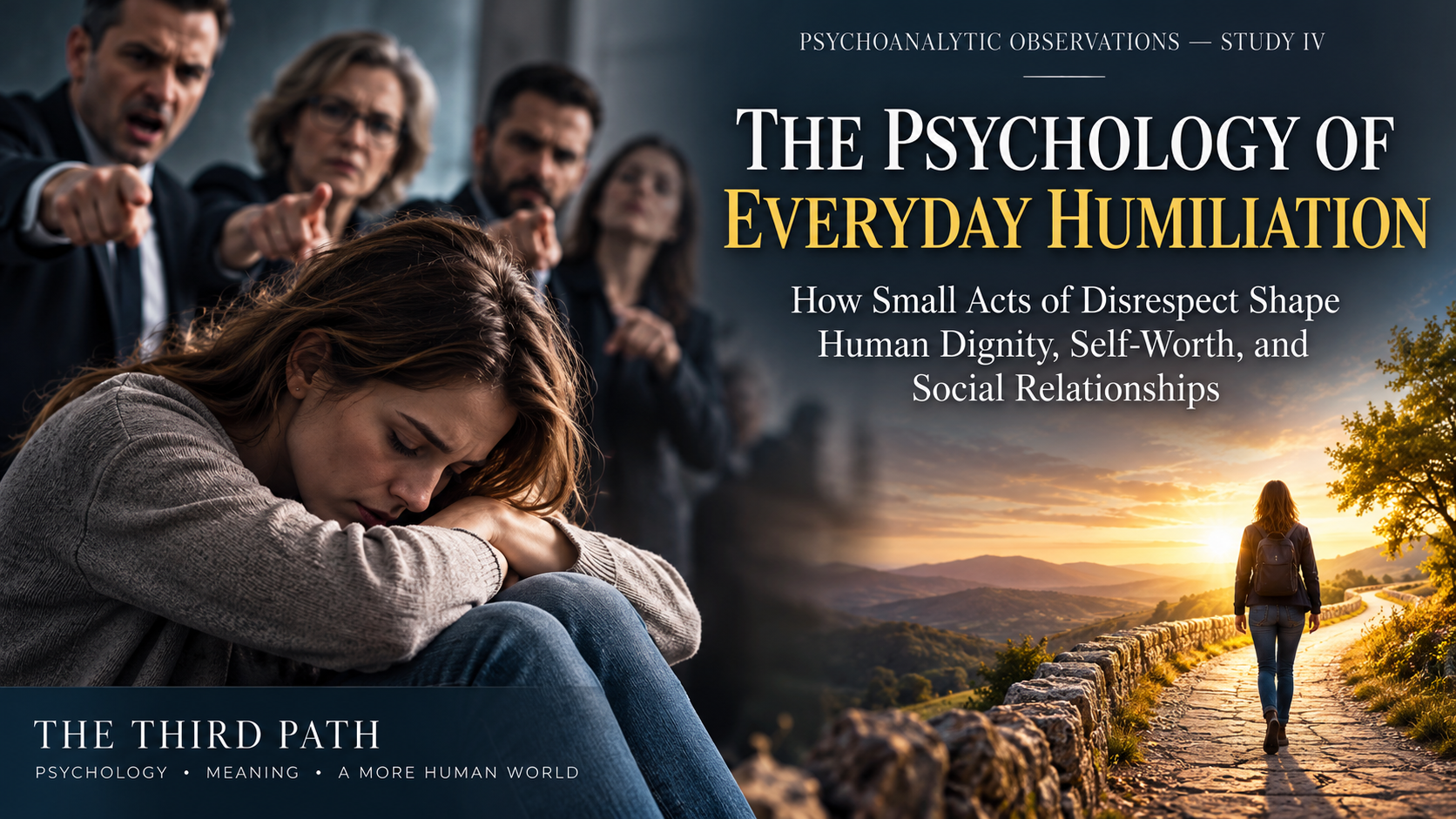
 NEW PUBLICATION | THE THIRD PATH
PSYCHOANALYTIC OBSERVATIONS — STUDY IV: THE PSYCHOLOGY OF EVERYDAY HUMILIATION
How Small Acts of Disrespect Shape Human Dignity, Self-Worth, and Social Relationships
Not every psychological wound is caused by an extraordinary event.
Sometimes, it begins with a dismissive remark, a mocking smile, a humiliating comparison, or a judgment spoken by someone who believes that authority gives them the right to diminish another human being.
Humiliation can occur almost anywhere: within families, schools, workplaces, friendships, and even communities founded upon ideals of compassion, morality, and spiritual development.
But what happens when these seemingly ordinary experiences become repeated patterns of disrespect?
How do humiliation and shame affect our sense of self-worth? Why do some people use knowledge, status, or authority to establish superiority over others? Why do witnesses remain silent? And what happens in the brain and body when social relationships become sources of persistent threat?
Our fourth study in the series Psychoanalytic Observations — Studies of Everyday Human Life explores these questions through psychology, social psychology, neuroscience, and the study of human relationships.
Across eight chapters, we examine the invisible wounds of humiliation, the psychology of those who inflict it, the normalization of degrading behavior, the silence of bystanders, the possible consequences of chronic social stress, and the pathways toward restoring personal dignity.
Particular attention is given to situations in which moral or spiritual authority is used to question another person's worth, invalidate personal experiences, or portray suffering as deserved punishment.
The study does not argue against criticism, responsibility, education, or legitimate authority. Instead, it asks whether these can exist without degrading the people they are meant to guide.
Because a person may be wrong without being worthless. A person may disagree without being inferior. And no difference in knowledge, status, or belief should erase another human being's dignity.
We invite readers to explore this new study and reflect upon a question that concerns us all:
How often do we recognize humiliation when it appears not as open cruelty, but as ordinary human behavior?
📖 Read the full study in PDF format
🌿 THE THIRD PATH
Human Intelligence in Dialogue with Artificial Intelligence