

Introduction
The burial mound at Gokstad in Vestfold, Norway, yielded an extensive assemblage of finds. However, the limited documentation of the excavation, undertaken by Nicolay Nicolaysen in 1880, considerably restricts attempts to reconstruct the original arrangement of the burial, particularly within the disturbed burial chamber. This also complicates the interpretation of many of the finds, whose original functions are difficult to establish. Without sufficiently close archaeological parallels, the purposes of some of these objects and the ways in which they were used are likely to remain uncertain. Among the finds from the mound are two particularly intriguing objects that appear to have attracted little scholarly attention: two miniature axes, differing in form and material and recovered from separate contexts within the burial mound. Their presence in such a richly furnished elite burial makes them especially relevant to the study of miniature axes in Viking Age Scandinavia, particularly examples that were not intended to be worn as jewellery. The Gokstad finds thus deserve closer consideration, both as individual objects and for what their occurrence in this burial may contribute to our understanding of the use and significance of miniature axes of this kind.
The Axes from Gokstad
The two miniature axes were found in different locations within the burial mound. One of them, made of wood, was found inside a large stave-built vessel in the forward part of the ship, on the port side, between the hull and a copper cauldron. The vessel contained wood chips and larger pieces of wood together with numerous wooden objects, including parts of other containers, boards bearing cutting marks, plates, and several small implements. Nicolaysen lists the axe last among its contents, describing it as a small, finely carved object of oak, with a form characteristic of the Late Iron Age and the lower part of its haft broken off (Nicolaysen 1882, 43–44). He provides no measurements but illustrates the axe (Nicolaysen 1882, pl. IX:9). The blade profile of the wooden axe most closely resembles Petersen’s Type E, whose E1 and E2 variants date to c. AD 850–1025 (Hjardar and Vike 2011, 161). This range is consistent with the chronology of the Gokstad burial, as dendrochronological analysis places the construction of the burial chamber at around AD 900, probably within the period AD 900–905 (Bonde and Christensen 1993, 582).
No record of the wooden miniature axe from Gokstad has been located in the online database of the Kulturhistorisk Museum in Oslo, nor have any photographs been identified. The approximate dimensions of the wooden axe were estimated from Nicolaysen’s illustration (pl. IX:9), using the known dimensions of the gaming piece depicted on the same plate (pl. IX:6), as recorded in the UniMus catalogue, as a reference. The head appears to have measured about 4.5 cm in length and 4.4 cm in height, while the haft measured approximately 1.3 × 0.9 cm in cross-section. Since the lower part of the haft was missing, neither its original length nor any further changes in its shape, such as possible tapering towards its end, can be established. The surviving fragment shown in Nicolaysen’s drawing appears to have been approximately 7.5 cm long (Nicolaysen 1882, 43–44, pl. IX:9).
 Fig. 1. Wooden miniature axe from Gokstad. After Nicolaysen 1882, pl. IX:9. Digitised by the National Library of Norway.
The second miniature axehead, made of iron, was found outside the ship, on its port side, a short distance aft of the bow (Nicolaysen 1882, 52; Gansum 2024, 135). Nicolaysen records its length as 7.7 cm. The shaft hole measures 2.5 × 1.5 cm. He describes its form as characteristic of the Late Iron Age, specifically noting the projecting lugs that supported the haft. He also recorded two fragments of reindeer antler lying slightly farther aft, one showing signs of initial working. No surviving haft is mentioned, and Nicolaysen offers no interpretation of the axehead’s function (Nicolaysen 1882, 52). The blade profile of the iron axehead most closely resembles Petersen’s Type G, dated mainly to c. AD 825–925 (Hjardar and Vike 2011, 161). This range is likewise consistent with the date of the Gokstad burial.
 Fig. 2. Iron miniature axehead from Gokstad (C10426). Photograph: Olav Heggø, Kulturhistorisk museum, UiO. UniMus catalogue, CC BY-SA 4.0.
Figure 3 shows reproductions of both axes at their original size, based on the recorded dimensions of the iron axehead and measurements estimated from Nicolaysen’s scaled drawing for the wooden axe. As the wooden axe’s haft survives only in part and the iron axehead has no surviving haft, the reconstructed lengths are only interpretations.
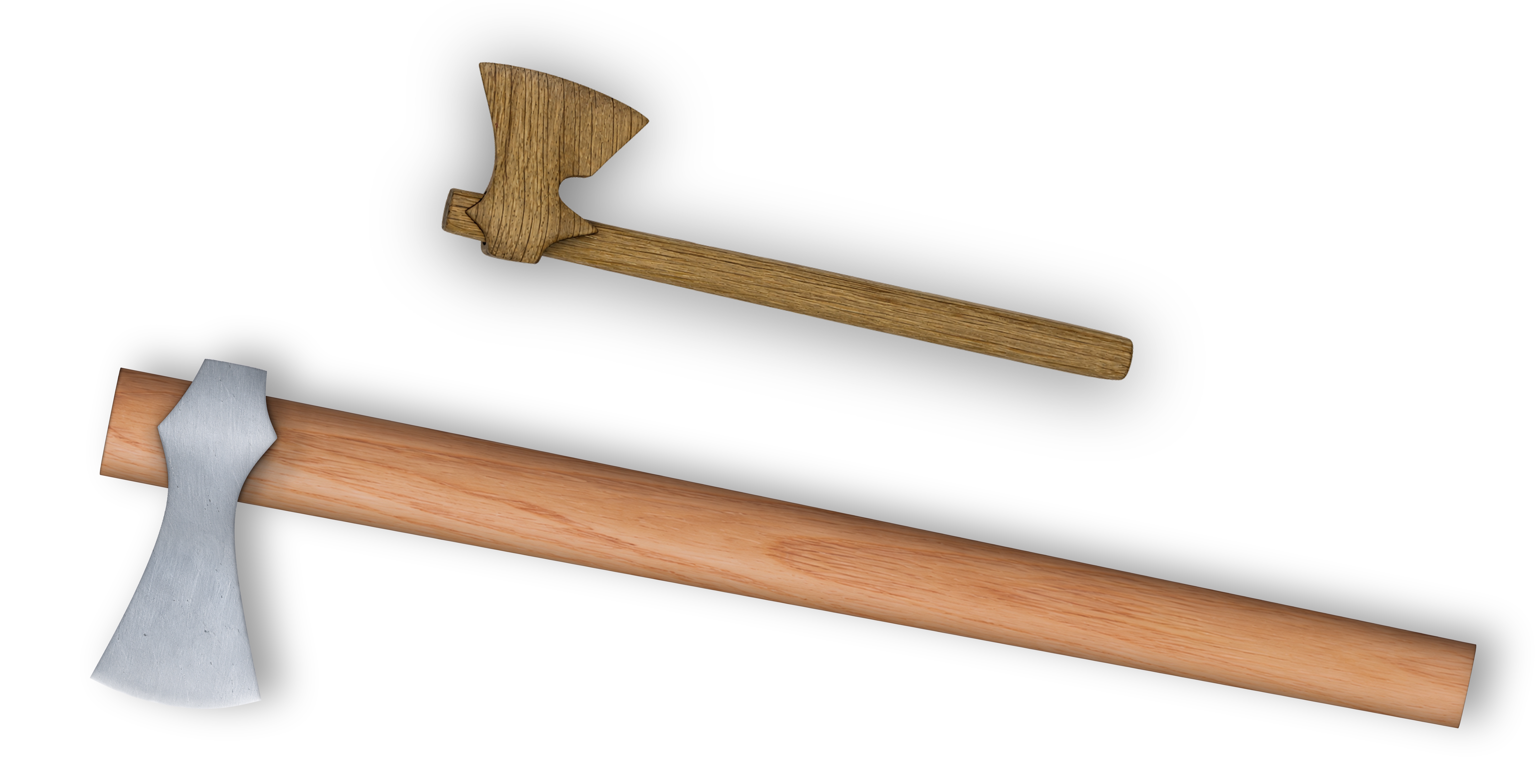 Fig. 3. Reconstructions of the two miniature axes from Gokstad. Above: wooden axe, reconstruction made and photographed by the author. Below: iron axe, digital reconstruction by the author. The original lengths of the hafts are unknown; those shown are hypothetical.
Possible Functions of the Gokstad Axes
The two axes from Gokstad require different sets of comparative material. The closest parallels for the iron axehead are small iron axes found in Norway. The wooden example, by contrast, calls for comparison with objects in which the form of an axe served purposes other than its conventional use as a cutting tool.
The main difficulty with small iron axes lies in distinguishing miniatures from small functional tools. Haakon Schetelig observed that Norwegian iron axeheads form a continuous range of sizes, making it difficult to draw a clear distinction between axes intended for practical use and objects requiring a different interpretation (Schetelig 1911, 9–10). Petersen adopted an approximate threshold of 10 cm in axehead length and compiled a group of fourteen examples, including one measuring 10.3 cm, suggesting that this boundary was not rigid. He did not consider all of them securely datable to the Viking Age, and information about their find circumstances was often limited or uncertain (Petersen 1951, 339–341). This size threshold therefore serves as a means of classifying the material rather than determining its function. The designation of the iron axe from Gokstad as a miniature refers here to its unusually small size compared with most Viking Age axes and does not rule out a practical function. Petersen’s survey included examples from Kleppe in Vågå (C25187/a), Villand in Hol (C26265/h), and Torshov in Gjerdrum (C822). Most of the objects he discussed were isolated finds, while the association of the remaining examples with grave assemblages was not always certain. Petersen considered Schetelig’s earlier suggestion that small iron axes might also have been used for craftwork. Ultimately, however, he favoured an interpretation of these objects as amulets (Schetelig 1911, 16–18; Petersen 1951, 339–341). The uncertain find contexts nevertheless limit the extent to which their functions can be established.
You can explore the distribution of miniature axes in Norway HERE.
 Fig. 4. Examples of miniature iron axes from Norway - (A) Sæl, Buskerud (C25255); (B) Bolken, Akershus (C30218/b); (C) Sjurderud, Innlandet (C33577); (D) Skjelve Vestre, Innlandet (C35939); (E) Kleppe Nordre, Innlandet (C25187/a); (F) Villand, Buskerud (C26265/h); (G) Torshov, Akershus (C822); (H) Hogganvik, Rogaland (C2101); (I) Korstad, Innlandet (C54655). Photographs: Olav Heggø (A, B, C, D, E, F, H), Ulla Schildt (G) and Eva Brænd (I), UniMus catalogue, CC BY-SA 4.0.
For the iron axe from Gokstad and comparable examples, the key question is whether their small size would have allowed them to be used for particular tasks. Assessing this requires consideration of the weight of the axehead, the shape and condition of its cutting edge, the way in which the haft was fitted, and any possible traces of use. The two fragments of reindeer antler found slightly farther aft, one of which showed signs of preliminary working, provide additional contextual evidence (Nicolaysen 1882, 51–52). This raises the possibility that the axe was used for small-scale antler working, although the recorded find circumstances are insufficient to establish that the axehead and antler fragments formed a tool-and-material assemblage.
The wooden axe raises a different question. Its form resembles that of an axe, but wood lacks the cutting properties of iron examples. Comparisons with toys, representations of weapons or tools, and objects incorporating the shape of an axe as part of dress are therefore more relevant when considering its possible function. Each of these parallels may help explain different aspects of the wooden object, but none should be assumed from the outset to provide the only valid interpretation.
One of the most plausible interpretations is that the wooden axe served as a toy. Wooden representations of weapons and tools in the Viking Age may have allowed children to imitate activities they observed adults performing, such as fighting or working (Raffield 2019; Gardeła 2019). The contents of the vessel in which the axe was found are also relevant in this context. Nicolaysen recorded fragments of larger objects and various small wooden items, some of which he described as resembling toys. He did not explicitly identify the axe itself as a toy, but his observation provides grounds for considering this possibility in light of its find context (Nicolaysen 1882, 43–44). A different comparison is offered by axe-shaped objects interpreted as dress pins. A copper-alloy example from Svingesæter has an integral, elongated shaft ending in a point. Gardeła (2026, 234–237) noted that its construction would have allowed it to fasten clothing, a function also demonstrated through experiments with a replica. Similar copper-alloy miniatures are known from Bjåland, Dublin, and Danish sites, while axe-shaped pins made of bone and antler have been found at sites including Hedeby (Schietzel 2022, 207–209).
These comparisons are relevant to the wooden axe from Gokstad only as examples of how the shape of an axe could be incorporated into a dress fastener. Since the lower part of its haft is broken off, it is unknown whether it originally ended in a point suitable for fastening fabric. The surviving portion does not allow this possibility to be confirmed or ruled out.
Discussion and Conclusion
The question remains why the two axes were placed in the grave and whether their inclusion reflected earlier use, personal significance to the deceased or the mourners, or some aspect of the funeral rites. An everyday object could have been selected as a grave good or used during the burial ceremony, acquiring significance beyond its original function.
As Gardeła (2026, 228–229, 240) has emphasized, the interpretation of miniature weapons requires careful consideration of their depositional contexts and associations with other objects. The iron axe from Gokstad may have been used for small craftwork. The nearby fragments of reindeer antler, one of which showed signs of working, lend some support to this possibility. However, it is not known whether these marks were made with the axehead in question. Its position outside the ship also raises the possibility of a connection with preparations for the burial. The axe could have been used during this work, deposited as a separate grave good, or employed in a ceremonial act. One of the more plausible interpretations of the wooden axe is that it served as a toy. This interpretation is supported by the fact that the axe is made of wood, as well as by its discovery in the same vessel as other small wooden objects, some of which may also have been toys (Nicolaysen 1882, 43–44). The absence of a recorded child burial in the Gokstad mound is relevant to this interpretation, but does not rule out such a function. The object may have been placed in the grave of an adult man as a keepsake or a gift from another person. It is also possible that it was a gift from one of the deceased's children, although the available evidence does not allow either the identity of the giver or their relationship to the man of Gokstad to be established.
Practical use, personal significance, and ritual functions need not have been mutually exclusive. A protective role for either axe may also be considered, but there is no evidence to support a specific amuletic function or an association with a particular deity. Nor does the elite character of the burial alone justify interpreting the axes as insignia (Jensen 2010, 43–45), particularly since neither was found directly beside the deceased in the burial chamber. The interpretation of the wooden miniature axe is further complicated by differences in the preservation of archaeological materials. The absence of close parallels for the wooden axe in the Scandinavian archaeological record does not necessarily mean that such objects were exceptional in the Viking Age. Similar objects may simply not have survived, making it difficult to establish how widespread they were or what purposes they served.
The two axes from Gokstad thus represent two distinct expressions of the axe form within a single elite burial. Their significance lies not only in their small size, but also in the different relationships between material, potential function, and depositional context. Further examination of the iron axehead and the working marks on the antler, together with locating and examining the wooden axe, could allow a more thorough assessment of the proposed interpretations. Regardless of their actual functions, the two miniature axes are also particularly significant as the only surviving objects from the Gokstad burial, apart from an arrowhead and the surviving shields (Nicolaysen 1882, 42–43, 62–63), that evoke weaponry. Full-sized weapons, which probably originally accompanied the deceased, were likely removed when the mound was plundered during the Viking Age (Bill and Daly 2012, 815).
Literature
Bill, J., and A. Daly. 2012. “The Plundering of the Ship Graves from Oseberg and Gokstad: An Example of Power Politics?” Antiquity 86 (333): 808–824.
Bonde, N., and A. E. Christensen. 1993. “Dendrochronological Dating of the Viking Age Ship Burials at Oseberg, Gokstad and Tune, Norway.” Antiquity 67 (256): 575–583.
Edberg, R., and A. Söderberg. 2018. “Insignier, amuletter, krigsleksaker? Sigtunas miniatyryxor än en gång.” Situne Dei 2018: 34–59.
Gansum, T. 2024. “Hvordan ble Gokstadhaugen konstruert?” Vestfoldminne 2024: 134–146.
Gardeła, L. 2019. “Tomboys and Little Vikings: A Comment on Ben Raffield’s Article.” Current Anthropology 60 (6): 827–828.
Gardeła, L. 2021. “Shield-maidens and Norse Amazons Reconsidered: Women and Weapons in Viking Age Burials in Norway.” Viking 84 (1): 143–166.
Gardeła, L. 2023. “Miniature Weapons in the Viking World: Small Things with Great Meaning.” In The Norse Sorceress: Mind and Materiality in the Viking World, edited by L. Gardeła, S. Bønding, and P. Pentz, 479–496. Oxford and Philadelphia: Oxbow Books.
Gardeła, L. 2026. “Women and Miniature Weapons in the Viking Age.” In Women and Goddesses in Old Norse Mythology and Folklore, edited by T. Kuusela and I. Ásdísardóttir, 219–246. Turnhout: Brepols.
Gardeła, L., S. Bønding, and P. Pentz, eds. 2023. The Norse Sorceress: Mind and Materiality in the Viking World. Oxford and Philadelphia: Oxbow Books.
Gardeła, L., and M. S. Toplak. 2020. “Kleider und Krieg – Militaria bei Wikinger-Frauen.” Archäologie in Deutschland 2/2020: 40–43.
Hjardar, K., and V. Vike. 2011. Vikinger i krig. Oslo: Spartacus.
Jensen, B. 2010. Viking Age Amulets in Scandinavia and Western Europe. BAR International Series 2169. Oxford: Archaeopress.
Zeiten, M. K. 1997. “Amulets and Amulet Use in Viking Age Denmark.” Acta Archaeologica 68: 1–74.
Kucypera, P., and S. Wadyl. 2011. “Early Medieval Miniature Axes of Makarov’s Type 2 in the Baltic Sea Region.” Archaeologia Lituana 12: 122–130.
Nicolaysen, N. 1882. Langskibet fra Gokstad ved Sandefjord. Kristiania.
Petersen, J. 1919. De norske vikingesverd: en typologisk-kronologisk studie over vikingetidens vaaben. Kristiania: Jacob Dybwad.
Petersen, J. 1951. Vikingetidens redskaper. Oslo: Jacob Dybwad.
Raffield, B. 2019. “Playing Vikings: Militarism, Hegemonic Masculinities, and Childhood Enculturation in Viking Age Scandinavia.” Current Anthropology 60 (6): 813–835.
Schetelig, H. 1911. “En miniatyrøks av bronse fra vikingetiden.” Bergens Museums Aarbok 1911 (13): 1–18.
Schietzel, K. 2022. Unearthing Hedeby: An Archaeological Exploration of the Early Medieval Settlement of Hedeby. Documentation and Chronicle 1963–2013. Neumünster: Wachholtz.
Vlasatý, T. 2019. “Possible Function of the ‘Perun Axes’.” Projekt Forlǫg.
Harald Hrodberhtsson 2026