

Imagine a world where the boundaries between
the physical and digital realms blur and where this
scenario is commonplace.
The World Economic Forum in collaboration with Accenture (https://headlineusa.com/from-enron-to-big-brother-accentures-secret-rise-exposed/) published an Insight Report, on March 2024 - 'Metaverse Identity: Defining the Self in a Blended Reality'. Inside this report, an "exciting" and near-future world is given for us to imagine, where emerging technologies seamlessly blend the physical and digital worlds. Of course, assuming most of us want to live in a blended reality to begin with. But, who's asking us anyways, right?
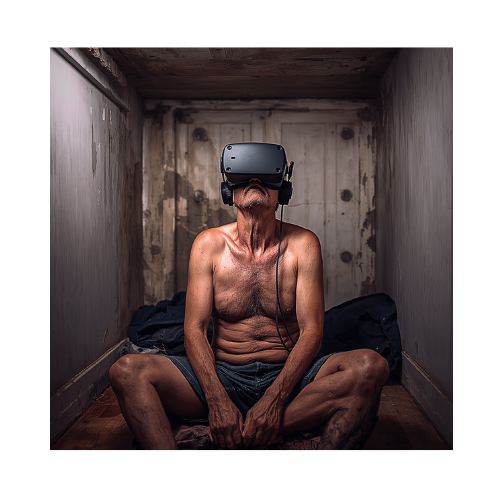 A glimpse into one's future, according to the WEF and their vision for humanity :
Morning sun filters through the blinds as future-you rises from bed. Your virtual assistant, sensing you’re awake, runs your pre-scripted morning wake-up routine. The companion authenticates you – not just froma password but from your unique voice pattern. Once you are verified, it runs the routine you’ve requested and reads out both your personal schedule and your work calendar; then, it prioritizes, summarizes and shares messages that were sent to your work email overnight. This morning’s readout puts you in the right mindset to tackle an early meeting in the office.
While prepping for your day, you put on your smart glasses, and they display a message from your mother. You consent to opening the messages, and rather than her text showing, her digital avatar (a close likeness to her real self) appears beside you in AR, relaying the message about a change in dinner plans. Using your smart mirror – and AI filters to make you more presentable so early in the morning – you send a video reply. Meanwhile, your virtual assistant updates your itinerary for the evening and schedules an autonomous vehicle to pick you up after work to drive you to dinner.
Throughout your day at the office, your smart glasses serve a dual purpose. They bring the work-from-home employees into the meeting room to improve accessibility. Additionally, when you speak with colleagues, real-time data overlays provide context – real-time subtitles, recent emails exchanged, upcoming shared events or even mutual contacts – aiding in smoother communication. All this is made possible because your co-workers have given tiered permission access as part of their professional digital identities.
Sounds like a hot ticket to me, aye? I don't know about you, but a few things come to mind and get my gears spinning when reading lines such as these.
What will one be asked or forced to exchange for this utopian type of existence? Privacy? Perhaps. Freedom of Movement and Speech? Maybe. Self Autonomy and Liberty? Quite possibly. They conveniently leave that part out. Yet, if any with a critical mind, put two and two together. You might be able to draw your own conclusions as to where this can lead and at what cost.
As the report encourages and promotes the pushing of society into a new, exciting, "inclusive" Digital World, with the creation of a Metaverse identity. It answers the question "Who has a Metaverse identity?" Everyone.
Given that the metaverse is an extension of and an evolution of today’s internet, it may be assumed that anyone online today can have a metaverse identity. Whether it’s composed of a photo, a Facebook profile, a Reddit account, a picture, an IP address, a gamer tag, digital wallet address, or something else, everyone online has a collection of digital crumbs that accumulate to form a metaverse identity.
The WEF does however, acknowledge what blurring the lines between objective reality and virtual reality can do to someone's psychological well being. But, regardless they're hell bent over developing a "Great Narrative" and creating a new (their) story for the future :
Additionally, unfettered augmentation may incidentally promote reality dysmorphia and/or depersonalization-derealization disorder (DPDR).
Recent research in DPDR has shown feelings of detachment in VR, where technology blurs the lines between objective reality and virtual reality or boundaries between a sense of self and avatar embodiment. Some individuals might find it difficult to integrate their online persona(s) with their real-world self, leading to struggles in self-perception and understanding. Virtual environments might further reinforce or aggravate existing feelings of unreality, contributing to a cycle that further entrenches the disorder.
Recent discourse has shown that AR “beautification” filters may be promoting body dysmorphia. While such identity presentation options are meant to provide diversion and entertainment, they may be exacerbating (DPDR) related issues.
If you're interested in reading the whole report, here ya go https://www.weforum.org/publications/metaverse-identity-defining-the-self-in-a-blended-reality/
Know your worth. You're more than just "digital crumbs" to be collected, farmed and trapped inside an augmented reality.
Til next time,
and very soon.
PEACE!!