

Wang Wen’s case for functional dialogue among great powers rests on a distinction between risk management and sphere-drawing that the historical record does not easily support
Opinion Analysis | November 2026
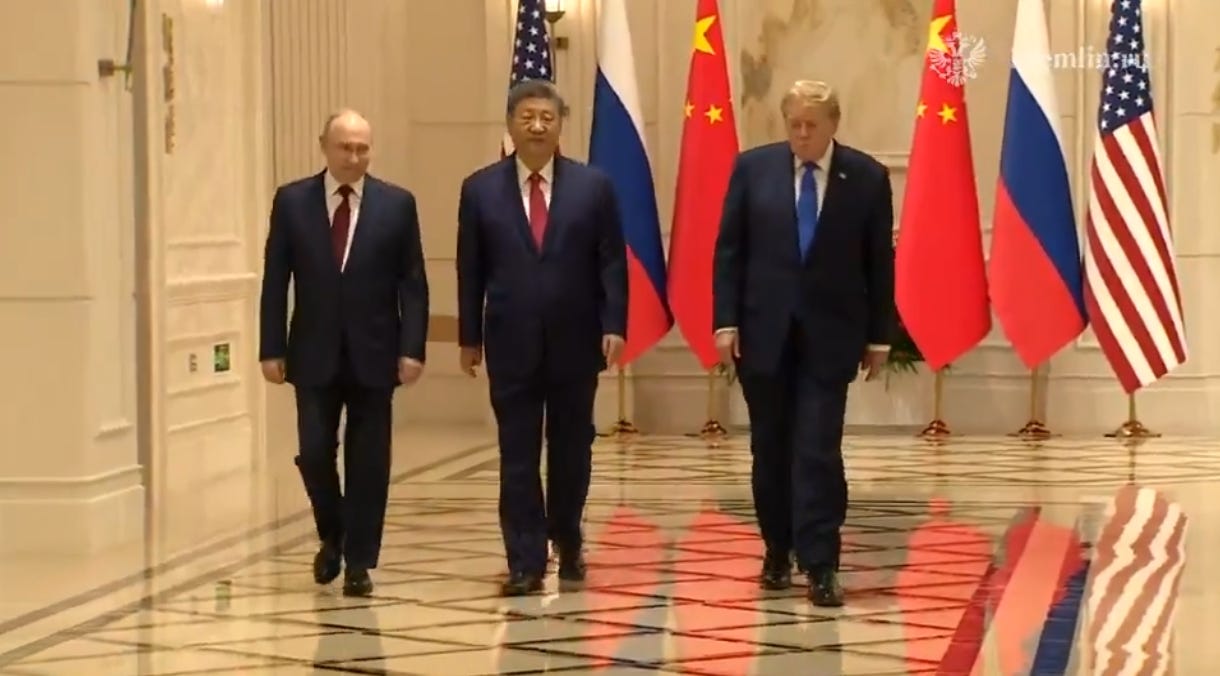
European commentary has already settled on the comparison that Wang Wen spent much of his interview rejecting, and the reflex reveals more about European anxieties than about Chinese intentions. A meeting of the American, Russian and Chinese presidents in Shenzhen on 18 November would be the first trilateral encounter of the three nuclear powers in the present format. The Yalta analogy arrives automatically because Europe has no other vocabulary for a great power summit, and because the continent's position in any such arrangement is the position it occupied in 1945. Wang Wen's response is that the comparison misreads both the purpose and the structure of what is being attempted.
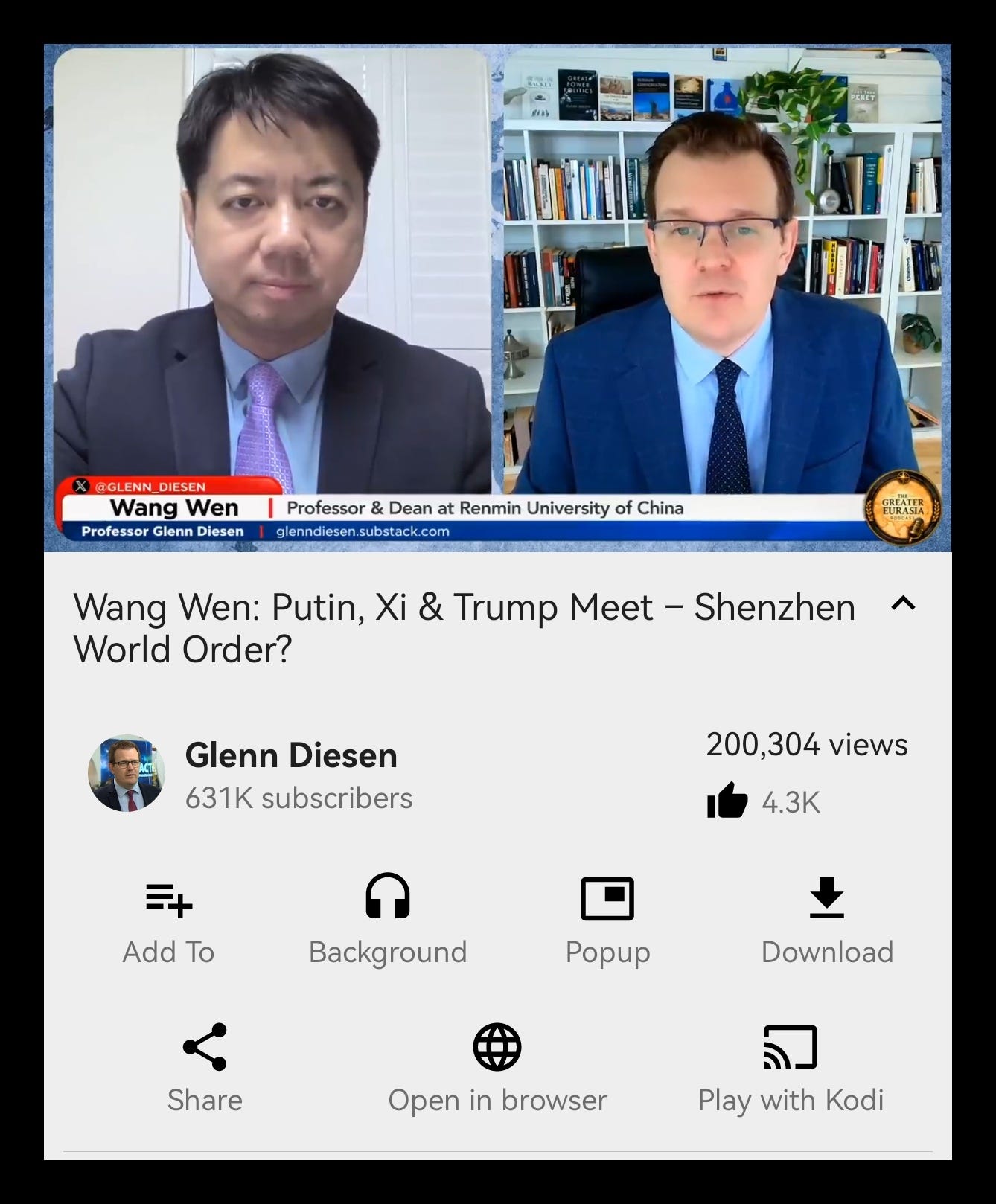
(Wang Wen interview by Glen Diesen)
His standing to make that argument rests on an institutional position that combines financial research, Track II diplomacy and direct access to the foreign policy apparatus. He serves as dean of the Chongyang Institute for Financial Studies, deputy dean of the Silk Road School at Renmin University, and secretary general of the Green Finance Committee of China. He predicted the trilateral meeting in a BBC interview early in 2026, repeated the prediction after Trump’s visit to Beijing in May, and now finds the speculation converging on his forecast. A prediction made twice before the event and confirmed by subsequent reporting establishes a record that a retrospective interpretation could not claim.
The objective he describes is narrower than the summit’s billing and considerably more defensible than the alternatives on offer. The meeting is not intended to forge a military alliance, sign a grand peace treaty, or establish a core rule for carving up the world. Its purpose is to manage the risks of conflict among the great powers and to establish a predictable framework for their coexistence. That formulation concedes a great deal, because it accepts that the three powers will continue to compete and asks only that the competition be conducted within limits. A meeting that aims at predictability rather than settlement is a meeting that has learned from the failure of previous attempts at settlement.
The three parties arrive with agendas that overlap only where the risk of mutual destruction is concerned, and Wang Wen’s account of those agendas is unusually candid. Washington is primarily concerned with avoiding direct conflict with China and Russia simultaneously, managing nuclear proliferation, containing the spillover of regional conflicts including the Iran crisis, and preserving its existing global influence. Moscow’s core concern centres on recognition as a true global power, on reshaping the European security architecture, and on managing the crisis in Ukraine. Beijing’s priorities lie in defending its core interests, opposing block-based confrontation, preventing the fragmentation of the world, and maintaining the stability of global supply chains. The overlap is real but narrow, and it consists almost entirely of things that all three would prefer to avoid rather than things any of them actively wants.
The agenda divides into three categories that differ in feasibility, and the ordering matters because it tells you what the participants actually expect to achieve. The first category concerns crisis management, where minimal consensus is most attainable, and it covers nuclear risk, the prevention of conflict escalation, and the establishment of rules to avoid direct collision between the great powers. The second category involves global public goods where interests genuinely intersect, including climate change, food security, energy, public health, the global governance of artificial intelligence, counterterrorism and non-proliferation. The third category entails principal dialogue on the rules of engagement, in which the parties communicate their respective core interests candidly, define the boundaries of competition, and distinguish competition from confrontation and from war. A meeting that produces agreement on the first category and honest disagreement on the third has succeeded, and Wang Wen’s conclusion reflects that judgement when he says the value of the trilateral lies not in resolving every conflict but in preventing bilateral disputes from spiralling into global catastrophe.
The objection from smaller powers is older than the summit and considerably better grounded than the reassurance offered in reply. When elephants fight the grass is trampled, and when elephants make love the grass is also trampled, which means that the smaller powers’ concern attaches to the encounter itself rather than to its outcome. A meeting of three great powers is a meeting about the terms on which the other hundred and ninety will live, and the fact that the three intend no harm is not the same as the absence of harm. European and Japanese anxiety about a new great power arrangement is not parochial sulking, because those governments have watched previous concerts of power allocate their security interests without consulting them. The concern is realistic, and Wang Wen concedes as much before attempting to answer it.
His answer turns on a distinction between two scenarios that observers habitually conflate, and the distinction is the strongest part of his argument. The first scenario involves great powers making backroom deals, privately designing the fate of other nations, and sacrificing the interests of smaller states to reach compromises among themselves, which is the old style of power politics that Europe and Japan rightly fear. The second scenario involves great powers establishing a dialogue for risk management and control aimed at preventing war between them and ensuring that conflict does not spread globally, without making decisions about the behaviour of other countries. The two scenarios look identical from outside the room, and the difference between them consists entirely of what the participants do with the instrument once they have built it.
He then supplies the criteria by which the difference can be tested, and the supply of testable criteria is what separates analysis from advocacy. On the agenda, any major issue directly affecting the fate of nations in Europe, Japan or any other region cannot be settled behind a closed door by the United States, China or Russia alone, and the parties concerned must have a full and meaningful voice in the discussion. On the nature of the mechanism, it must remain a functional dialogue focused on crisis communication and risk management rather than evolving into an exclusive council that makes decisions on global affairs. The outcome of such a dialogue cannot be imposed upon a third party, and those two bottom lines determine whether the enterprise stabilises the system or reproduces the thing it claims to replace.
The Yalta comparison requires a more careful reading than the European reflex permits, because the original settlement was not a single meeting but an architecture that persisted for forty-five years. Yalta delineated the spheres of influence of the victorious powers, and its underlying logic rested on the partitioning of influence, the formation of opposing blocs, and the proposition that security is determined by great powers. Surrounding regions became buffer zones, and small nations were largely treated as bargaining chips in the games of major states. The unipolar moment that followed the Cold War pushed that logic to its extreme rather than abandoning it, and a single nation attempted to define the global order while using institutions, alliance networks and sanctions to constrain other major powers. The Shenzhen paradigm, as Wang Wen describes it, differs from both in its starting point rather than in its ambitions.
The first claimed difference concerns the logical starting point, and it is the difference on which the others depend. Yalta was rooted in the delineation of interests and spheres of influence, while the Shenzhen paradigm begins by acknowledging the core interests of all nations and explicitly rejecting the logic of spheres. Major powers may safeguard their own security without treating other sovereign states as buffer zones or vessels, and they may not violate another nation’s sovereignty under the guise of security. That formulation is an aspiration rather than a description, and its status as aspiration is precisely what makes the second and third differences difficult to sustain.
The second claimed difference concerns the operational model, and it is where the paradigm encounters the problem that defeated every previous attempt at concert diplomacy. Yalta was defined by bloc-based confrontation in which one was either a friend or an enemy, while the Shenzhen paradigm accepts that competition may exist without confrontation being inevitable. Intense rivalry between major powers need not compel other nations to take sides, and it need not involve the creation of exclusive military blocs. Competition must have boundaries, and conflict must be equipped with a breaking mechanism. A paradigm that permits competition while prohibiting blocs is a paradigm that asks the great powers to forgo the most effective instrument they possess for winning the competition, and no previous great power has accepted that restraint voluntarily.
The third claimed difference concerns relations with the Global South, and it is the most consequential of the three because it addresses the constituency that Yalta ignored. Under the Yalta and unipolar systems, small nations and developing countries were largely recipients of arrangements made by the great powers, and their sovereignty was honoured in principle while being disregarded in practice. In the Shenzhen paradigm, coordination among major powers cannot bypass small and medium-sized states, and deals struck between great powers cannot take precedence over the sovereignty and aspirations of the developing world. Communication between major powers is intended to reduce the global risk of war rather than to facilitate a private carving up of the world among them. That commitment is the paradigm’s moral claim, and its credibility depends on whether the developing world is consulted before the meeting or informed after it.
The construction of such a system cannot be achieved overnight through a single conference, and Wang Wen’s account of the sequence is deliberately modest. The first requirement is the establishment of functional mechanisms for crisis management among the major powers. The second, and more important, is the accumulation of practical experience in cooperation on global public issues. The most important requirement is that the Shenzhen paradigm remain open to the entire world rather than becoming an exclusively closed circle, and that it remain compatible with and complementary to the existing international system centred on the United Nations rather than seeking to replace it. A paradigm that complements the United Nations is a paradigm that accepts constraints, and a paradigm that accepts constraints is one that its architects have not yet attempted to escape.
The competition between the United States and China now constitutes the central relationship of the international system, and Wang Wen’s assessment of its character repays close reading. The two largest powers are engaged in a contest over technology, military capability and global influence, and the contest has remained largely economic while threatening constantly to spill into the military sphere. His judgement is that the relationship has entered a prolonged era characterised by limited competition and managed conflict, and that the term truce misdescribes it because a truce implies gathering strength for the next round. The current rivalry persists within a single integrated global system, and the competition is structural in the sense that it cannot be eliminated through any single agreement. What has changed is the recognition on both sides that the costs of contemporary great power competition are prohibitively high, because a limited conflict, a total decoupling or a complete technology blockade would produce no winners at all.
That recognition produces the arrangement he describes as divided competition, in which rivalry persists while red lines prevent a slide into direct conflict. Competition has become the new normal, and conflict must be deeply managed. This is not a fleeting truce but a long-term model of coexistence that the major powers are compelled to adopt by the structure of their interdependence rather than by any convergence of values. The formulation is more pessimistic than the summit’s billing and more useful than the language of partnership, because it accepts that the parties will continue to seek advantage while acknowledging that the pursuit has limits. A relationship defined by managed rivalry is a relationship that requires permanent management, and permanent management requires institutions that outlast the personalities conducting it.
The question of how Beijing handles the current American president produced the most revealing passage in the interview, because it exposed the limits of the paradigm’s own logic. Wang Wen’s answer is that no side holds an absolute advantage permitting it to shape the relationship unilaterally, and that the trajectory results from two-way interaction rather than from one party’s dictation. China’s more proactive stance reflects its growing national strength and a clearer, more sober understanding of the outside world, while the United States retains formidable military, technological and alliance advantages that give it a wider range of instruments. The advantages on both sides are relative rather than absolute, and each party holds leverage while facing constraints. The implication is that neither can impose the terms of coexistence, which is the structural reason a negotiated framework is possible at all.
His treatment of the American president’s governing style is pragmatic to the point of conceding the paradigm’s dependence on personality. The administration’s foreign policy is characterised by a high degree of pragmatism and a strong transactional nature, and there is no universal formula that works once and for all. China’s approach therefore rests on two points, and the transcript breaks off before the second is fully developed. A framework for great power coexistence that must be renegotiated with each change of administration is not a framework at all, and the dependence of the Shenzhen paradigm on transactional counterparts is its least examined vulnerability. The paradigm requires continuity, and the political systems of all three participants are organised around discontinuity.
The paradigm’s coherence can be tested against the criteria its author supplied, and the test produces a mixed verdict that is more useful than either endorsement or dismissal. On the first criterion, which concerns whether affected parties are consulted on matters touching their security, the Shenzhen meeting fails before it begins, because the agenda is being set by three governments and the parties most affected will learn of the outcomes afterwards. On the second criterion, which concerns whether the mechanism remains a functional dialogue rather than an exclusive council, the verdict is genuinely undetermined and will be settled by what the participants do rather than by what they announce. A paradigm whose own author supplies the standards by which it may be judged has performed an unusual act of intellectual honesty, and the standards should be applied without deference to the author’s conclusions.
Three interpretations of the meeting compete, and the evidence does not yet discriminate decisively among them. The first treats the trilateral as the founding moment of a multipolar concert, in which the great powers accept limits on their competition and construct the mechanisms through which those limits are enforced. The second treats it as a tactical pause purchased by mutual exhaustion, in which each party seeks time to consolidate before resuming the contest on more favourable terms. The third treats it as a diplomatic performance addressed to domestic audiences in all three capitals, in which the appearance of statesmanship substitutes for the substance of agreement. The first interpretation requires institutional outcomes that have not yet appeared, the second requires evidence of preparation for resumed conflict that is abundant but inconclusive, and the third requires a level of cynicism that the participants’ evident investment in the meeting does not support.
The historical record of great power concerts is discouraging without being decisive, and the comparison that matters is not Yalta but the Congress of Vienna. The Vienna settlement endured for a century because the great powers constructed mechanisms for consultation that survived the personalities who created them, and because each participant concluded that the settlement served its interests better than any available alternative. The Concert of Europe collapsed when that conclusion ceased to hold for the powers whose interests the settlement had constrained, and it collapsed through a sequence of crises that the mechanisms proved unable to absorb. A Shenzhen paradigm that produces consultation mechanisms without producing shared interest in their survival will follow the same trajectory at a faster tempo, because the present distribution of power is shifting more rapidly than the nineteenth-century distribution ever did.
The strongest objection to the paradigm is not that it is insincere but that it is structurally unstable, and the instability arises from the relationship between risk management and advantage. A great power that manages risk with a rival simultaneously creates the conditions in which the rival can pursue advantage without fear of catastrophic escalation, and the safer the competition becomes the more attractive it becomes to prosecute it vigorously. Risk management therefore does not dampen competition but redirects it into channels below the threshold of direct conflict, which is precisely where the contest over technology, supply chains, alliances and standards is currently being fought. The paradigm may succeed in preventing war while accelerating the competition that makes war more likely in the longer term, and that outcome would satisfy the letter of the framework while defeating its purpose.
The Global South commitment is the paradigm’s most exposed element, because the constituency it promises to protect has heard comparable promises before and possesses the means to test them. A consultation architecture that includes small and medium-sized states is expensive to build, slow to operate and difficult to keep focused, and the temptation to conduct the substantive business in smaller forums will be continuous. The test is whether the developing world gains a voice in the agenda or merely a seat at the table, and the distinction will be visible in whether the meeting’s outcomes address the concerns those states have articulated or the concerns the great powers find convenient. A paradigm that fails this test will not collapse immediately, because the developing world has limited capacity to withdraw cooperation, but it will lose the legitimacy that its author claims as its principal advantage over Yalta.
The dependence on transactional counterparts is the second vulnerability, and it is more immediately consequential than the Global South question. A framework for coexistence that must be renegotiated with each change of administration in any of the three capitals is not a framework but a series of arrangements, and arrangements made between individuals dissolve when the individuals leave office. The American political calendar cycles every two and four years, the Russian system is organised around a single individual whose tenure is finite, and the Chinese system operates on a generational horizon that outlasts both. A paradigm constructed at a meeting between three leaders cannot survive the departure of any one of them unless it has been embedded in institutions, and no institutions have been described beyond the dialogue mechanism itself.
The framework’s future depends on whether it acquires an institutional existence independent of the meeting that created it, and three trajectories are consistent with the evidence available. A stabilising trajectory would see the dialogue regularised into a standing mechanism with a defined agenda, published outcomes and participation from affected states, which is the minimum required for the paradigm to become more than a photograph. An ossifying trajectory would see the dialogue continue as ritual while the substantive business migrates to bilateral channels, which would satisfy the form of consultation while reproducing the substance of condominium. A fragmenting trajectory would see the framework collapse under the first serious crisis it confronts, because a mechanism designed for risk management that cannot survive a risk has failed at its only stated purpose.
The unresolved tensions are not incidental to the paradigm but constitutive of it, and their persistence is what makes the framework a process rather than a settlement. The tension between risk management and advantage cannot be resolved, because managing risk with a rival necessarily creates the security in which advantage can be pursued. The tension between consultation and efficiency cannot be resolved, because consulting the affected states is slow and excluding them is illegitimate. The tension between institutionalisation and the transactional preferences of the parties cannot be resolved, because institutions constrain the very leaders who would have to build them. A paradigm that manages these tensions indefinitely is a paradigm that works, and a paradigm that attempts to eliminate them will break on the attempt.
The judgement that follows is narrower than either the advocates or the sceptics would prefer. Wang Wen’s distinction between risk management and sphere-drawing is analytically correct and historically fragile, because every previous concert of powers began as the first and became the second. His paradigm names the right problem, which is that the great powers now compete within a single integrated system and require mechanisms to prevent the competition from becoming catastrophic. It supplies the right criteria, which are that affected parties must be consulted and that the mechanism must not become an exclusive council. It does not yet supply the institutions that would satisfy those criteria, and without institutions the paradigm remains a description of how the powers ought to behave rather than a structure that compels them to.
The Shenzhen meeting will be judged by what it leaves behind rather than by what it announces, and the leaving behind will take years to assess. A communiqué is a press release, a regularised dialogue is an institution, and the difference between them is the difference between a paradigm that exists and a paradigm that was described. The European fear of a second Yalta is misplaced in its object and correct in its instinct, because the danger was never that three leaders would divide the world in a single afternoon. The danger is that the world becomes accustomed to three leaders deciding what may be discussed, and that the habit outlasts the leaders who established it.
Authored By: Global GeoPolitics
If you prefer to make a one time donation in support of my work, you can do so by clicking any link below:
https://donate.stripe.com/7sY8wPfvi864don0k3awo07 |
https://buymeacoffee.com/ggtv |
https://ko-fi.com/globalgeopolitics |
Bitcoin: 3NiK8BoRZnkwJSHZSekuXKFizGPopkE7ns
References
Wang, W. (2026) Interview on the Shenzhen Paradigm and the trilateral summit, recorded 21 November 2026. Transcript supplied.
Wang, W. (2026) Article on the Shenzhen International System, published October 2026.
Kissinger, H. (1957) A World Restored: Metternich, Castlereagh and the Problems of Peace, 1812–1822. London: Weidenfeld & Nicolson.
Morgenthau, H.J. (1948) Politics Among Nations: The Struggle for Power and Peace. New York: Knopf.
Waltz, K.N. (1979) Theory of International Politics. Reading: Addison-Wesley.
Mearsheimer, J.J. (2001) The Tragedy of Great Power Politics. New York: W.W. Norton.
Ikenberry, G.J. (2001) After Victory: Institutions, Strategic Restraint, and the Rebuilding of Order After Major Wars. Princeton: Princeton University Press.
Schroeder, P.W. (1994) The Transformation of European Politics, 1763–1848. Oxford: Clarendon Press.
United Nations (1945) Charter of the United Nations, Articles 2(1), 2(4) and 33.