
An examination of leverage constraints, state capacity and the material consequences of debt-driven expansion in the world’s second-largest economy

China’s decision in 2020 to impose quantitative leverage limits on property developers marked a deliberate intervention in a sector that had become both an engine of growth and a source of systemic vulnerability. Regulators from the People’s Bank of China and the Ministry of Housing and Urban-Rural Development set three explicit thresholds: the liability-to-asset ratio, calculated after excluding advance proceeds from contracted projects, was not to exceed 70 per cent; the net debt-to-equity ratio was to remain below 100 per cent; and liquid cash holdings were required to cover at least the full amount of short-term debt. Developers meeting all three conditions could expand interest-bearing liabilities by up to 15 per cent annually, while those breaching one or more faced progressively tighter caps, culminating in a complete freeze for firms that violated every line. The policy emerged against the background of Xi Jinping’s repeated statements, beginning at the 19th Party Congress, that houses are for living in rather than for speculation. By the late 2010s property and related activities accounted for a substantial share of economic output, local government revenues relied heavily on land conveyance fees, and leading private developers had built balance sheets characterised by extreme leverage and extensive use of pre-sale deposits.
Evergrande Group illustrated the risks that the rules sought to constrain. Founded by Hui Ka Yan, the company expanded aggressively through borrowing from domestic banks and offshore bond markets, while simultaneously collecting large volumes of advance payments from households. These pre-sale receipts, which under conventional accounting could be treated as assets, masked the true scale of liabilities and enabled further leverage. When the three red lines took effect, Evergrande breached all of them. Access to new financing narrowed sharply. Construction halted on numerous projects, suppliers went unpaid, and by late 2021 the firm entered formal default. Subsequent judicial proceedings against its founder reflected the political determination that private capital would not be permitted to externalise the costs of speculative over-extension onto workers, subcontractors and home-buyers. The refusal to orchestrate a comprehensive bail-out of the equity holders stood in contrast to the treatment of certain systemically important financial institutions in other jurisdictions during earlier crises.
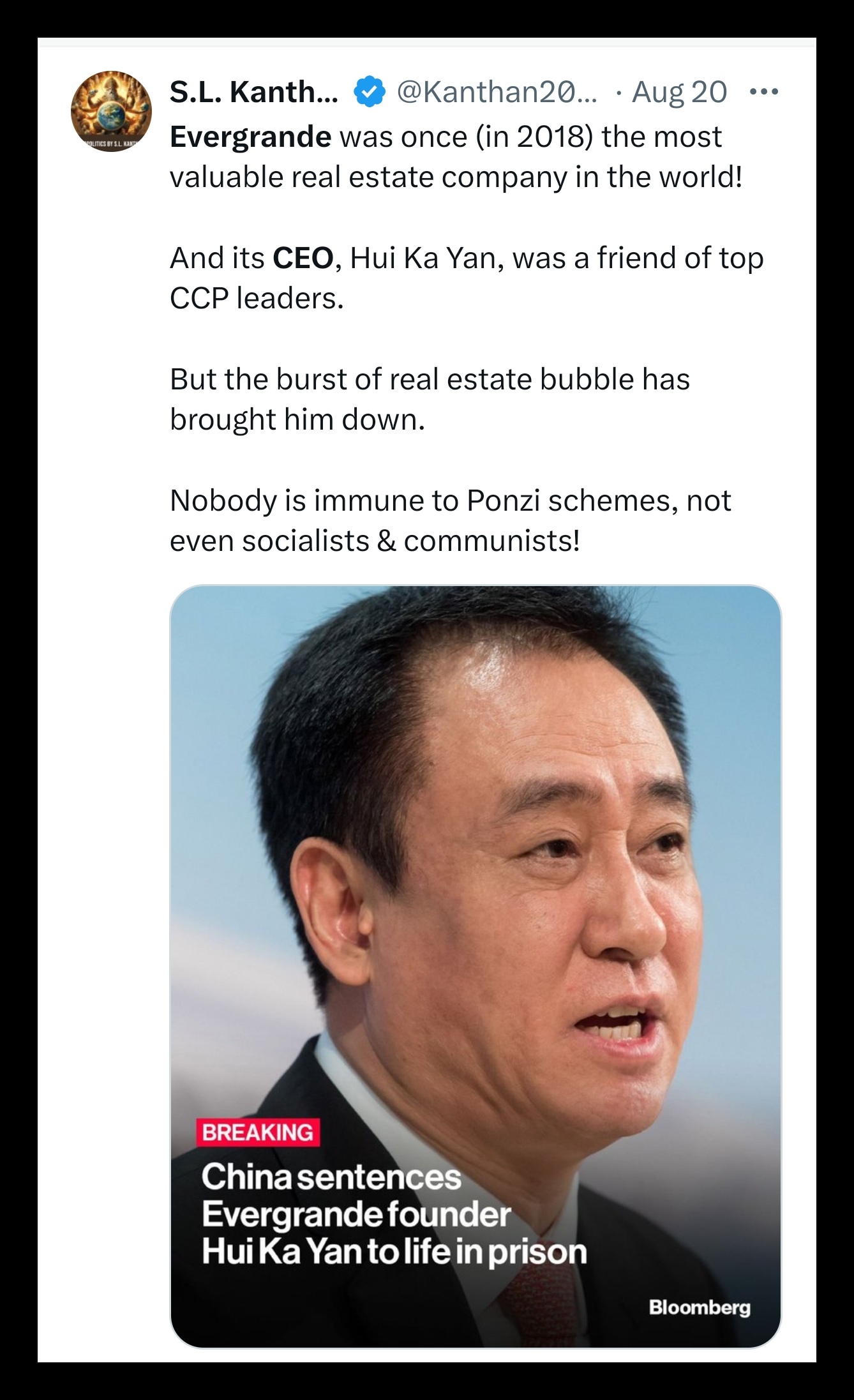
The first red line, by excluding advance receipts from the asset base, directly targeted a common practice in which developers used household savings as collateral for additional bank loans. Under this arrangement the shelter needs of ordinary families became instruments for the rapid concentration of control over land and construction capacity. Capping the liability-to-asset ratio at 70 per cent after the exclusion forced a clearer separation between genuine equity and funds that remained contingent liabilities until delivery of completed units. The second red line limited net debt relative to equity, thereby restricting the ability of a small equity base to command a vastly larger pool of social resources through debt. Extreme ratios of the kind observed at Evergrande, and earlier at institutions such as Lehman Brothers, create structures of fictitious capital that remain viable only so long as asset values continue to rise and refinancing remains available. The third red line required developers to demonstrate actual liquidity sufficient to meet obligations falling due within twelve months, interrupting the perpetual rollover that characterises financially strained enterprises. When cash coverage falls below this threshold the first losses typically fall on construction workers, site engineers and smaller suppliers rather than on senior management.
These measures operated within a political system that concentrates decision-making authority in a disciplined party apparatus rather than subjecting long-term structural adjustments to continuous electoral contestation. The capacity to enforce deleveraging against powerful commercial interests, even at the cost of short-term growth and local fiscal pressure, reflects institutional features that differ markedly from systems in which campaign finance, media ownership and short electoral cycles constrain the scope of regulatory action. Post-colonial states that adopted liberal-democratic forms after independence often confront electorates whose educational and informational resources remain limited by historical extraction, rendering them vulnerable to clientelism, ethnic mobilisation and external influence operations. In such settings politicians face strong incentives to prioritise immediate distributional appeals over painful institutional reforms. A vanguard organisation trained in political economy and institutional analysis can, in principle, maintain continuity of policy across longer horizons, including the acceptance of temporary contraction in one sector in order to redirect capital towards manufacturing, technology and infrastructure of higher strategic value.
The three red lines therefore functioned less as abstract moral injunctions than as concrete instruments of balance-sheet discipline. Their introduction coincided with broader efforts to reduce the economy’s dependence on property-driven expansion and to address the accumulation of local-government contingent liabilities. Subsequent softening of the reporting regime, reported in 2023 and more explicitly in 2026, indicates that the authorities retained flexibility to adjust the intensity of enforcement once the most acute risks of uncontrolled collapse had been contained. Millions of unfinished housing units, unpaid wages and disrupted supply chains remain visible consequences of the earlier excess. The episode demonstrates both the reach and the costs of centralised regulatory power when confronted with a sector that had grown too large relative to underlying demand and fiscal capacity.
Comparative experience suggests that systems lacking equivalent institutional insulation from short-term political and commercial pressures have found it more difficult to impose comparable constraints before crises materialise. The 2008 experience in the United States and Europe showed how highly leveraged private institutions could transmit losses across the financial system until public authorities ultimately absorbed a substantial portion of the costs. China’s approach accepted sector-wide contraction and the failure of individual firms in preference to the open-ended socialisation of private speculative positions. Whether the redirection of capital towards higher-productivity activities will fully offset the drag from property remains an open empirical question. Local governments continue to face fiscal strain from reduced land revenues, while household confidence in the delivery of pre-sold units has been damaged. The longer trajectory will depend on the ability of the political system to sustain investment in alternative growth engines while managing the social and financial legacies of the preceding boom.
The three red lines stand as a case study in the use of quantitative regulatory thresholds to interrupt the conversion of social necessities into instruments of private leverage. Their enforcement illustrated the priority accorded to systemic stability and the material interests of ordinary participants in the housing market over the preservation of any single private conglomerate. Future assessments will measure success by the extent to which capital is reallocated, unfinished projects are completed, and the fiscal foundations of local administration are stabilised without a return to the previous pattern of debt-fuelled expansion.
Authored By: Global GeoPolitics
If you prefer to make a one time donation in support of my work, you can do so by clicking any link below:
https://donate.stripe.com/7sY8wPfvi864don0k3awo07 |
https://buymeacoffee.com/ggtv |
https://ko-fi.com/globalgeopolitics |
Bitcoin: 3NiK8BoRZnkwJSHZSekuXKFizGPopkE7ns
References
People’s Bank of China and Ministry of Housing and Urban-Rural Development (2020) Key regulations on real estate enterprise fund monitoring and financing management (Three Red Lines framework). Verbal guidance and pilot implementation rules issued at the joint symposium with twelve major property developers, Beijing, 20 August. Implementation extended sector-wide from 1 January 2021. (Official public text not released as a standalone numbered circular; content reconstructed from contemporaneous official briefings and subsequent regulatory practice.)
Xi, J. (2016) Speech at the Central Economic Work Conference. Beijing, December. Introduced the principle that “houses are for living in, not for speculation” (房子是用来住的,不是用来炒的).
Xi, J. (2017) Report to the 19th National Congress of the Communist Party of China. Beijing, 18 October. Reaffirmed the housing principle and set the broader policy direction for subsequent real-estate deleveraging measures.
People’s Bank of China and China Banking and Insurance Regulatory Commission (2020) Notice on establishing a real-estate loan concentration management system for banking financial institutions. Issued 31 December 2020, effective 1 January 2021. Caps on the share of property loans and personal mortgages in total lending by institution type.
China Evergrande Group (2021–2024) Corporate announcements, bond default notices and restructuring filings. Hong Kong Stock Exchange and related regulatory disclosures documenting liquidity shortfalls after the imposition of the three red lines.
Supreme People’s Court of the People’s Republic of China / relevant intermediate courts (2024–2026) Judgments and sentencing records concerning Hui Ka Yan (Xu Jiayin) and associated Evergrande executives on charges including misuse of funds and related offences.
Xinhua News Agency (2020) Official reporting on the 20 August 2020 joint symposium convened by the People’s Bank of China and the Ministry of Housing and Urban-Rural Development. Contemporary summaries of the four-tier (red/orange/yellow/green) classification and debt-growth limits.