

Yield Curve Control, Financial Repression, Rising Debts, Financial Credibility, and Geopolitical Power
Contents
Introduction
Japanese Intervention Shifts
The United States and Financial Repression
Will Bessent’s Strategy Work?
Concluding Remarks
Bitesize Edition
Japan’s Market Shift - Japan is moving away from yield curve control and allowing government bond yields to be increasingly determined by the market. But the unwinding of this system has exposed pressures in the Yen, bond market, and financial system. Japan may therefore be moving from suppressing bond yields towards intervening in foreign exchange markets.
The United States and Financial Intervention - The United States is taking a different path, with Scott Bessent using Treasury buybacks to support liquidity and reduce volatility at the long end of the bond market. Buybacks are not financial repression by themselves, but repeated intervention could become more significant if market forces continue to push yields higher. Rising debt, refinancing costs, and pressure on the Federal Reserve could eventually create stronger incentives to suppress yields.
The Debt-Growth Dilemma - The United States has three potential routes to reducing its debt burden, those being stronger productivity growth, higher inflation, or fiscal changes through spending cuts and higher taxes. AI could provide the productivity growth needed to outpace debt accumulation, while inflation could reduce the real burden of existing debt but will damage purchasing power and financial credibility. If neither approach works, greater intervention in financial markets could eventually become necessary.
Bessent’s Strategy and U.S. Power - For now, strong Treasury auction demand and the range of liquidity tools available to the United States suggest that a financial crisis is not imminent. But if intervention repeatedly fails to reassure markets, confidence in U.S. financial policy could weaken, potentially forcing more aggressive forms of financial repression. This matters because the erosion of financial credibility would also threaten one of its most important sources of power, that being geopolitical power.
Introduction
Last Thursday, we explored the financial history of Japan, from the Japanese Economic Miracle in the 1980s, through to the yield curve control of the last decade, and its eventual end.
Today, Japan finds itself in a period of transition as it moves away from yield curve control and allows the market to determine yields.
But we’ve also seen Scott Bessent intervening in the U.S. bond market.
And so, as Japan enters an environment of market pricing, could the United States be entering the opposite: an environment of market repression marked by increased intervention?
It’s these questions we’ll address today, along with the geopolitical implications.
Japanese Intervention Shifts
Just this week, Deutsche stated that the global bond sell-off isn’t a financial crisis, but it’s the end of financial repression.
Japan kept government yields low and supported asset prices, which suppressed the usual market-determined levels.
Today, Japan is moving towards a system of market pricing. Yields are allowed to shift, reflecting inflation. If inflation does rise, the Japanese hope that interest rates and monetary policy can work to restrict this.
However, rising debt and fiscal sustainability in the developed world are among the biggest long-term worries. Japan is the furthest along this curve due to its decades of stimulus, but the United States also has rhetoric surrounding its rising debt situation, and when this will become unsustainable.
These shifts in Japan are seeing underlying risks emerge. For example, the Japanese Yen carry trade is unravelling. A carry trade is a strategy where an investor will borrow money in a currency with a low interest rate, as the Japanese Yen was for many years. They will then use the borrowings to invest in an asset that provides a higher rate of return. With the Japanese raising interest rates, borrowing is no longer cheap. As a result, the Japanese carry trade is unravelling.
As investors sell their other assets and purchase Yen, the Yen should gain value relative to the U.S. dollar. This means a lower number for the USD/JPY chart below.
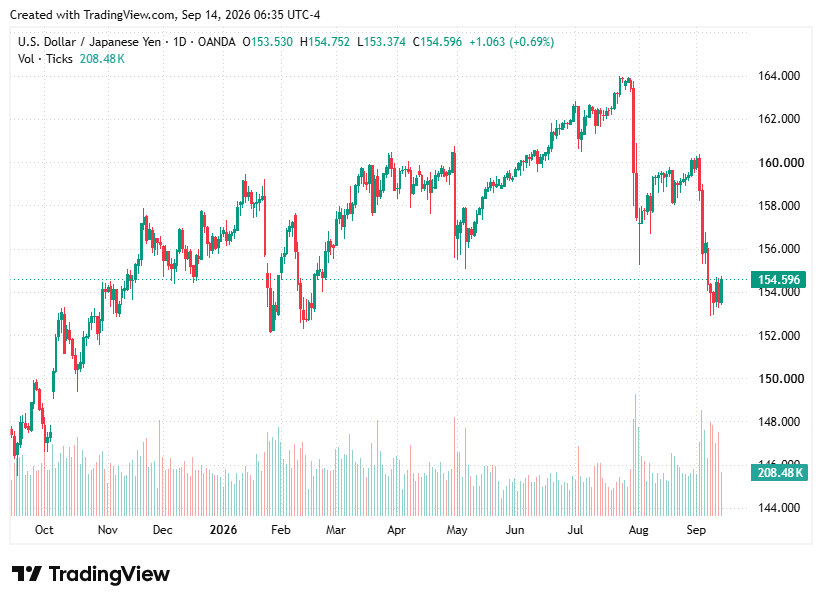
This has been the case over the last few months, albeit with a retest of 160 a few weeks ago.
But if we zoom out and look at the longer term, the value of the Yen against the U.S. dollar continues to fall in general. This is because the raising of interest rates is the stronger force, and the difference between the United States and Japanese interest rates is still large.
This has seen the U.S. Treasury support the yen by selling euros. It was reported that this operation from the United States was around $500m in size.
This is small in relation to Japan’s $87.8B intervention in August, which was the size of the reduction in Japan’s foreign securities to purchase Yen. Japan’s holdings of U.S. Treasuries may have made up a portion of the assets sold.
And so, this U.S. operation could be because the Japanese have been selling some U.S. Treasuries.
Selling bonds lowers prices and raises yields, the exact issue Bessent hopes to address at the long end.
Also, Japan is the largest owner of U.S. Treasuries. For the U.S. deficit, they need strong continued demand for Treasuries, which Japan is important for.
We’re also seeing unrealised losses on bond holdings from life insurers, with up to $200B in unrealised losses. This situation resembles the crisis surrounding Silicon Valley Bank in 2022.
 Rising yields reduce the market value of existing bonds. If liquidity issues arise, selling these bonds can create a spiral, as selling bonds reduces market value even further.
However, from regional banks to life insurers, there are many differences. Japan also has extensive domestic savings. This would provide a much greater liquidity buffer than Silicon Valley Bank possessed.
So, Japan isn’t out of the woods yet with regard to its financial system. Japan has stopped yield curve control, but it has now pivoted to intervention in the FX markets to attempt to manage its currency.
But what about the United States?
The United States And Financial Repression
As Japan moves towards some market pricing, could the United States, with its recent intervention at the long end of the bond yield curve, be shifting towards a system of greater financial repression?
Bond buybacks aren’t financial repression when monitored in isolation, but what if this intervention doesn’t have the desired effect?
What is this desired effect? Well, as we discussed last week, Bessent wants to buy long-term bonds to increase liquidity and reduce pressure in the long end of the Treasury market.
A few days ago, we saw the buyback amount increase to $6B. But when this didn’t meet market expectations of $10B in buybacks, yields actually rose further.
 Through this strategy, Bessent hopes that prices will move less when bonds are bought or sold. He wants a bond market that is less reactionary and which is less likely to reach extremes where intervening is necessary.
This once again returns us to the concept of rising debt. In the United States, it has to refinance this debt to continue to fund its rising deficits.
At higher interest rates, this increases borrowing costs, and hence new Treasuries have to be issued, or debt is rolled over at these higher rates. The risk is that investors demand higher yields for the perceived risk of holding longer-duration debt.
The feedback loop sees larger deficits require more bond issuance, which investors demand higher yields for, which contributes to even larger deficits.
If interest payments grow to become a significant portion of government revenue, then political pressure for low interest rates could increase. This risks fiscal dominance and the erosion of Federal Reserve independence, as we’ve been discussing over the last few weeks.
And so, Japan was led to yield curve control by low growth and low inflation. Their stimulus didn’t work, and this led to rising debt burdens while their intervention wasn’t having the desired effect.
Will this recent intervention work in the United States, or could this mark the beginning of a journey towards stronger financial repression?
Will Bessent’s Strategy Work?
To reduce the debt burden, there are three potential routes:
Growth - Productivity growth that outpaces debt accumulation decreases the debt-to-GDP ratio.
Inflation - Inflation can erode the real value of existing debt, but hurts purchasing power and risks undermining financial credibility.
Fiscal Changes - Lower spending or higher taxes can address debt, but are politically difficult.
Inflation and fiscal changes have negative political consequences, at a time when Trump’s approval rating has taken a hit. Hence, the Trump Administration would prefer to grow its way out of the debt.
One potential source of growth for the United States, if it is to grow its way out of its debt burden, is artificial intelligence.
The United States today is operating in a world where AI CapEx is growing increasingly important for growth.
Could the hope of productivity gains in artificial intelligence see the United States continue to accumulate debt burdens with no proactive, forward-thinking strategy to reduce the burden?
Alternatively, inflationary pressures will rise the longer the conflict in the Middle East continues. Will the United States hope to inflate the debt burden away?
 The risk is that this hope for growth or the need for elevated inflation both have financial consequences.
High inflation erodes the purchasing power of the dollar and hurts people’s bottom line, while the growth required to positively impact the debt burden has to outpace debt accumulation.
Also, artificial intelligence may not deliver continued productivity gains.
This is the risk Scott Bessent and the United States are seemingly willing to take, despite the associated risks financially and with artificial general intelligence. Without a strong financial system, the United States loses one of its key strengths in the superpower tussle with China. As a result, the United States is incentivised to maintain its financial power.
If one or more of these strategies don’t pan out, however, rising U.S. debt could one day lead to the need to suppress yields, which could come from greater financial repression, as Japan did via Yield Curve Control.
An even bigger worry is that if the strategies that the United States pursues no longer provide market reassurance regarding the debt situation, such drastic action could be necessary. If debt continues to accumulate unaddressed, this scenario could arise at any unpredictable point in the future.
It’s this thesis that supports the idea that the United States will be drawn towards an environment of even greater financial repression and intervention.
The key question to consider is then whether we reach a financial environment where this intervention no longer has the desired effect.
The difference between the United States and Japan’s case would be the trigger: Japan’s introduction of YCC occurred after years of low economic growth and deflationary pressures that weren’t being affected by typical monetary policy; the United States’ YCC could be triggered by fiscal pressures such as ever-rising debt burdens growing unsustainable. Both could see pressure to suppress long-term yields, but would arise from different economic environments.
Another key trend to highlight is Japan’s shift to market-pricing and whether it is sustainable. If Japan is forced to return to a strategy of yield suppression, confidence in its financial approach would be greatly impacted.
Could the United States face the same risk one day?

Concluding Remarks
Despite these risks, auction demand for the 10Y U.S. government bond last week was labelled as “stellar”. As such, the perception of risk in bond markets is a vital element.
In 2022, the UK GILT crisis was contributed to by rapid market movements, and it required intervention. Today, UK GILTS sit higher than they did in 2022, but the crisis hasn’t returned. This highlights that the perception of the financial system is an important element when it comes to financial crises.
But for the United States, when these crises do emerge, it has more cards it can play.
It has liquidity measures such as swap lines, FIMA, and the repo markets. Also, in the aftermath of each financial crisis, the world and its financial systems learn and create supports. The United States has learned from the last few decades, especially.
It’s also worth reiterating that an underlying force in this is the relationship between the political and economic branches in the United States.
Each move the political branch makes to address the economic issues in the United States and to boost geopolitical power risks hindering financial credibility, especially if Federal Reserve independence and fiscal dominance are brought into question.
As such, with each intervention that doesn’t work, this risks undermining the financial credibility of policy decisions. If actions don’t control the underlying market forces, market participants could recognise this, and chaos could emerge.
This likely won’t be a problem today. The United States has many levers it can pull. But if debt continues to accumulate, this could be a problem one day. This could then risk the decline of the United States’ geopolitical power through the erosion of its financial power.
To stop such an environment from emerging, a coherent strategy to address U.S. debt would be required. Or alternatively, the perception of a coherent strategy that would convince market participants could also be sufficient. The important aspect is that this would have to be convincing.
Will Bessent’s strategy be convincing enough today, or are we already seeing the early signs of the markets recognising that his actions could be insufficient?
Thanks for reading! I’d greatly appreciate it if you were to like or share this post with others! If you want more, then subscribe on Substack for these posts directly to your email inbox. I research history, geopolitics, and financial markets to understand the world and the people around us. If any of my work helps you be more prepared and ease your mind, that’s great. If you like what you read, please share this with others.
Key Links
The Geopolitics Explained Podcast
If you want to see daily updates and discover other newsletters that suit you, download the Substack App.
 Get more from Dylan Muggleton in the Substack app
Available for iOS and Android
You can become a paid subscriber to support my work. There are paid posts every Thursday and long-form monthly articles in my global questions series exclusively for paid subscribers. The Geopolitics Database is also accessible. Read Geopolitics Explained for 20p per day or start a free trial below to find out if my work is for you! I appreciate your support!