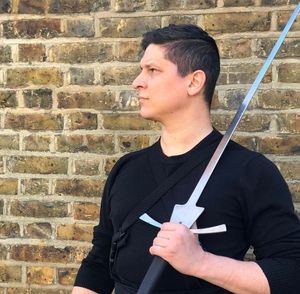

Dear Reader,
I would like you to know that HemaLore is originally written in my mother tongue, and then I use AI to translate it and smooth the reading in English. Everything you find here is my own intellectual work, created by me, Gábor Antali, along with any mistakes or errors that may come with it.
This project of mine is meant for entertainment. It is not intended as an academic essay or formal scholarly work.
My music recommendation this time:
“Nincs kockázat, nincs történet” — which translates to “No risk, no story.”
A powerful title, and fitting for its sound — ambient music with a stoic theme. It’s reflective, atmospheric, and quietly intense — perfect for deep thinking, creative work, or just getting lost in thought.
If you're into moody, minimalist soundscapes that carry a sense of calm determination, this one’s worth a listen.
Most of us have probably heard of the so-called “Renaissance man” — and perhaps the most iconic of them all, Leonardo da Vinci (1452-1519). He was a scientist, architect, painter, engineer, theorist… and so much more. I truly encourage you to read about his life and work — it's hard not to be inspired.
He lived during the Renaissance, a time of rediscovery and deep fascination with the cultural and intellectual achievements of ancient Rome and Greece. This rediscovery sparked a revolutionary transformation in culture, society, economy, exploration, the arts, architecture, and science.
This light of change first emerged in Florence, in the north of what is now Italy — the Republic of Florence — under the patronage of the powerful Medici family. From there, this spirit of inquiry and excitement quickly spread through northern Italy and eventually touched the rest of Europe.
At the time, northern Italy was divided into small, independent city-states. These states were often in competition with one another for economic and political power. Many were influenced — and sometimes overshadowed — by powerful foreign forces like the Holy Roman Empire, Spain, and France. The four main cultural and political centers of the region were the Papal States, Milan, Florence, and Venice.
These city-states constantly struggled for dominance, forming and breaking alliances in pursuit of wealth, power, and prestige. It was a time of great ambition but also of instability, marked by frequent conflicts and shifting loyalties.
Because most of these city-states could not afford to maintain a permanent standing army, they relied on mercenaries instead. This led to the rise of the condottieri — mercenary captains who turned warfare into a business, offering their services to the highest bidder.
This mix of war and culture defined the Renaissance and made it one of the most dynamic and transformative periods in European history.
Fortunately, we have preserved fragments from that time — writings, manuals, and records from fencing masters and soldiers whose teachings and theories have stood the test of time. Their legacy, once nearly lost in the depths of history, still survives. And through their words, we can still learn, understand, and be inspired.
So, how does Leonardo da Vinci tie into all of this?
Stay with me — the connection will reveal itself by the end of the article.
The Ancient Line – The Vadi Family
Filippo di Vadi Pisano (1425–1501) was born in Pisa, though little is known about his life. He was likely a member of the numerous Vadi family, whose name appears frequently in historical texts dating back to the 1000s—an idea supported by the article Historical Overview of the Vadi Family on HROARR.
Pisa, Filippo's birthplace, was part of the Republic of Florence but repeatedly attempted to break free from Medici dominance. The Medici family was the powerful rulers of Florence during this time.
Between 1452 and 1470, Filippo served as the governor of Reggio, which was part of the Duchies of Modena and Ferrara. He served under Leonello d’Este (1407–1450), a highly educated man and a renowned patron of the arts and culture. After Leonello’s death, Vadi continued in service under his successor, Borso d’Este (1413–1470). Borso’s position was legitimized by both Frederick III (1415–1493), Emperor of the Holy Roman Empire, and Pope Paul II (1417–1471). Borso allied with Venice and maintained a hostile stance against both the Medici of Florence and the Sforza of Milan.
We also know that the d’Este family owned two copies of Fiore di Battaglia by Fiore dei Liberi—another important 14th-century fencing manual, still widely studied and practiced by historical fencers today. (One of my students actually came from the same village as Fiore dei Liberi—such a cool connection!)
It’s likely that Vadi had the opportunity to study or at least become familiar with Fiore’s work thanks to the d’Este family’s copies.
Sometime between 1482 and 1487, Vadi wrote his own fencing manual: De Arte Gladiatoria Dimicandi. While it undeniably shares similarities with Fiore di Battaglia, Vadi's work offers far more detailed information on fighting techniques. It’s truly worth reading for its unique insights into aspects of swordsmanship that are hard to find elsewhere.
De Arte Gladiatoria was dedicated to Guidobaldo da Montefeltro, Duke of Urbino—although no surviving records link Vadi directly to him. However, it’s worth noting that between 1480 and 1516, Benedetto Vadi di Fossombrone served at the court of Urbino as a doctor of law and jurisprudence, which might suggest a familial connection or introduction.
Under Federico da Montefeltro and later his son Guidobaldo, the Court of Urbino became a major center for Renaissance art, culture, and learning—attracting artists, scholars, and intellectuals from across Europe. Both Federico and Guidobaldo were not only patrons of the Renaissance but also successful condottieri (mercenary military leaders).
Federico da Montefeltro (1422–1482), one of the most respected condottieri of the Italian Renaissance, became Lord of Urbino in 1444 and was named Duke in 1474. He was a celebrated civil leader and humanist with impeccable martial skills and a strong sense of honor. He also established one of the greatest libraries in Italy (second only to the Vatican’s), complete with his own team of scribes in a dedicated scriptorium.
His son, Guidobaldo da Montefeltro (1472–1508), followed in his father’s footsteps as both a military leader and ruler of Urbino, though his life was tragically cut short at the age of 36.
Personally, I’m very glad that Vadi successfully secured a place for De Arte Gladiatoria in Urbino’s prestigious library. His manual is also notable for being one of the few Renaissance works to describe fencing as a science—a “geometry of combat.” Renaissance fencing manuals began to evolve in this period, incorporating mathematical principles and shifting toward more analytical interpretations of movement. In later Renaissance manuals, guards would even be renamed using numbers, and the wide variety of guard positions would be drastically reduced.
But let’s save that fascinating transformation for another time.
Now, let’s leave Vadi behind and journey not too far—to the city of Bologna.
Fencing Masters of Bologna
During the time of Leonardo da Vinci, Bologna was officially governed by its city council, but in reality, it was ruled by the Bentivoglio family, who held the title of “First Citizen” – in essence, a tyrant. Chief among them was Giovanni II Bentivoglio (1443–1508), who secured his family’s power by serving as a condottiere for Milan, Florence, and Venice. Under his rule, Bologna blossomed into a vibrant cultural metropolis.
Bologna also boasted one of Europe’s most prestigious universities – the Studium, founded in 1088. During Giovanni’s rule, the university expanded significantly. New professorships were created in fields such as Music (the first in Europe), Mathematics and Astronomy (1451), Greek Language and Literature (1453), Hebrew Language and Literature (1464), and Metaphysics (1466).
Thankfully, some records from the city council and the Studium have survived. Among these emerges the name of a fencing master: Lippo (or Filippo) Dardi, son of Bartolomeo Dardi (or Dardo). He is an essential figure, as he laid the foundations for a well-documented fencing ideology and methodology. His teachings became characteristic of many Bolognese fencing masters across generations, leading to what is now referred to as the Dardi or Bolognese school of fencing.
Dardi’s birthdate is unknown, but records show he was granted a license by the city council to open and teach a fencing school in 1412. These same records give us insight into how much he earned for his instruction. Interestingly, he also taught astrology, astronomy, geometry, and mathematics at the Studium. Some sources suggest he was of Spanish origin, though this is confusing, as only those born in Bologna had the right to teach at the Studium. This discrepancy remains unresolved.
Dardi died in 1464. He is known to have written a fencing manual, which sadly remains lost – perhaps still waiting, tucked away in the dark corners of an Italian library, for passionate hands to rediscover it.
From the records, we also hear of another master – even less known, yet certainly significant: Guido Antonio di Luca. We know little about his life, but his fame lives on through his students. The famous fencing master Achille Marozzo (1484–1553), once wrote:
“From his school came more warriors than from the belly of the Trojan Horse.”
That says everything.
Guido Antonio di Luca’s legacy is monumental. Among his students were not only Marozzo, but also Antonio Manciolino – both of whom had notable teaching careers and wrote fencing manuals that are still studied today. But that is a story for another article.
We also know of two more famous students:
- Guido Piccolo Rangoni (1485–1539), a celebrated condottiere known for his tactical brilliance and considered one of the finest swordsmen of his time. His life is fairly well documented and worth reading about.
- Ludovico de' Medici, better known as Giovanni delle Bande Nere, the fearsome leader of the Bande Nere (Black Bands). Ludovico was reportedly a violent and aggressive man. From a young age, he was interested in physical and martial education. He committed his first murder at age 12 and was allegedly involved in a rape case, his behavior led to his banishment from Florence – although, for a Medici, such punishment seems more symbolic than effective.
As a condottiere, he specialized in mounted, fast-moving, and devastating skirmish tactics. His life, filled with warfare and duels, is well documented.
Guido Antonio di Luca is also believed to have written a fencing manual around the turn of the 16th century, now lost. However, in the early 2000s, two manuscripts – MSS Ravenna M-345 and M-346 – were rediscovered in the Classense Library in Ravenna, Italy. These texts align remarkably well with the principles of the Dardi/Bolognese school but remain unpublished. Based on stylistic and contextual evidence, they appear to have been created between 1510 and 1550.
Some scholars suggest these manuscripts may be remnants of Guido Antonio di Luca’s lost work. Whether this is true may never be known - but thankfully, due to the work of modern researchers, the manuscripts are available for study. And what a treasure they are.
Just the longsword section alone contains 451 combat situations – and there’s so much more, covering various weapons. If you dig into it and truly harness the core of its teachings, you'll quickly realize that the system is designed to produce a cunning, strategic, and deadly fighter.
From Bologna to Milan: Pietro del Monte and His Lost Legacy
Leaving Bologna behind, we journey to Milan, where I’d like to introduce you to Pietro del Monte da Santa Maria—also known as Pedro Monti, Moncio, or Petrus Montius—and his somewhat lost, forgotten, and eventually rediscovered Collectanea, along with his intriguing connection to Leonardo da Vinci.
Pietro Monte (1457 - 1509) was a condottiere, soldier, engineer, athlete, and theologian. Though born in Milan, his family had ties to the Kingdom of Castile and León. His military career is well documented and will be explored in detail in a separate article.
His Collectanea is a true treasure from the past—a wide-ranging manual on military training, physical conditioning, the challenges of leading multilingual armies, and his views on combat. It includes his methods, ideas, and even philosophical characterizations of soldiers: how to lead them, how to fight beside them, and how to understand their mentality. It covers descriptions of arms and armor, insights into how the Moors fought, and principles of wrestling used both as combat strategy and mental framework.
Of particular interest are references to a fighting method known as Levada (or Levata) and a specialized wrestling style tailored for swordfighters and armored combatants.
To understand his impact, look at what his contemporaries said:
“…an exceptional infantry captain, nobility was native in this person.”
— Gamurrini Hill, Genealogical History of the Noble Families of Tuscany and Umbria
“One of the most reputable heroes of his time, and one of the most famous captains, both because of his long experience in the trade of war and because of his tactical schemes.”
— Francesco Sansovino, Origine e fatti delle famiglie illustre d’Italia
“It is said of Pietro that he was in his time one of the first infantrymen that Italy had.”
— Francesco Sansovino, Illustrious Families of Italy
Around 1492, Pietro began spending more time in Milan, likely staying until early 1494. During this time, he formed friendships with two important figures:
Galeazzo da San Severino (1460–1525), son of the famous Milanese condottiere Fortuna. He was the captain general of Milan and roughly the same age as Pietro. It’s believed that Pietro taught Galeazzo his unique style of wrestling.
The second figure was none other than Leonardo da Vinci, who lived and worked in Milan from 1482 to 1499. In Leonardo’s Codex Atlanticus, there is a page dedicated to war javelins and other projectiles, detailing their mechanical properties and flight dynamics. On that page is written:
“Parla con Pietro Monti di questi tali modi di trarre i dardi.”
“Speak with Pietro Monti about these ways of drawing (launching) the darts.”
Unfortunately, we have no further concrete details about their relationship—only speculation. However, Leonardo’s Codex Atlanticus contains many sketches and ideas for various war machines and polearms, some of which bear possible influence from conversations with Pietro.
I’ve attempted to access some of the relevant pages, and they are available for viewing by members of HemaLore. It’s well worth exploring.
And so, for now, we end our journey here. Yet something still echoes in my mind—how many masters and how many ideas have been lost to time? Likely many. Not everyone had the privilege or opportunity to record their knowledge in manuals or summaries. Even those who did were at the mercy of accident, war, and decay.
Who knows what is still hidden or lost?
Still, I’m grateful for what we do have—these fragments of brilliance—and the chance to learn and practice from them, keeping the legacy of these forgotten warriors alive.
Dear Reader,
If you enjoy the content and would like to support the growth of HemaLore, please consider becoming a MEMBER for just $1/month.
Your support helps me create more articles, explore deeper topics, and keep this project alive and growing.
Thank you so much for being part of the journey!
Whenever you’re in London, don’t miss the chance to visit SwordFight Club, right in the heart of Bromley.
Join a longsword class or book a private lesson to deepen your skills—or harvest new knowledge—in longsword, rapier (& dagger), saber, or even poleaxe, with Gábor Antali.
Step into the world of historical fencing, and experience the art at its finest.