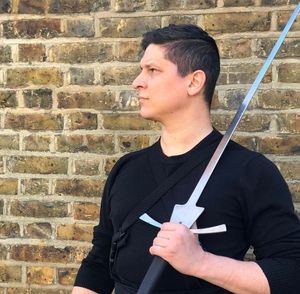

Dear Reader,
I would like you to know that HemaLore is originally written in my mother tongue, and then I use AI to translate it and smooth the reading in English. Everything you find here is my own intellectual work, created by me, Gábor Antali, along with any mistakes or errors that may come with it.
This project of mine is meant for entertainment. It is not intended as an academic essay or formal scholarly work.
🎧 Recommended Listening: Siouxsie and the Banshees – "Cities in Dust"
For the full atmospheric experience, put this track on while reading—because nothing says swordfighting history like post-punk vibes and dramatic synths. Trust me, it works. 😉
Historical European Martial Arts—commonly called HEMA—is a fascinating, ever-evolving martial art rooted in the combat traditions of medieval and Renaissance Europe, continuing up through the early 20th century, including the period around World War I. HEMA, as we know it today began to blossom in the second half of the 20th century, sparked by a curiosity for historical weapons and a desire to revive martial systems preserved in surviving European books and manuscripts.
HEMA is a dynamic and adaptable martial practice, covering a wide variety of weapon styles and unarmed techniques. These arts were used both on the battlefield and in civilian life, with or without armor—even on horseback. HEMA isn't a single martial art, but an umbrella term that includes many styles and disciplines.
The experience you’ll have in HEMA depends a lot on the club or group you join. Each may focus on different weapons, eras, or training goals. So it’s always worth asking what a particular group specializes in before diving in.
The Soul and Heart of HEMA
The Soul of HEMA is the historical source material—source, source, soooource! 😊
Books, paintings, manuscripts, drawings… so many documents have luckily survived the iron tooth of time. Dedicated scholars have transcribed and translated these into modern languages, giving us access to incredible knowledge. It’s amazing how rich and sophisticated these martial traditions are—and we’re still discovering more sources today!
The Heart of HEMA is the people.
The instructors interpreting those historical texts. The fencers who breathe life into old techniques. The club founders, community builders, competition organizers, and small businesses making gear for this unique art. It’s the love, passion, and effort of countless individuals that keep HEMA alive and growing.
What Can You Learn?
That depends a lot on your club. But no matter where you train, you’ll find that HEMA teaches values like:
Self-control
Confidence
Humility
Discipline
Respect
And of course—how to fight with swords!
There are two main types of clubs (most fall somewhere between):
Social Fencing Communities
These are relaxed, welcoming groups where people of all backgrounds can enjoy fencing together without pressure. Perfect for those more interested in movement and history than competition.
Competitive Fencing Communities
These clubs focus on tournaments and see HEMA as a martial sport. They enjoy pressure testing techniques and pushing physical limits through regular challenges and sparring.
What Weapons Can You Learn?
Almost every club focuses on one or a few weapons as their main study. Larger clubs may offer more.
The most popular weapon by far is the two-handed longsword. It's well-documented in historical sources and has become the flagship weapon of HEMA competitions.
Other popular weapons include:
Military sabre
Rapier (and rapier with dagger)
Sidesword and buckler
Messer (a big battle knife)
Small sword
Some weapons are taught but not commonly used in competition, such as:
Polearms (halberd, poleaxe)
Staves (short and long)
Greatsword
Dagger
Sickle
Flail
Scythe
Dual shields
Peasant stick
Historical wrestling (many styles)
Mounted fencing (on horseback – still rare!)
Note: Armoured HEMA exists but is still a smaller niche. It’s not the same as Buhurt, which is a full-contact sport with its own separate tradition.
Competitions: A Cavalcade of Chaos and Craft
HEMA doesn’t have a single universal ruleset. There are many different formats, but most competitions share some core elements.
The Goal:
Hit your opponent without being hit. (Simple idea, incredibly hard to master!)
Most parts of the body are valid targets, with some areas like the back of the head, spine, and groin often excluded for safety.
Safety First:
All competitions require standard safety gear:
Fencing mask with additional protection
Padded jacket and trousers
Rigid elbow, forearm, and knee protectors
Chest protection
Groin protection
And more, depending on the event.
Weapons are blunt, flexible, and designed to replicate the original weapons safely. They have no sharp edges or point and aren’t excessively heavy.
Techniques:
HEMA allows a full range of strikes—thrusts, cuts, and slices—but all techniques must be performed with mechanical excellence for judges to award points. This means a thrust can't be just a light touch, and a cut must have sufficient intent and structure—not just a gentle tap. Some grappling techniques are also allowed (within safety limits). However, there are no knockouts or submissions—HEMA is a point-based combat sport.
Pro Tip:
If you’re able to apply the perfect ending during a bout—meaning, as described by the old masters, you successfully strike your opponent while defending yourself at the same time—that is considered the highest form of fencing. It’s beautiful, clean, efficient, and often leaves no room for argument in competition about who scored the point.
An equally satisfying moment is executing a clean disarm or grappling action while protecting yourself. These moments show true control, understanding of timing and distance, and mastery of the art.
Formats:
Some competitions reset after every scored point (like Olympic fencing), while others prefer continuous fights.
Most events match the same weapons (e.g., longsword vs. longsword), but some have started experimenting with mixed weapon matchups—imagine facing a rapier and dagger with a longsword!
Rankings:
Many competitions upload results to the HEMA Ratings website, which tracks fencer performance and ranks them across various weapons and regions.
Final Thoughts
Historical European Martial Arts are a thrilling and rich form of martial expression. There is still so much to learn, develop, and rediscover. Whether you want to study ancient techniques, compete, or just swing a sword and make friends—HEMA has something for you.
P.S.
To the mysterious billionaire out there who’s been secretly dreaming of funding a professional swordfighting sport for global entertainment—this is your sign. I’m ready. The swords are ready. The world is almost ready.
Let’s build the next great combat sport together.
Seriously… write me. I won’t tell anyone. 😉⚔️
Dear Reader,
If you enjoy the content and would like to support the growth of HemaLore, please consider becoming a member for just $1/month.
Your support helps me create more articles, explore deeper topics, and keep this project alive and growing.
Thank you so much for being part of the journey!
References and more
Swordfighting Sources for free ( please support them they are awesome)
https://wiktenauer.com/wiki/Main_Page
A few competition footage
https://www.youtube.com/watch?v=IKyGZceCHP8
https://www.youtube.com/watch?v=91IIARM5lVs
https://www.youtube.com/watch?v=NtaBLxTAX2A
Non-choreographed armor fighting
Sword knowledge in general
Awesome example about a Hema club
The SwordFight Club London/Bromley, United Kingdom