
The fluorescent lights of Stellar Flight Academy always hummed with a low, steady energy, but today, there was a palpable buzz, like an aircraft at idle, ready for takeoff. Captain Anya Sharma, a seasoned airline pilot moonlighting as a flight instructor for advanced students, felt it keenly. She watched her student, David, a promising but sometimes overly cautious aspiring commercial pilot, strap into the cockpit of the FP7+.
"Alright, David," Anya’s voice came through his headset, calm and clear. "Today, we're going to put that new motion platform to the test. Let's start with a normal takeoff from a short field, just to get your feel for it."
David nodded, his hand resting lightly on the Cirrus sidestick. He’d flown the old fixed-base sim a hundred times, but the FP7+ was a different beast entirely. It wasn't just the hyper-realistic XR visuals, showing a perfectly rendered KCRG (Cambridge, MD) airport in crisp detail; it was the entire cockpit, nestled within the gleaming black frame of the 6-Degrees-of-Freedom motion platform, subtly shifting, breathing with anticipation.
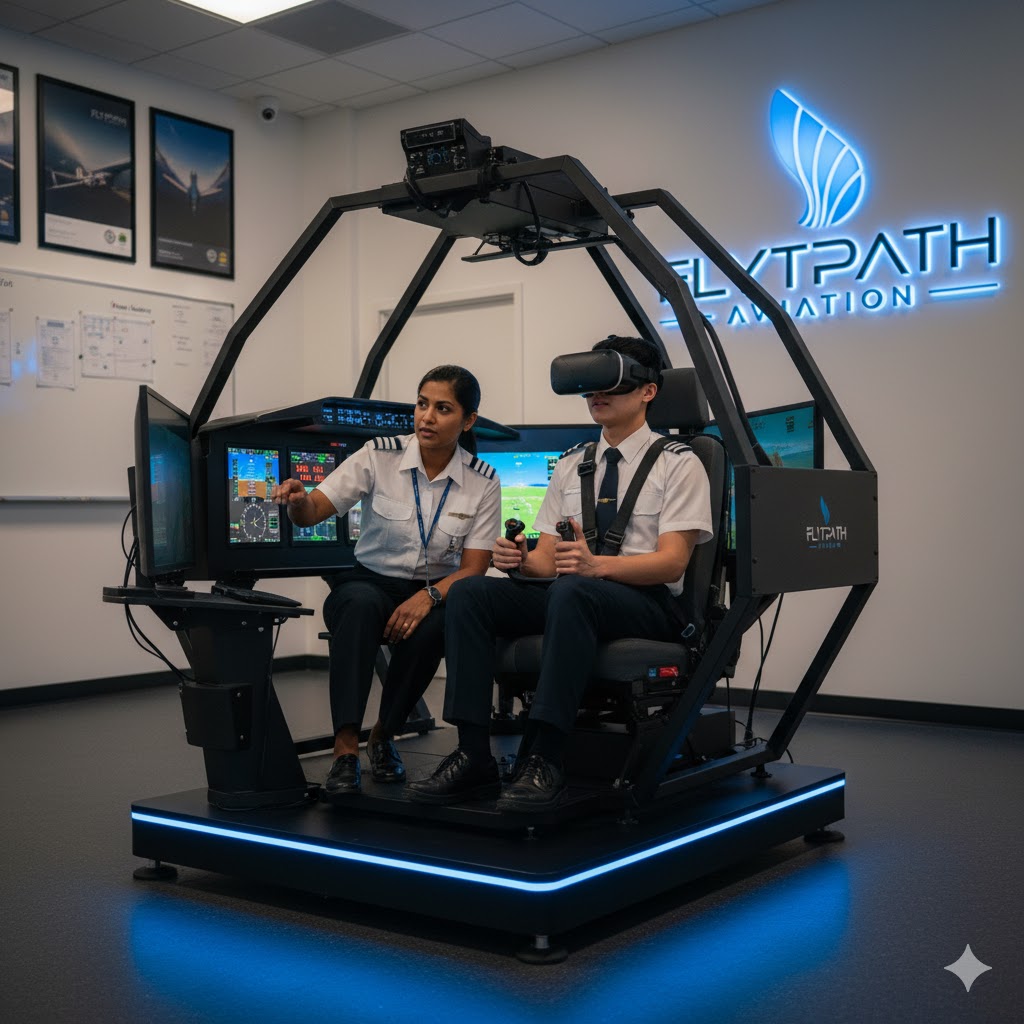
As David advanced the throttle, the platform immediately responded. He felt the surge, the initial push against his seatback, replicating the acceleration down the runway. The subtle vibrations through the airframe, the nose wheel lifting, the main gear skipping off the ground—it was all there, transmitted directly to his body.
"Positive rate, gear up," Anya prompted, her eyes on the Instructor Operating Station (IOS), watching the data stream. David’s hands moved with a newfound confidence.
"Now, David, let's try something a little more... dynamic." Anya subtly injected a scenario into the sim. "You're at 500 feet, climbing, when you hit a sudden, unexpected gust of wind. You've got an immediate, significant loss of airspeed."
Before Anya finished speaking, the FP7+ lurched. David's body was instantly thrown sideways, then pitched forward as the sim accurately depicted a sudden sinker and an uncommanded yaw. His instincts, honed by countless hours in real aircraft, immediately took over. He felt the buffet through the controls, the subtle shudders indicating an approaching stall, and without hesitation, he pushed the nose down, added power, and coordinated with rudder. The platform moved with him, the forces mirroring his recovery, a deep, physical confirmation that his inputs were correct.
He leveled out, breathing a little harder. "Wow. That... that really felt like it. I actually felt the plane drop."
Anya smiled. "That's the point, David. Your body is learning the nuances, not just your eyes. We're building muscle memory for the moments that matter."
They continued, pushing the boundaries. David practiced an engine failure at a critical phase of flight, feeling the sudden, violent yaw that would characterize a loss of thrust in a single-engine plane. He experienced the terrifying disorientation of entering thick cloud in an uncommanded turn, the platform subtly twisting to reinforce the confusion his inner ear would feel, forcing him to rely solely on his instruments.
The climax of their session came with a full CAPS (Cirrus Airframe Parachute System) deployment. This was a maneuver impossible to practice in the real world, yet absolutely critical for a Cirrus pilot to master.
"We have an unrecoverable airframe failure, David. Deploy CAPS," Anya commanded.
David reached up, his hand closing around the red handle on the overhead console. The tension was realistic, a heavy 45 pounds of force. He pulled. The simulator reacted with an immediate, jarring deceleration and a violent, controlled swing as the virtual parachute deployed. David felt his body press into the harness, the sudden shift in momentum, the pendulum motion as the aircraft settled. It was a visceral, unforgettable experience.
When the session ended, and David unstrapped, he looked a little pale, but his eyes were bright with understanding. "Captain Sharma," he said, "I've never felt anything like that. In the old sim, it was intellectual. Here, it was... physical. I actually learned how to react with my whole body."
Anya nodded. "That's the magic of Flytpath Aviation. It's not just a simulator; it's a bridge to real-world experience. You just gained hours of invaluable experience that would have been impossible or too dangerous to get in an actual aircraft."
As David packed up, Anya thought about the broader impact. Flight schools could now provide this training, reducing costly aircraft hours, fuel burn, and wear-and-tear, while simultaneously producing safer, more confident pilots. The FP7+ wasn't just a piece of technology; it was an investment in the future of general aviation, ensuring that the next generation of pilots would be ready for anything the sky could throw at them, not just intellectually, but instinctively. The low hum of the academy seemed to carry a new promise now, a testament to training that truly moved.