

Introduction
Managers today face increasingly complex situations, it feels like every small detail need to be controlled to keep the overall projects or supply chains in control, leading to information overload, increased noise level and potentially burnout. Theory of Constraints simplifies this complexity by focusing on the critical few that drive the system’s performance.
What is the Theory of Constraints? Developed by Eliyahu M. Goldratt, the Theory of Constraints (TOC) is a management philosophy that identifies and addresses the most critical constraint in a system to maximize its overall performance. It provides a structured framework for continuous improvement while emphasizing four main principles (four pillars of TOC):
Inherent Simplicity: Every system is interconnected, and its behavior can be fully controlled by managing a few critical points, often just one.
Inherent Consistency: Every conflict can be removed by finding a win-win solution that aligns individual and organizational goals.
Inherent Goodness: People are inherently good. When provided with the tools and clarity to succeed, they align their efforts with organizational objectives.
Inherent Potential: Never say, “I know.” Continuous improvement requires acknowledging there is always more to learn and discover.
By embracing these pillars, TOC not only offers practical tools for improvement but also instills a mindset that promotes collaboration, growth, and resilience.
The Five Focusing Steps
TOC introduces a structured method for continuous improvement, known as the Five Focusing Steps:
Identify the Constraint: Pinpoint the bottleneck that limits the system’s performance.
Exploit the Constraint: Maximize the productivity of the constraint without requiring additional resources.
Subordinate Everything Else: Align all other operations to support and protect the constraint.
Elevate the Constraint: If the constraint remains a bottleneck, invest in additional capacity or resources to resolve it.
Repeat: Once the constraint is resolved, find and address the next limiting factor.
This iterative process ensures sustained progress and helps managers focus their efforts where they matter most.
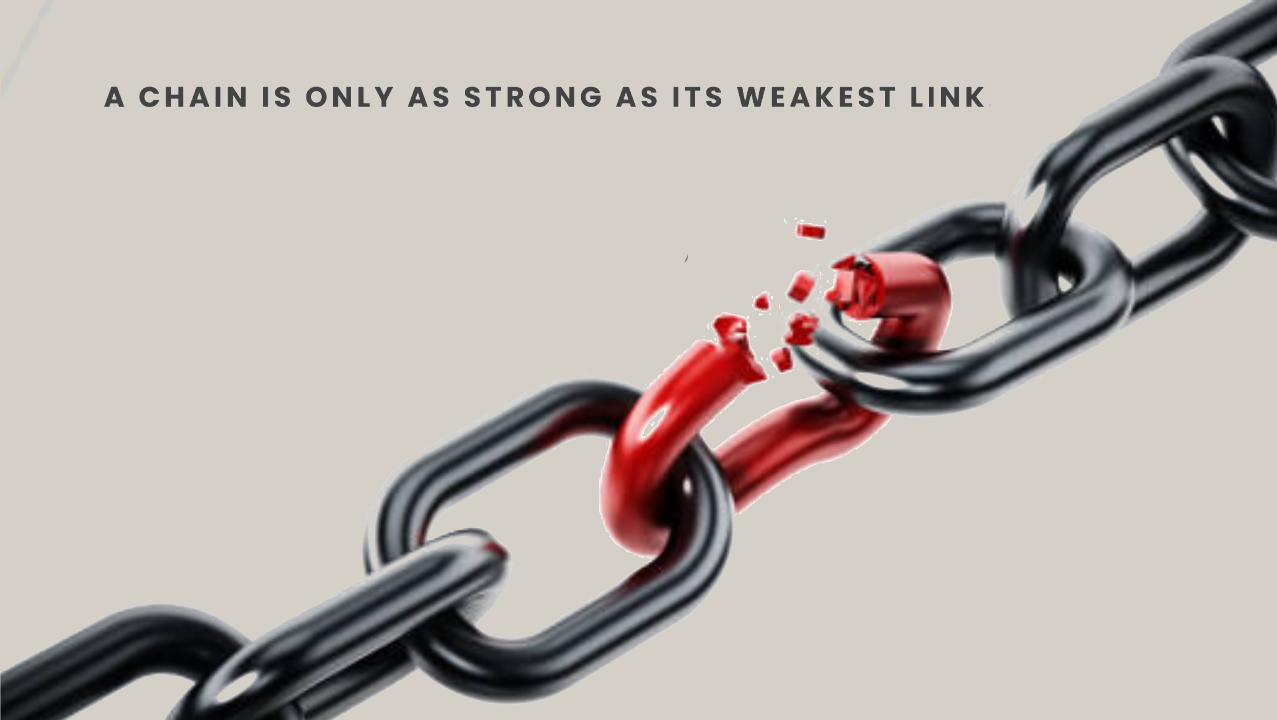
Analogue to say that you can improve a chain performance only acting on its weakest link or improve the flow of an economic system only acting on the chocke point. The 5 focusing steps help you identyfing this leverage point and exploit it for the betterment of the overall system.
Personal Perspective: Why TOC is a Manager’s Secret Weapon
As a manager, I’ve found TOC invaluable for three main reasons: Goal Tree and Alignment, Throughput Accounting, and Risk Standardization. Together, these tools simplify complexity, improve decision-making, and foster proactive teamwork.
1. The Goal Tree: A Tool for Alignment
The Goal Tree is a visual tool that breaks down an overarching goal into Critical Success Factors (CSFs) and Necessary Conditions (NCs). It bridges the gap between strategy and execution.
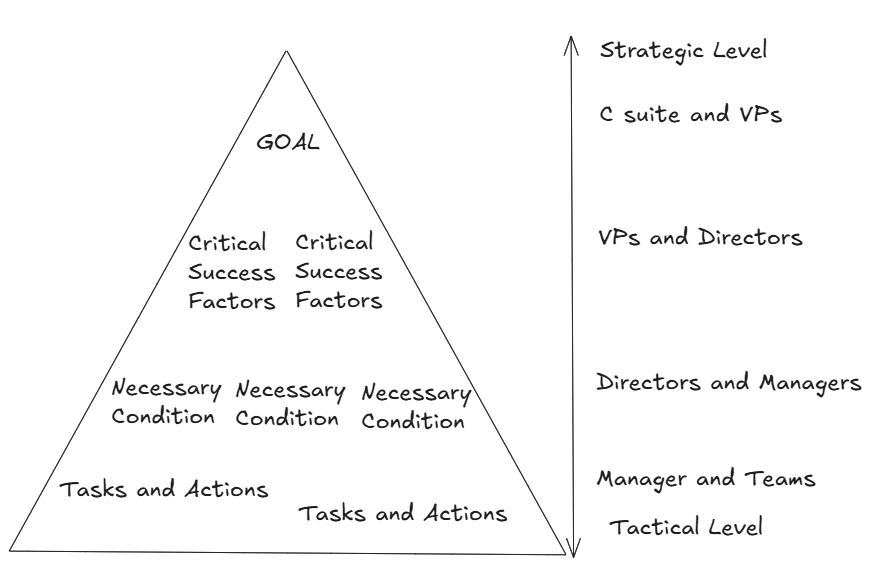
Why it matters: The Goal Tree ensures that intentions are communicated clearly across the management chain, eliminating gaps where teams might interpret strategies differently and pursue conflicting tactics.
The outcome: Teams stop chasing KPIs blindly and align their efforts toward a unified organizational goal.
2. Throughput Accounting: A Framework for Better Decision-Making
Throughput Accounting (TA) focuses on maximizing the flow of money through the system, emphasizing decisions that increase throughput (value delivered to customers). Unlike traditional cost accounting, TA provides a clearer picture of the true impact of decisions.
Why it matters: TA shifts managerial focus to three key metrics:
Throughput: The rate at which the system generates money through sales.
Inventory: The money tied up in the system (e.g., materials, work-in-progress).
Operating Expenses: The money spent to turn inventory into throughput.
Managers can make smarter, faster decisions by focusing on throughput rather than cutting costs indiscriminately.
The outcome: Decision-making becomes aligned with long-term value creation, ensuring resources are allocated to activities that truly drive system performance.
3. Risk Standardization and Proactive Teamwork
TOC provides a clear framework for managing risks, rooted in the philosophy of accepting variation as unavoidable and allocating measured protection against it.
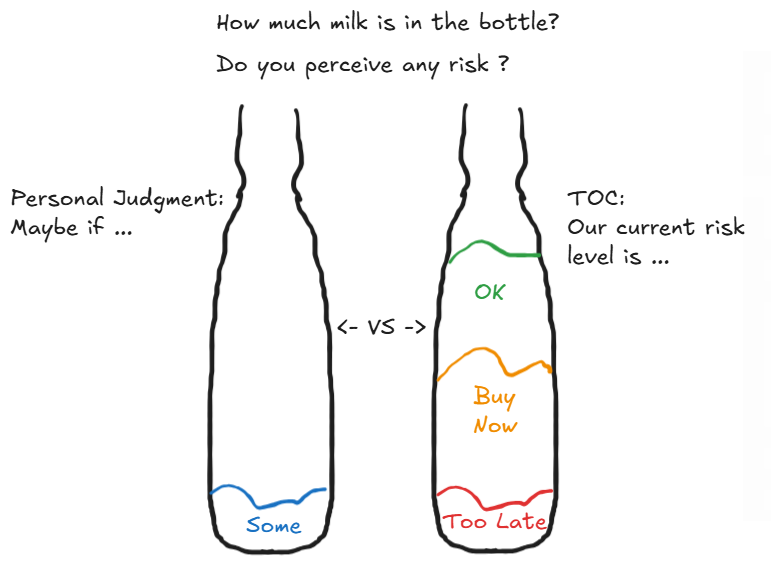
Why it matters: TOC uses pre-agreed thresholds (green, yellow, red) to define when and how to act, ensuring a consistent understanding of risk across teams.
The outcome: Risk management becomes measurable, standardized, and proactive. Teams work collaboratively to reduce risks, fostering trust and transparency throughout the organization.
Deming and Goldratt: Reducing Variation to Improve Throughput
Both W. Edwards Deming and Eliyahu Goldratt stressed the importance of addressing variability, albeit from different angles:
Deming’s Insight: Focused on reducing systemic variations through statistical control, improving quality and predictability.
Goldratt’s Contribution: Highlighted how variability at constraints amplifies delays, disrupting the entire system.
By reducing variations that affect constraints, TOC stabilizes the entire system performance, enhancing reliability and throughput.
TOC Meets Lean and Six Sigma: The TLS Approach
The TLS methodology integrates TOC, Lean, and Six Sigma for a laser-focused improvement framework: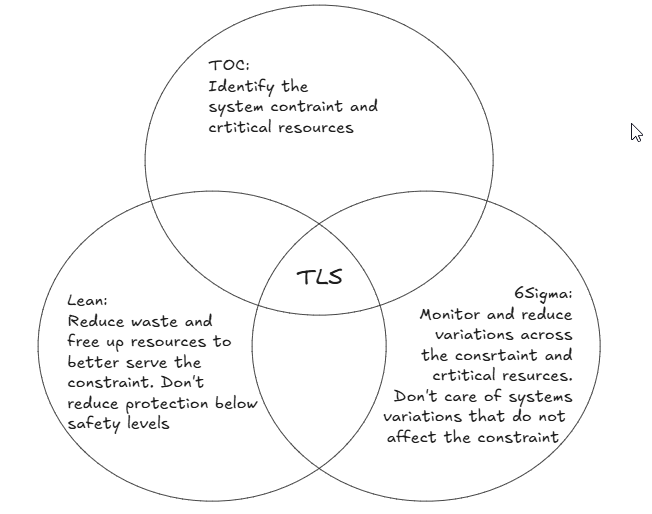
TOC identifies the bottleneck to determine what to improve.
Lean eliminates waste and non-value-adding activities.
Six Sigma targets critical variations impacting constraints.
Unlike broader Lean Six Sigma implementations, TLS focuses on the variations that matter most, delivering faster and more measurable results.
Applications in Management and Operations
TOC’s principles shine in various managerial contexts:
Goal Trees for Strategic Alignment: Clarify objectives and ensure teams work toward shared goals, avoiding conflicting tactics.
Risk Management with Buffers: Use TOC’s buffer management to measure, track, and address risks consistently, ensuring proper bottlenecks management.
Critical Chain Project Management (CCPM): Manage resources and timelines effectively by protecting the constraint in complex projects.
Conclusion: Simplifying Complexity with TOC
The Theory of Constraints isn’t just a framework: it’s a philosophy that empowers managers to align teams, manage risks, and simplify complexity. Tools like the Goal Tree provide clarity and focus, while TOC’s approach to variability builds trust and resilience by protecting the system constraints. By embracing TOC, managers can turn bottlenecks into opportunities and drive meaningful, sustained improvements.
Enjoyed the content?
If you found this article useful, consider supporting my work with a coffee or exploring the downloadable examples available on my Buy Me a Coffee page. Your support helps keep the motivation high and fuels more hands-on content!

Bibliography
Goldratt, E.M. (1990). The Goal: A Process of Ongoing Improvement. North River Press.
A foundational text introducing TOC, the Five Focusing Steps, and the importance of constraints in system optimization.
Goldratt, E.M. (1997). Critical Chain. North River Press.
Explores TOC's application in project management and introduces Critical Chain Project Management (CCPM).
Goldratt, E.M. (1994). What is This Thing Called Theory of Constraints?. North River Press.
A deeper dive into TOC’s core principles, including inherent simplicity and the belief in people’s potential.
Deming, W. Edwards (1982). Out of the Crisis. MIT Press.
Details Deming’s philosophy on quality, systems thinking, and reducing variability in processes.
Schragenheim, Eli, and Henry Fitzhugh Camp (2000). Manufacturing at Warp Speed: Optimizing Supply Chain Financial Performance. CRC Press.
A practical application of TOC to supply chain management, with a focus on buffers and throughput.
Dettmer, H. William (2007). The Logical Thinking Process: A Systems Approach to Complex Problem Solving. ASQ Quality Press.
Provides tools for implementing TOC principles systematically in complex environments.
Goldratt, E.M. (2009). Isn’t It Obvious?. North River Press.
A novel exploring TOC in the context of retail inventory management and logistics.
Liker, Jeffrey K. (2004). The Toyota Way: 14 Management Principles from the World's Greatest Manufacturer. McGraw-Hill.
Focuses on Lean principles and their synergy with TOC.
Pande, Peter S., et al. (2000). The Six Sigma Way: How GE, Motorola, and Other Top Companies are Honing Their Performance. McGraw-Hill.
A comprehensive guide to Six Sigma methodologies, useful for understanding its integration with TOC and Lean in TLS.
Marris Consulting (2024). The Case for TLS: TOC, Lean, and Six Sigma as a Unified Approach. Marris Press.
An updated resource detailing the TLS methodology and its high-impact approach to process improvement.
Goldratt Institute (2020). TOC Insights: Managing Variability.
A white paper focusing on the role of variability in constraint management and throughput optimization.
Ohno, Taiichi (1988). Toyota Production System: Beyond Large-Scale Production. Productivity Press.
Explores the foundations of Lean and its role in waste reduction, complementing TOC's focus on constraints.
Lepore, Domenico, and Cohen, Oded (1999). Deming and Goldratt: The Theory of Constraints and the System of Profound Knowledge. North River Press.
A seminal work linking the philosophies of Deming and Goldratt, showing how reducing variability and focusing on constraints can drive systemic improvement.