
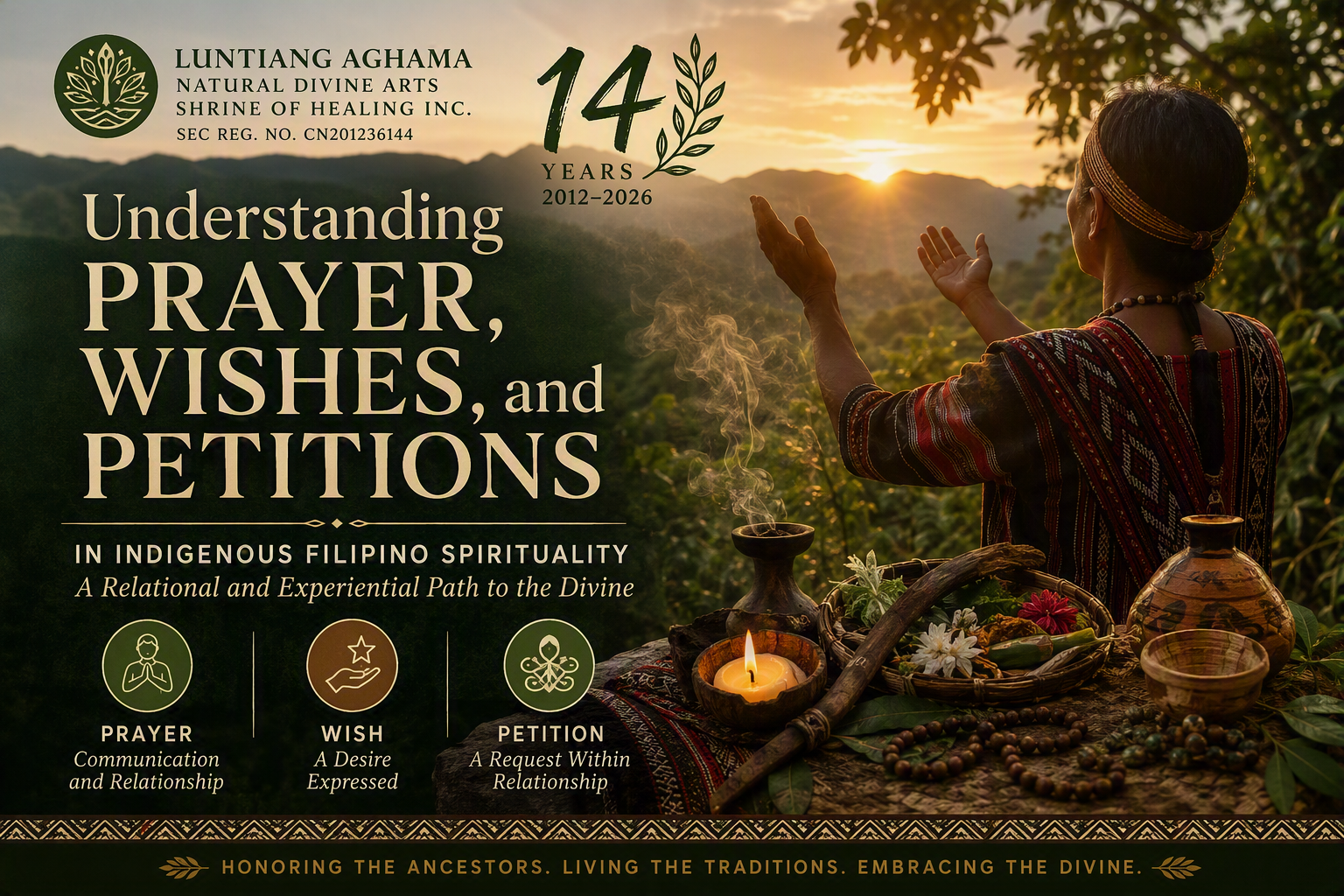
 Last September 4, 2026, we celebrated an important milestone in our spiritual journey. Fourteen years ago, on September 4, 2012, Luntiang Aghama Natural Divine Arts Shrine of Healing Inc. was officially registered with the Philippine Securities and Exchange Commission as a religious corporation. What began as a vision to preserve, practice, and share the wisdom of our ancestors has now grown into a living movement dedicated to advocating Malayang Maaram Faith, also known as Indigenous Filipino Spirituality.
As I reflected on our anniversary, Lakay asked me a simple but profound question:
"What is the difference between prayer, a wish, and a petition?"
Many of us use these words interchangeably. However, within Indigenous Filipino Spirituality, they carry distinct meanings. Understanding these differences can help us deepen our spiritual practice and better understand how our ancestors related to the unseen world.
Prayer: The Language of Relationship
Many people think of prayer as a collection of sacred words, memorized formulas, or recited invocations. While words can certainly be part of prayer, our ancestors understood prayer in a much broader way.
For the precolonial Filipino, prayer is communication with Spirit.
Prayer is not limited to spoken language. It can be expressed through silence, song, chanting, dance, ritual gesture, tears, gratitude, intention, or even the sincere movements of the heart. Prayer is the expression of our thoughts, feelings, and aspirations directed toward the Great Divine Spirit and the many unseen beings who share existence with us.
As Filipinos, our ancestors believed that reality extends beyond what the physical eyes can see. They recognized that humans coexist with unseen beings and intelligences, some possessing greater wisdom, power, and understanding than ourselves. Because of this, our elders taught us humility, respect, and right relationship, not only with fellow human beings but also with the many visible and invisible forms of life that inhabit creation.
Prayer therefore is not merely asking.
Prayer is relationship-building.
Just as friendships grow through conversation, spiritual relationships are strengthened through regular communication. Through prayer, we develop intimacy with the Divine, our ancestors, our spirit allies, and the unseen forces that guide and protect us.
Within many Indigenous Filipino traditions, each person is believed to have an Abyan, a spiritual guide who helps illuminate the path toward wisdom, healing, and personal growth. Some traditions also recognize protective spirits tasked with guarding individuals from harmful influences. Through prayer, we open channels of communication with these spiritual companions and learn to walk in harmony with the larger spiritual ecosystem around us.
Prayer is therefore the foundation of all spiritual relationships.
Without relationship, there is no meaningful spiritual exchange.
A Wish: Expressing a Desire
A wish is something that arises from our hopes, dreams, wants, or needs.
When we make a wish, we express a desire for something we hope to receive or experience. We may wish for health, abundance, protection, success, love, healing, or guidance.
However, a wish carries no inherent spiritual claim.
It is simply a desire expressed toward the universe, toward Spirit, or toward life itself. Anyone can make a wish. No special training, initiation, or spiritual relationship is required.
A wish says:
"This is what I hope for."
Whether that wish comes to pass depends on many factors, including circumstances, timing, personal effort, and spiritual alignment.
A Petition: A Request Within Relationship
A petition goes beyond a wish.
A petition is a formal spiritual request made within an established relationship.
In Indigenous Filipino Spirituality, relationships matter. Spirituality is not transactional; it is relational. Just as we would not demand a favor from a stranger, our ancestors understood that meaningful petitions arise from genuine connections.
When a practitioner makes a petition to a specific spirit, ancestor, or divine being, the request is often grounded in a history of interaction, reciprocity, respect, offering, and service.
This is why a petition carries greater spiritual weight than a wish.
A petition says:
"I come before you not as a stranger, but as one who has cultivated relationship with you."
For this reason, many traditions reserve certain forms of petition for those who have undergone initiation, training, or formal spiritual commitment. While anyone may express a wish, a petition reflects an active spiritual relationship that has been nurtured over time.
This does not mean that the spirit is obligated to grant every request. Rather, it means that the request is being made within an established framework of trust and reciprocity.
The Relational Nature of Indigenous Filipino Spirituality
One of the greatest misunderstandings about Indigenous Filipino Spirituality is the assumption that it is merely a collection of rituals, prayers, or supernatural beliefs.
In reality, it is fundamentally relational.
Our ancestors viewed the universe as a living web of relationships. Humans exist in relationship with nature. We exist in relationship with our communities. We exist in relationship with our ancestors, the spirits, the Divine, and the sacred powers that animate creation.
Knowledge alone is not enough.
A person can read books about spirituality for years and still lack genuine spiritual connection. Indigenous spirituality invites us beyond intellectual knowledge into lived relationship.
This is why prayer, ritual, and offering remain important.
They are not magical shortcuts.
They are acts of relationship.
Every offering express gratitude. Every prayer opens communication. Every ritual strengthens connection. Through these practices, we learn the values of respect, reciprocity, humility, and responsibility.
The Experiential Nature of Indigenous Filipino Spirituality
Indigenous Filipino Spirituality is also deeply experiential.
Our ancestors did not simply believe spiritual truths; they sought to experience them directly.
Wisdom was gained through practice.
Knowledge came through observation.
Understanding emerged through participation.
One learns about healing by healing. One learns about prayer by praying. One learns about one's spirit allies through direct interaction, consistent practice, and lived experience.
This experiential dimension is what makes Indigenous Filipino Spirituality so transformative. It is not merely a philosophy to be studied. It is a way of life to be lived.
Through prayer, ritual, service, and relationship, spiritual knowledge becomes personal experience.
And experience becomes wisdom.
Moving Forward Together
As we celebrate fourteen years of Luntiang Aghama, I am grateful to everyone who has walked this journey with us. From our earliest days until now, our mission remains the same: to preserve and share the living wisdom of Indigenous Filipino Spirituality in a respectful, responsible, and contemporary way.
If our articles, teachings, and reflections have inspired your spiritual journey, I invite you to support our work.
Your support allows us to continue creating educational content, documenting indigenous wisdom, developing learning materials, and preserving the sacred traditions of our ancestors for future generations.
☕ Support our work at Buy Me a Coffee:
https://buymeacoffee.com/filipinomagick
Together, we can continue building a bridge between ancestral wisdom and the modern world, ensuring that the voice of Indigenous Filipino Spirituality continues to be heard, practiced, and experienced for generations to come.
Maraming salamat, at mabuhay ang Malayang Maaram Faith. 🌿✨