
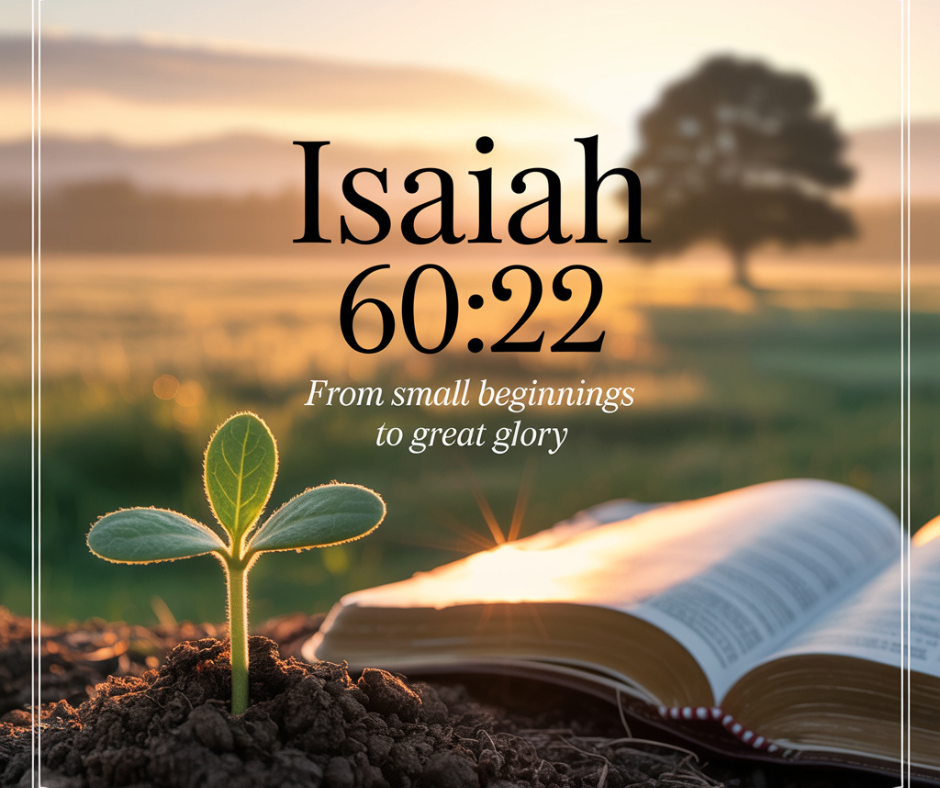
“The least one shall become a clan, and the smallest one a mighty nation; I am the LORD; in its time I will hasten it.”
—Isaiah 60:22 (ESV)
Isaiah 60 brims with prophetic promises of restoration and glory for Israel after exile. Nestled within this chapter is verse 22, a concise declaration of divine sovereignty over growth and timing. In just one sentence, God assures that what begins small will expand into something great, and that He will bring this promise to fulfillment at precisely the right moment. In this post, we will explore the literary and historical context of Isaiah 60:22, unpack its theological themes, examine its immediate relevance to ancient Israel, and draw practical applications for believers today.
1. Context: Chapter 60 and the Promise of Restoration
Isaiah 60 opens with a call to “Arise, shine, for your light has come” (v.1), ushering in a vivid portrait of Jerusalem’s future splendor. This chapter is part of what scholars call “Second Isaiah” (Isaiah 40–55) and “Third Isaiah” (Isaiah 56–66), prophetic sections written during or just after the Babylonian exile (6th century BC). The exiles had experienced the trauma of Jerusalem’s destruction (587 BC), removal from the land, and loss of national identity. Isaiah’s message turns from impending judgment (Isaiah 1–39) to comfort and hope: God would gather His scattered people, restore the covenant community, and exalt Zion as a beacon to the nations.
1.1 Key Features of Isaiah 60
* Universal Attention (vv.1–5): Nations and kings gravitate toward Jerusalem’s radiance—“your sons shall come from afar” (v.4) and “kings shall be your nursing fathers” (v.7).
* Wealth and Prosperity (vv.6–9): Camels bring gold and frankincense, a foreshadowing of Gentile riches flowing to God’s people.
* Justice and Peace (vv.10–14): Ruins are repaired—“violence shall no more be heard in your land” (v.18)—and foreigners become workers in Zion.
* Everlasting Glory (vv.15–22): Though Israel was once forsaken, now God’s presence redeems her. Notably, shepherds and princes will arise, and God’s covenant love ensures the city’s enduring prosperity.
Isaiah 60:22 falls at the chapter’s conclusion, summing up God’s promise that, despite a humbling past, Israel’s future will exceed imagination according to divine timing.
2. Exposition: Unpacking Isaiah 60:22
“The least one shall become a clan, and the smallest one a mighty nation;
I am the LORD; in its time I will hasten it.”
2.1 “The least one shall become a clan”
In Hebrew, “the least” (דָּקָא, daqâ) means “small, insignificant.” God assures Israel that what appears utterly insignificant—small remnants or a handful of exiles—will multiply into a “mishpāḥâ” (מִשְׁפָּחָה), a clan or extended family. In ancient Near Eastern society, a mishpāḥâ connoted both genealogical pride and social stability. What feels tiny now—the remnant returning with Ezra and Nehemiah—will burgeon into thriving familial units settled in the land.
2.2 “The smallest one a mighty nation”
Parallelism heightens the promise: “the smallest one” (קָטָן, qaṭān) will become “a mighty nation” (גּוֹי־גָּדוֹל, gôy-gâdôl). Whereas “clan” suggests internal growth, “mighty nation” signals external influence and strength. Israel, a defeated vassal state under Babylon and then Persia, would assume a renewed identity—no longer cowering but standing strong. This transformation foreshadows later developments under Zerubbabel, Nehemiah, and ultimately the Messianic hope in Christ, through whom God extends blessings to all nations.
2.3 “I am the LORD”
The declaration “I am the LORD” (יְהוָה אֲנִי, YHWH ’ănî) underscores divine authority. God is not a mere observer; He is sovereign, orchestrating the growth of nations. This formula echoes Exodus 3:14 (“I AM WHO I AM”)—God’s self-existence and faithfulness. The promise flows from His unchanging character: if He has spoken, Israel’s restoration and magnification are assured.
2.4 “In its time I will hasten it”
The phrase “in its time” (בְּעֵתּוֹ, bə‘êttô) indicates God’s perfect timing, often inscrutable from a human perspective. Though impatient hearts might chafe for immediate deliverance, the promise arrives precisely when divine wisdom sees fit. “I will hasten it” (אֶמָּהֵר, ’emâhêr) paradoxically suggests both suddenness and punctuality—when the appointed time comes, God will swiftly fulfill His word.
3. Theological Themes in Isaiah 60:22
3.1 Divine Sovereignty over Nations
Throughout Isaiah 40–66, God repeatedly asserts His mastery over world powers (Isaiah 40:15–17; 45:1–7). In 60:22, God’s control extends to national destiny: He can elevate the “smallest” to “mighty nation” status. This sovereignty undermines human pride and points to God’s prerogative to raise or humble rulers according to His purposes (Daniel 2:21).
3.2 Hope in Small Beginnings
Biblical history overflows with examples of God redeeming meager starts: Jacob’s twelve sons multiplied into twelve tribes; Gideon’s band of 300 delivered Israel; Mary’s virgin birth heralded the seed of the world’s Savior. Isaiah echoes this pattern, assuring exiles that their seemingly minuscule numbers anchor God’s grand design for renewal.
3.3 The Interplay of Promise and Patience
“In its time” reminds believers that faith involves both believing the promise and waiting on God. Micah 7:7 echoes: “Therefore I will look to the LORD; I will wait for the God of my salvation.” Jesus Himself was “appointed” (Greek: τέλειον, téleion) but came “in the fullness of time” (Galatians 4:4). Waiting on God’s timetable cultivates perseverance and trust.
3.4 Corporate and Individual Implications
While centering on national Israel, this verse also speaks to individual believers: a person’s faith—even if seemingly small—can mature into a legacy that impacts communities. God often elevates humble servants to positions of influence, not by merit but by His grace (1 Corinthians 1:26–29).
4. Historical Fulfillment and Messianic Overtones
4.1 Post-Exilic Restoration
Historically, Zerubbabel led roughly 50,000 exiles back to Jerusalem (Ezra 2:64–65). Compared to pre-exilic numbers, they were small. Yet under Persian patronage, they rebuilt the temple (516 BC) and reestablished worship. Nehemiah’s return (c. 445 BC) reinforced Jerusalem’s walls and the community’s vitality. Over generations, this remnant regained identity and influence in Judah, proving that God’s promise began to unfold.
4.2 Messiah and the Church
Isaiah’s promise ultimately points to the Messiah, who comes “born of a woman” (Isaiah 7:14) from the tribe of Judah—an ostensibly minor lineage—yet ushers in an age where “a shoot will come out from the stump of Jesse” (Isaiah 11:1). Through Christ, a “small” group of disciples became a worldwide church (Matthew 28:19–20; Acts 1:8). Thus, “small becomes great” finds its ultimate fulfillment in the expansion of God’s kingdom through Jesus.
5. Practical Applications for Today
5.1 Encouragement in Discouragement
When life circumstances feel insurmountable—career struggles, broken relationships, spiritual dryness—remember that God specializes in turning “small” into “great.” A child with a pure heart can influence an entire family; a single act of kindness can ripple through a community. Isaiah 60:22 reassures that God is at work, even when outcomes seem delayed.
Action Step: Keep a journal of “small wins” over weeks or months—answered prayers, incremental progress, moments of peace. Reviewing these entries fosters faith that God indeed is magnifying small steps.
5.2 Trusting God’s Timing
Patience feels scarce in our instant-gratification culture. But true wisdom lies in waiting on God’s “perfect time.” Whether awaiting a new job, healing, or spiritual breakthrough, trust that “in its time” God will act swiftly.
Action Step: Create a “Waiting Prayer” routine: set aside a few minutes each day to silently affirm Isaiah 60:22, focus on God’s sovereignty, and surrender timing concerns. Notice how peaceful trust grows over weeks of practice.
5.3 Embracing Humble Beginnings
If you sense a big calling—starting a ministry, launching a business, or serving others—don’t be discouraged by limited resources or small beginnings. God often chooses what is weak to shame the strong (1 Corinthians 1:27). Expect His enabling to expand your efforts beyond initial human capacity.
Action Step: Identify a “small beginning” project—volunteering at a local center, mentoring one student, writing weekly devotionals—and commit it to the Lord. Pray that He multiply your efforts in ways you cannot foresee.
5.4 Cultivating Community Vision
Isaiah’s promise encompasses corporate restoration. Believers today can apply that to local churches or small groups: God desires to grow faithful communities from modest gatherings. Cultivate a shared vision that, under God’s blessing, a small group can impact a neighborhood, city, or wider region.
Action Step: As a church or small group, discuss Isaiah 60:22. Pray for God’s involvement to foster growth—numerical, spiritual, or missional. Identify one concrete way to extend hospitality or outreach, believing God can magnify your witness.
6. Addressing Common Questions
6.1 “Does Isaiah 60:22 Guarantee Instant Success?”
No. The promise affirms that God’s enlargement occurs “in its time.” Biblical examples—Israel’s regathering, Nehemiah’s rebuilding, Jesus’s ministry—often involved years of preparation and seeming setbacks. Trust that God is not slow (2 Peter 3:9) but operates on an eternal timetable.
6.2 “Is This Promise Only for National Israel?”
While Isaiah addressed Israel’s restoration, New Testament writers apply similar principles to the church. For example, Christ’s parables of the mustard seed (Matthew 13:31–32) and the leaven (Luke 13:20–21) echo small-to-large growth. Thus, the principle extends to faith communities and individual Kingdom projects.
6.3 “What If I Never ‘Become Great’?”
“Greatness” here reflects God’s purpose, not human definitions of success or fame. A faithful life in Christ—marked by love, service, and perseverance—is itself “great” in God’s eyes. Moreover, some promises await consummation at Christ’s return, when the eschatological “mighty nation” of God’s redeemed fully emerges.
7. Conclusion: Anchored in Divine Promise
Isaiah 60:22 offers a beacon of hope: what seems tiny in our eyes—our talents, our resources, our numbers—God can magnify into something extraordinary. Yet this transformation unfolds “in its time,” underscoring divine sovereignty and wisdom. Whether you lead a fledgling ministry, navigate personal setbacks, or yearn for community revival, remember:
* Wait on the Lord with active faith (Isaiah 40:31).
* Trust in God’s timing even when circumstances appear stagnant.
* Embrace humble beginnings as the very platform for God’s multiplying power.
* Celebrate incremental growth as evidence that God is at work.
As you meditate on Isaiah 60:22, let it reshape your perspective: small beginnings are not obstacles but invitations for God to display His greatness. May you live each day in confident expectation that the “least one” entrusted to God will become part of a People through whom He reveals His glory to the ends of the earth.
Prayer of Expectant Hope
Heavenly Father, You are our sovereign King who takes what is small and multiplies it according to Your perfect will. Help us to wait on Your timing, to trust in Your purposes, and to embrace each humble beginning as fertile ground for Your power. May we see Your promise unfold in our lives, communities, and ministries—that what seems insignificant now will become a mighty demonstration of Your grace and glory. In Jesus’ name, Amen.