

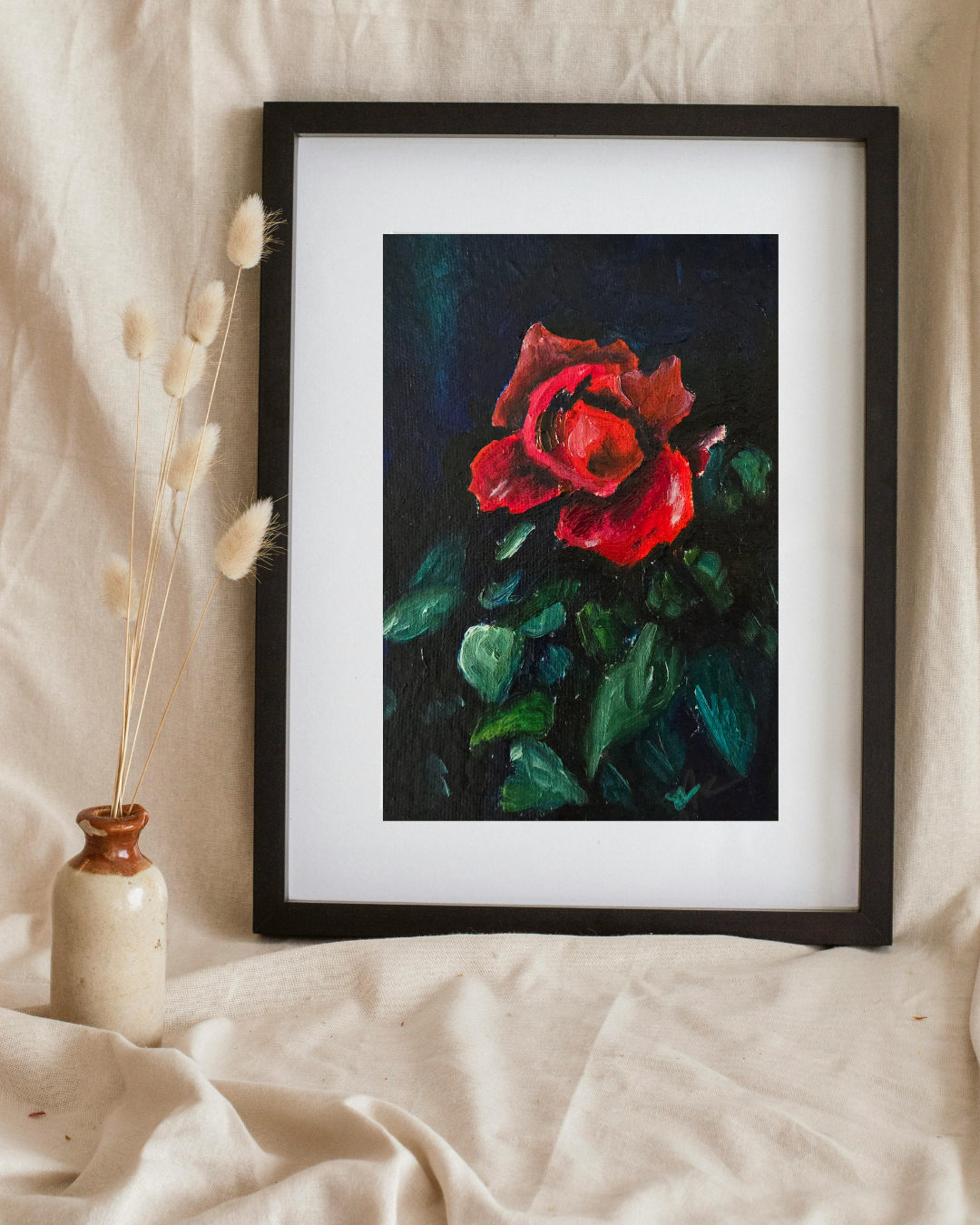
 Pictured: "Red and Black Rose" oil painting
Order prints of Red and Black Rose from Geo Galleries here
Burns Awareness Week is the first full week in February, recognized with a red ribbon.
The ribbon color was used in the petals of this rose. The petals have deep black shadows to symbolize the charred skin that can present with severe burns. A rose was used as a reminder that roses are always beautiful, no matter what color or stage of bloom they are in. Someone that has been severely burned can still be beautiful too.
Burns used to be known as first, second- and third-degree burns. Burns are now classified as superficial, partial thickness and full thickness burns.
Superficial burns are similar to a sunburn. Run cool water over the skin to stop the burning process. The treatment for partial thickness burns is similar. Partial thickness burns present with blisters- don't pop them! Popping a blister causes an opening in the skin that can become infected.
Full thickness burns are the most severe. These burns may look black and charred, or even white. These burns may be extremely painful, or even painless due to nerve damage. Jewelry should be taken off or cut off immediately due to swelling that will occur.
Our skin helps regulate our body's temperature. For this reason, burn units are kept warm. Burn patients can be treated in a variety of ways, including medications for pain, swelling or infection control, surgery, and dressing changes. Debridement, skin grafts, and fasciotomy may be performed as well.
Burn units see a high turnover rate due to the stressful nature of the work. I worked with a burn unit nurse one night that had picked up an extra shift in the ER. She told me that the high turnover rate is due to how difficult it is seeing patients in pain during treatment. However, modern day medicine can help patients fully recover. One of my high school students told me that as a young child, she accidentally burned her face severely. Looking at her, you would never know! She had zero scars or deficits.
Burn prevention is best. Make sure to have smoke detectors installed, don't leave candles unattended, and be mindful of what you are doing while cooking. Keep a fire extinguisher in your kitchen just in case, and remember PASS- pull, aim, squeeze, sweep to put out a fire.
Learn more:
About the integumentary system (our skin)
The integumentary system is a vital component of the human body, primarily composed of the skin, which is the largest organ. This system serves multiple essential functions that are crucial for maintaining overall health and well-being.
One of the primary roles of the skin is to protect the body from environmental hazards. It acts as a barrier against pathogens, chemicals, and physical injuries. Additionally, the skin plays a significant role in regulating body temperature. Blood vessels within the skin can contract and dilate in response to temperature changes, helping to maintain a stable internal environment. Furthermore, the skin produces sweat, and the evaporation of sweat from the body is a key mechanism for cooling down.
The integumentary system is composed of three main layers:
Epidermis: This is the outermost layer of skin, which is superficial and consists of several layers. It provides a watertight protective barrier for the body, with thickness varying across different body parts. The epidermis includes:
Stratum Corneal Layer: A dead layer of skin that helps protect underlying layers.
Germinal Layer: Responsible for producing new skin cells that migrate to the surface and also provides pigment.
Dermis: Located beneath the epidermis, the dermis contains essential structures such as sweat and oil glands, hair follicles, blood vessels, and nerve endings. Key functions include:
Production of sweat by sweat glands to cool the body.
Production of sebum by oil glands, which seals the skin's surface and keeps it soft.
Each hair follicle is associated with a sebaceous gland.
Subcutaneous Tissue: This layer is primarily composed of fat, which serves to insulate the body and store energy. It also helps anchor the skin to the underlying structures.
Learn more about the integumentary system:
Watch a video by the Amoeba Sisters
Artist blog content and images are not authorized for reproduction. Produced for information and encouragement only; consult your doctor for health advice.