
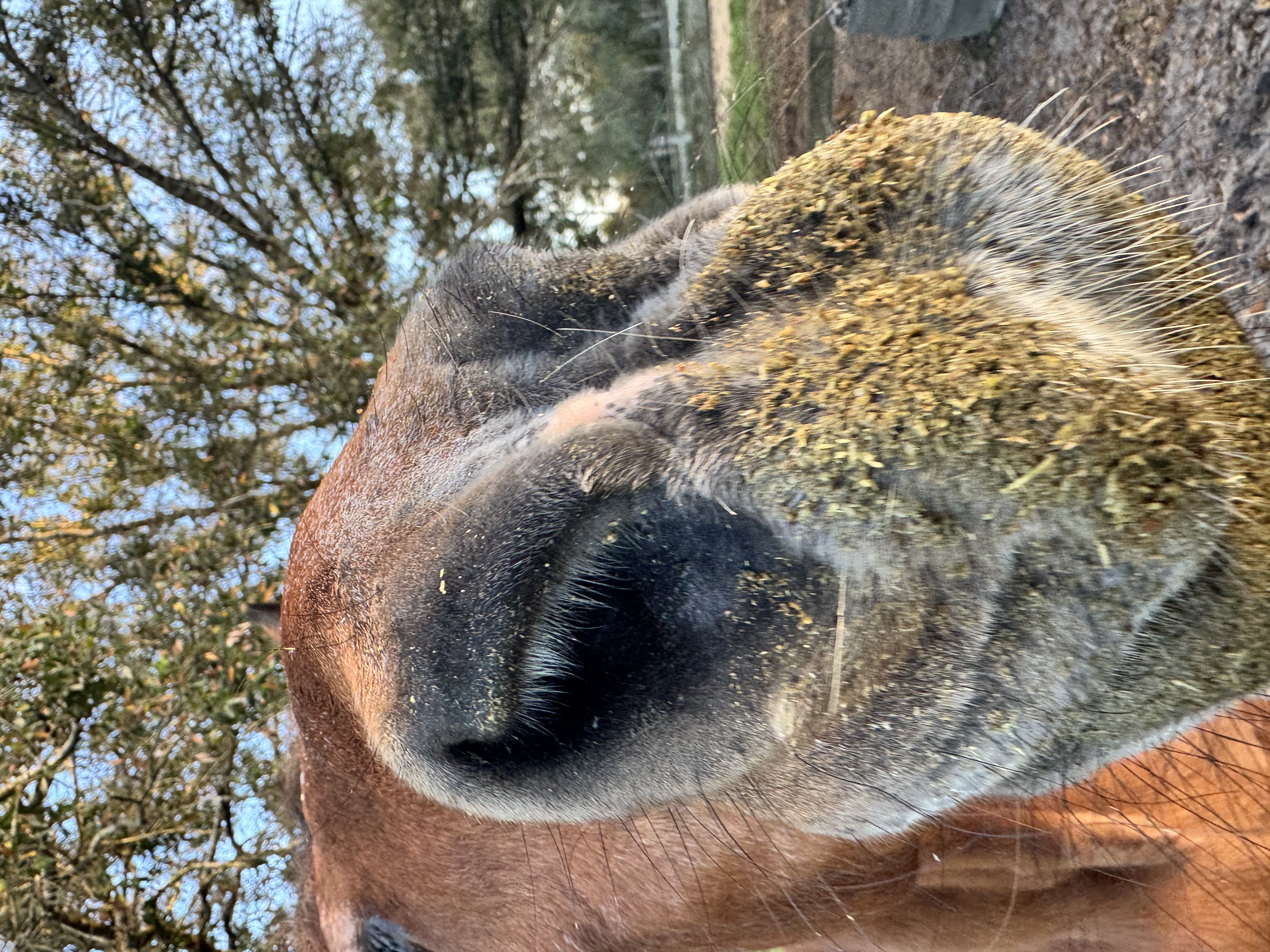
One of the top reasons people abandon clicker training shortly after they begin is that their equids often start behaving in unexpected ways that make the person uncomfortable.
When you’ve been told all your life that horses are dangerous and you need to make your equid respect your space, it’s easy to understand why people get nervous when their equids get excited about the food and start crowding them, cutting them off, and frisking them for food.
Below are a few things you can do to prevent your equid from becoming a treat monster, so you can successfully clicker-train them without fear.
1. Have free food available during your training sessions.
When the only food available is the food you’re carrying, your equid may feel a little desperate if they don’t know how to get the food. Trying to work with a hungry animal is not conducive to good training. It will be harder for them to focus, and it will end up being more negative reinforcement (relief from hunger) than positive reinforcement (adding an appetitive).
Instead, make sure your equid has had something to eat (like hay) before your training session and keep free food (more hay!) available for your equid during training sessions.
2. Start training in protected contact.
Your equid might have issues around food that you don’t know about, which means that they might throw out some very unexpected behaviors when you first introduce food reinforcers to them. For this reason, it’s best to start training in protected contact.
Protected contact will help your equid focus on what you’re teaching while limiting their behavioral options, like searching for food on your person or crowding you. Because they’re unable to reach you, you’ll have more opportunities to reinforce the behaviors you want, and they’ll learn a lot faster that the food comes to them.
3. Know the value of the food you’re using.
The higher the value of the food, the more likely your equid is to mug you. Start clicker training with low-value food to help keep your equid’s excitement in check. The food should be valuable enough to work for, but not so valuable that your equid is desperate to get it.
In my experience, most equids are happy to work for hay, hay pellets, or similar feed. Save the high-value foods or treats for when you’re working on more challenging behaviors, like loading into a trailer or accepting an injection.
4. Click before you move your hands.
Because we’re impatient by nature, we tend to start the food delivery process before we’ve clicked the clicker. Unfortunately, the movement of your hand ends up marking the behavior for the horse rather than the clicker, which can lead to a lot of confusion for your equid, as your behavior is not clear or consistent.
Instead, make sure to keep your hand still until you’ve marked the intended behavior with your clicker, then move your hand to reach for the food. Or try preloading your hand so you can deliver the food immediately after the click, instead of reaching into your pouch. This can be useful when you need to maintain a high rate of reinforcement, but your hand must be still before you click, either way.
5. Feed where you want your equid to be.
Your equid might move between the moment you click and the moment you deliver the food, but you’re still going to deliver the food to where your equid was when you clicked and not necessarily where they end up after you click.
You can also use food delivery to move your equid, instead of pushing them if you feel they’re too close. For example, if your equid is too close for comfort and you want them to back off, you can deliver the food towards their chest so that they have to back up to get it.
Consistently feeding your equid away from your body will help them learn to wait for the food to come to them instead of searching for it on your person or grabbing at your hands.
6. Maintain a high rate of success
You might have heard that you need to maintain a high rate of reinforcement, but this statement often leads people to stuff their equid’s face with food without a clear reason. I prefer to think of it as maintaining a high rate of success. Frustration can lead to pushy behavior, so breaking down your goal into manageable steps will help your equid succeed and avoid frustration.
7. Have a clear beginning and end of session signal
For some equids, the presence of the treat pouch alone can signal that training is about to begin and that food reinforcers are available. However, if you’re like me and wear your food pouch all the time, it’s a good idea to come up with another signal that indicates whether or not reinforcement is available so that your equid is not constantly pestering you every time you’re in the same space together.
Many people avoid having food on them at all times and prefer to wear a pouch only during training. Taking it off can be a cue to your equid that training is over and reinforcement is no longer available.
Either way, it’s a good idea to give your equid a large handful of food on the ground or in a bucket before you make your exit so that they have something to focus on as you leave, and your leaving doesn’t become aversive. If your equid is having trouble understanding, establish your end-of-session signal in protected contact first before using it in free contact.
Using food in training can be a bit messy and frustrating at first as you work out your food-delivery mechanics and your equid learns how to get the food, so if you find you need more help to work through your equid's pushy behaviors, schedule a virtual consult here and we'll work through it together!