

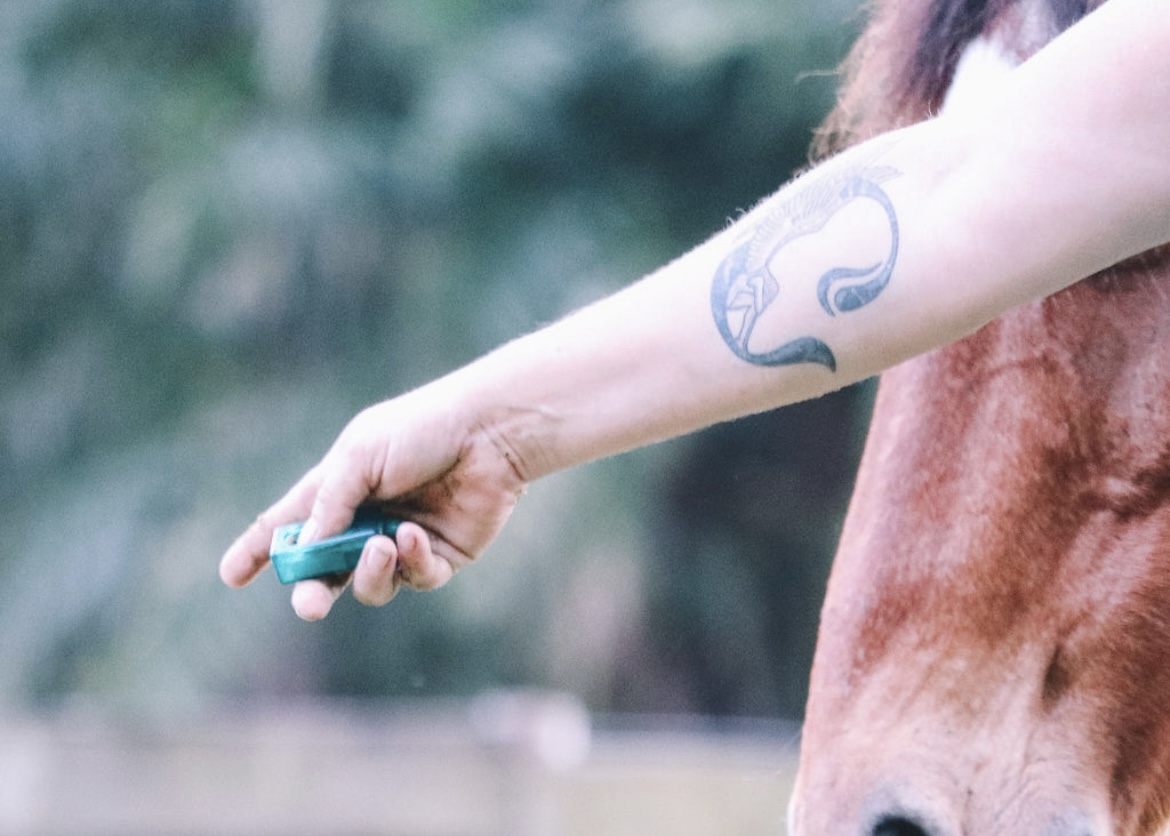
Clicker training is a fun and easy way to train all your animals but there’s a little more to it than just click and treat!
Here are five tips to help you get started with clicker training your equids:
1. Set your horse up for success
If you think about how children learn to read, you might imagine a kindergarten classroom where everything is strategically designed to facilitate learning letters. In the same way, you can arrange your horse’s environment to be more conducive to their success in learning.
Training in protected contact with your horse behind a fence or other divider can help them succeed by limiting their behavioral options. It can also help your horse feel safe and allow them the opportunity to walk away if they need a break.
For some horses, being away from their friends can be stressful, so keeping them close to their friends during training or bringing one of their friends with you to the training area can help reduce your horse’s stress, allowing them to focus on you.
Small things like starting in areas with little distraction where your horse feels more comfortable, or even starting on the side your horse prefers to keep you on, can go a long way toward helping your horse remain open and enthusiastic about learning.
2. Ditch dominance ideas
Dominance and Training have absolutely nothing to do with one another. You don’t need to show your horse who’s boss, you just need to show them horse how to find the right answers.
Horses that don’t comply are not stubborn or trying to be the herd leader. They’re merely trying to control their own outcomes. If they’re not responding to your cues, they either don’t understand, don’t have sufficient motivation to perform, or are experiencing physical or psychological discomfort that is preventing them from performing.
3. Think in observable, measurable behaviors, not labels
It’s tempting to label our horses stubborn, dominant, pushy, etc., when they’re doing things that we don’t like or not doing what we want, but their behavior is what they are doing, not who they are. We can’t train a stubborn horse to be un-stubborn, but we can teach a horse that won’t walk forward on lead to walk forward on lead.
Let’s say, for example, your friend thinks your horse is pushy because he uses her as a scratching post. You don’t mind this behavior, however, but think your horse is pushy because he bumps into you while you’re walking. When the trainer comes to work with your horse, and you tell them your horse is pushy, the trainer agrees because your horse stood there nuzzling her arm with his lips.
Three different people with three entirely different pictures of what "pushy" looks like, and not enough information to resolve any of those people's issue with the horse's "pushy" behavior.
Instead, the trainer needs to know that your horse bumps into you while you're walking. This is an observable behavior that can be fixed by training the horse to walk where you want them to walk instead.
4. Break your training down into manageable steps
One of the main reasons training often fails is that we try to achieve the goal behavior all at once, rather than focusing first on the steps to get there.
You’ve probably heard people say, “Reward every try”. This holds true for any training method you choose. The more you reinforce each small approximation towards the goal behavior, the faster you’ll reach those goals.
For example, if you want your horse to let the farrier hold their foot for the time it takes the farrier to trim and file the hoof, you first need to reinforce your horse just for picking up their foot for you, then letting you hold it for a few seconds, then for the time it takes you to pick it out, and so on.
5. It’s OK to make mistakes
We all make mistakes, but thankfully, unlike with other training methods, your horse won't have to pay for your mistakes.
Unlike the common belief that you should always end on a good note, with clicker training, when things aren’t going well, you can just stop and re-evaluate your plan without fear that your horse has “gotten away with it” or “pulled one over on you”.
Learning can be a positive experience for both you and your horse, even when you’re working through complex behavior problems.