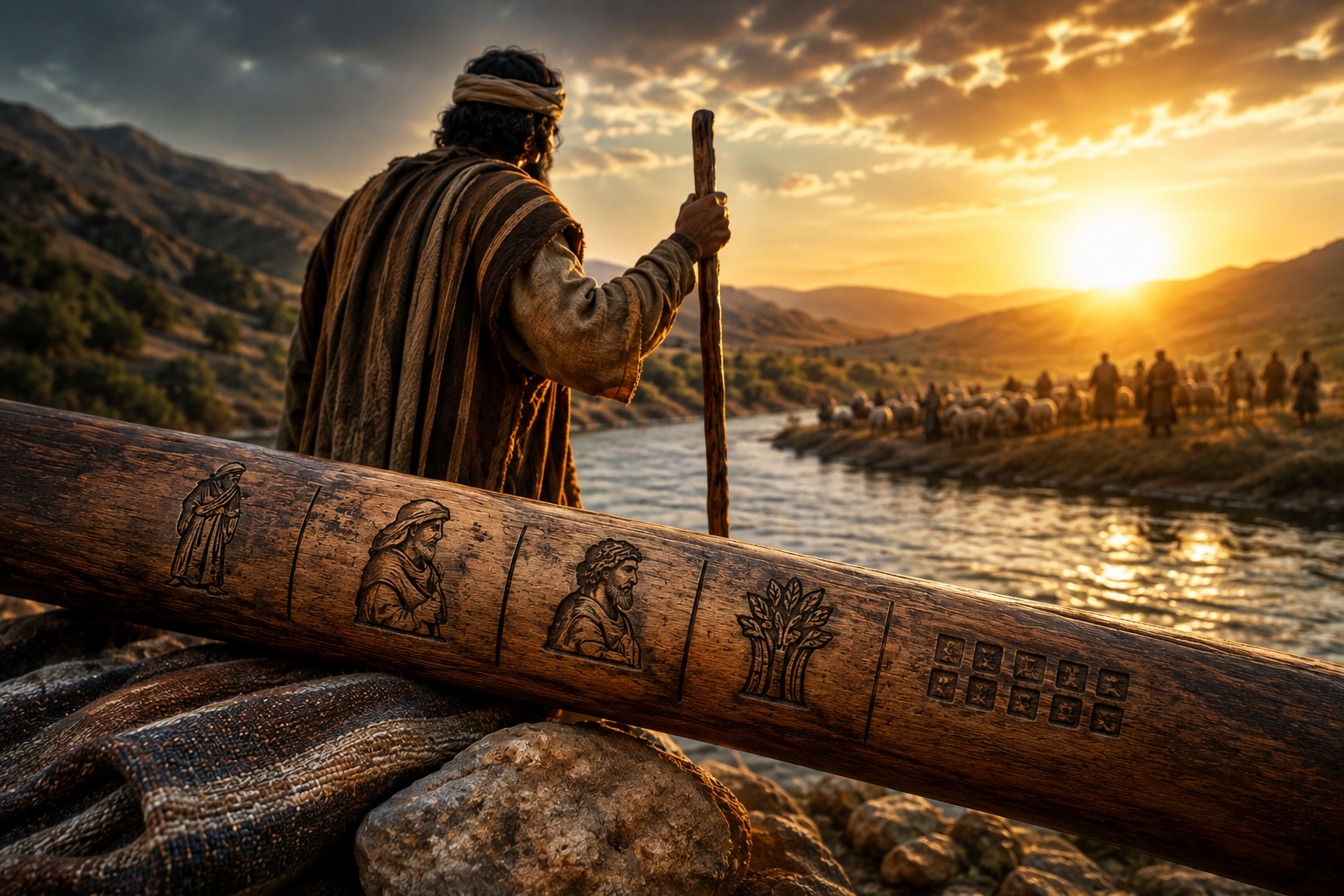
The first sermon I preached as a senior pastor was based upon the idea that in the ancient world, the staff served as a family heirloom where history was literally carved into the wood. I decided to look into that idea again, and what I found was truly amazing.
As I taught it, in the ancient world, a man’s staff could be more than something he used for walking. It could serve as a record of his family, with names and significant events etched into the wood and passed from one generation to another.
The claim was that Abraham may have possessed such a staff, eventually passing it to Isaac, then Jacob, with the story of the family and the promises of God accumulating upon it.
It is a beautiful thought.
But is it all true?
Again, I went looking.
And what I found was not enough to establish that ancient families routinely kept genealogical records carved into their staffs. I found some traditions which made the idea plausible, but could find no archaeological or scholarly evidence strong enough to make that claim as historical fact.
What I did find, however, may be considerably more interesting.
A Staff With a Name
There is at least one place in Scripture where God explicitly commands people to write their names on their staffs.
In Numbers 17, God tells Moses:
“Speak to the children of Israel, and get from them a rod from each father’s house, all their leaders according to their fathers’ houses, twelve rods. Write each man’s name on his rod.”
The staff represented a man, but it also represented his father’s house.
And his name was written upon it.
There is an interesting Hebrew detail here. The word translated “staff” or “rod” is maṭṭeh. But maṭṭeh is also the Hebrew word used for a tribe.
A maṭṭeh could be a stick in your hand.
A maṭṭeh could also be the family to which you belonged.
That makes the imagery in Numbers 17 particularly significant. Each ancestral house stands before God, represented by a staff bearing a name.
So perhaps a staff was never merely something you leaned on.
It could say something about who you were, where you came from, and to whom you belonged.
And that made me think about Jacob.
“With My Staff I Crossed This Jordan”
Jacob makes a peculiar statement in Genesis 32.
He is returning home after years away. Esau is coming toward him with four hundred men, and Jacob is terrified. So he prays.
And in that prayer, he remembers the day he first crossed the Jordan:
“I am not worthy of the least of all the mercies and of all the truth which You have shown Your servant; for I crossed over this Jordan with my staff, and now I have become two companies.”
That is thought-provoking to me.
Jacob can remember himself as a young man crossing that river with almost nothing.
He was a young man with a staff and a promise. Now he looks around.
Wives. Children. Servants. Flocks. Herds.
Two entire companies.
And Jacob knows what happened, and It wasn’t the staff.
“I am not worthy of the least of all the mercies and truth You have shown Your servant.”
The staff could remind Jacob where he came from.
Only the faithfulness of God could explain where he was now.
Later Jewish tradition makes this image even more intriguing.
The Staff of the Fathers
Centuries after the biblical text was written, Jewish tradition developed an elaborate history for Moses’ staff.
The tradition said the staff was extraordinarily ancient and had been passed down through generations: eventually through Abraham, Isaac, Jacob and Joseph before finally coming into the possession of Moses.
Another Jewish tradition, preserved in Targum Pseudo-Jonathan, describes inscriptions upon Moses’ staff. Among the things engraved upon it were the names of the patriarchs, the matriarchs and the twelve tribes of Israel.
While tradition doesn’t mean fact, these assertions are certainly profound. They do not prove that Abraham actually carried such a staff, nor that ancient Hebrew families routinely carved their genealogies into walking sticks.
But they do tell us something fascinating about the way ancient Jewish interpreters understood the symbolism of the staff.
They connected it with ancestry, identity, covenant and memory.
And Scripture itself gives that idea some foundation. Numbers 17 gives us named staffs representing ancestral houses. Judah’s staff in Genesis 38 is among the personal possessions Tamar can later produce to identify him.
So I began imagining Jacob crossing that river again.
Perhaps we cannot know what, if anything, was carved into the wood in his hand.
But we know what Jacob was carrying. He was carrying a past.
Abraham.
Isaac.
A birthright.
A blessing.
A covenant.
And yet Jacob did something his descendants would eventually struggle to do.
He carried his ancestry without leaning upon it.
When Israel Began Leaning on the Staff
By the time of Jesus, ancestry had become enormously important to Jewish identity.
“We have Abraham as our father.”
John the Baptist heard it.
Jesus heard it.
Paul knew it because he had once lived it.
John confronted it directly:
“Do not think to say to yourselves, ‘We have Abraham as our father.’”
Jesus encounters the same confidence in John 8.
“Abraham is our father.”
At one point they even declare:
“We are Abraham’s descendants, and have never been in bondage to anyone.”
Were they delusional? Such a statement from a people whose national history included Egypt, Assyria, Babylon, Persia and Greece, and who were speaking while living under Roman occupation!
Something had happened.
Their ancestry had become so central to their understanding of themselves that it was affecting their ability to recognize their present condition.
They were no longer simply carrying the staff.
They were leaning on it.
And Jesus’ response is blatantly direct:
“If you were Abraham’s children, you would do the works of Abraham.”
In other words, having Abraham’s name on the staff was not the same thing as possessing Abraham’s faith.
Abraham trusted God.
Abraham went when God said go.
Abraham built his life around a promise concerning a future he could not yet see.
His descendants knew his name.
But knowing what was written on the staff had become a substitute for walking the same journey.
There is a tremendous difference between remembering your history and trusting your history.
Jacob understood the difference.
He crossed the Jordan carrying his past while leaning upon God’s promise for his future.
Paul’s Staff
Paul had an impressive staff of his own.
Listen to him describe it:
“Circumcised the eighth day, of the stock of Israel, of the tribe of Benjamin, a Hebrew of the Hebrews; concerning the law, a Pharisee…”
That is a genealogy. It’s a traceable identity, maybe even a resume’.
If anyone could point to what was carved into his staff and say, “Look who I am,” it was Paul.
And he doesn’t deny any of it.
He was still a Benjaminite.
He was still a Hebrew.
He still had a history.
“But what things were gain to me, these I have counted loss for Christ.”
Paul didn't throw away the staff.
He changed what he was leaning on.
And that brings us back to Jacob.
Because the last picture Scripture gives us of Jacob and his staff may be the most beautiful of all.
Leaning on His Staff
Hebrews remembers the final days of Jacob this way:
“By faith Jacob, when he was dying, blessed each of the sons of Joseph, and worshiped, leaning on the top of his staff.” –Hebrews 11:21
The wording comes from the Greek version of Genesis. The Hebrew text reads “bed,” while the Septuagint reads “staff,” a difference involving two nearly identical Hebrew words.
But the author of Hebrews chooses the image of the staff.
And suddenly Jacob’s story comes full circle.
Decades earlier:
“I crossed over this Jordan with my staff.”
One man.
One staff.
One promise.
Now that same man is dying.
And once again, there is the staff.
Except this time Jacob is leaning on it.
But something has changed.
The staff is no longer merely a reminder of his ancestry.
It has become a testimony.
Jacob can lean upon the accumulated evidence of a lifetime and say:
God has been faithful.
He crossed the Jordan with a staff.
Now nations are standing around his deathbed.
Ephraim and Manasseh kneel before him, and Jacob places his hands upon their heads and speaks blessing into a future he will never personally see.
That is how history is supposed to work.
To be avoided:
“God must do this for me because Abraham was my father.”
But embrace:
“Children, let me tell you what God has done.”
Jacob leans backward upon the faithfulness of God so that he can bless forward into the promise of God.
That is a very different way of leaning on your staff.
What’s Written on Yours?
We all have one.
Maybe not a piece of wood with names carved into it, but we all carry a history.
Family.
Church.
Tradition.
Education.
Successes.
Failures.
Titles.
Accomplishments.
Wounds.
Things God has spoken.
Things God has done.
Names of people who came before us.
Moments when we crossed rivers with almost nothing and discovered years later that somehow we had become two companies.
There is nothing wrong with remembering any of it.
There is nothing wrong with honoring it.
There may even come a time when you need to lean upon it.
But be careful what part of the staff is holding you up.
Israel leaned upon who their fathers were.
Jacob leaned upon what God had done.
One produces entitlement.
The other produces worship.
One says, “Abraham is our father.”
The other says, “I am not worthy of the least of all the mercies and truth You have shown Your servant.”
Perhaps that is why Jacob could carry his history without being imprisoned by it.
His staff could tell him where he had been.
But only the promise of God could tell him where he was going.
And when Jacob finally reached the end of that journey, he took the testimony accumulated over a lifetime, leaned upon it one final time, and used it to bless the generation that would walk farther than he ever could.
So maybe the question isn't merely:
What’s written on your staff?
Maybe the more important question is:
What are you leaning on?