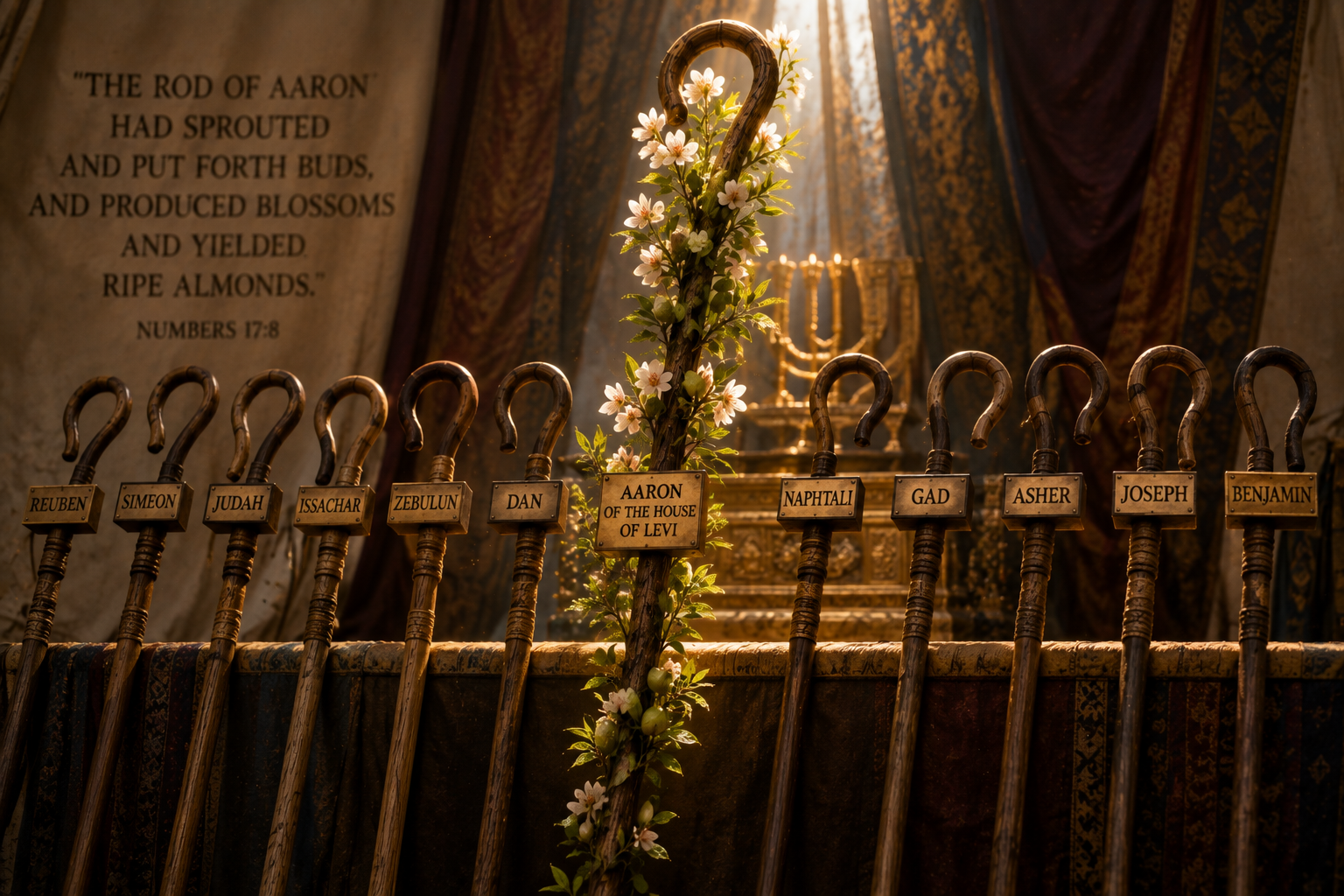

The Staff That Blossomed
There comes a point when you have to stop defending yourself.
That may be one of the stranger lessons hidden in the story of Aaron's staff.
Israel had a problem.
People were questioning Moses and Aaron.
Questioning their leadership.
Questioning their authority.
Questioning whether they were really as special as they seemed to think they were.
And to be fair, the challenge sounded almost spiritual.
“You take too much upon yourselves, for all the congregation is holy, every one of them, and the LORD is among them. Why then do you exalt yourselves above the assembly of the LORD?”
That's Korah speaking in Numbers 16.
Everyone is holy.
God is among all of us.
Who made you special?
Within the bounds of the New Covenant, that accusation should definitely be examined. But in within the bounds of the Sinai Covenant, it posed a huge risk.
God addressed it immediately.
Bring Me your staffs.
Put Your Name on It
In Numbers 17, God tells Moses to collect a staff from the leader of each ancestral house.
Twelve staffs.
And then He gives an interesting instruction:
“Write each man's name on his rod.”
We've talked about this before.
The Hebrew word maṭṭeh can mean both staff and tribe.
So each man brings something representing his ancestral house, and his name is written upon it.
Twelve men.
Twelve staffs.
Twelve names.
Twelve histories.
Twelve claims to identity.
And Aaron's name is written upon the staff of Levi.
Then God says:
“The rod of the man whom I choose will blossom.”
That's it.
No campaign, or debate, or opportunity for Aaron to explain why he is uniquely qualified.
Just put the staffs before God.
And wait.
I love that.
Because sometimes the exhausting thing about being questioned is feeling as though you must constantly prove that you belong where God put you.
Have you been there?
You explain yourself, defend your calling, list your qualifications, point to your history...
And God says:
Put your staff down.
Let Me answer.
Twelve Dead Sticks
Think about what was lying before the Lord that night.
Twelve pieces of dead wood.
Bonfire material, really.
These weren't twelve saplings planted in soil to see which one grew fastest.
They were staffs.
Cut, dry wood.
Objects that had once been connected to life but weren't anymore.
Every staff had a name.
Every staff had a pedigree.
Every staff represented a father's house.
Every staff could tell you where it came from.
But none of them could make itself live.
Hmm. Is that the point?
A name can establish pedigree, but it cannot produce life.
A title can identify your position, but it cannot produce life.
A résumé can document what you've done or capable of, but it cannot produce life.
A theological education can tell people what you've studied, but it cannot produce life.
You can carve almost anything onto a dead stick.
But you cannot carve fruit onto it.
Fruit has to grow.
By Morning
Moses enters the tent the next day.
And something impossible has happened.
“Behold, the rod of Aaron, of the house of Levi, had sprouted and put forth buds, had produced blossoms and yielded ripe almonds.”
It sprouted.
It produced buds.
It produced blossoms.
And it produced ripe almonds overnight!
A dead piece of wood has apparently passed through an entire growing season while everyone slept.
God could simply have made Aaron's staff glow.
He could have written Aaron's name across the sky.
He could have thundered from heaven:
I chose Aaron.
Instead, God answered the question of legitimacy with life.
That feels, I don't know... weightier?
Aaron didn't need to make his staff look more impressive than the others.
He simply left it in the presence of God, and by morning there was fruit on it.
Sometimes the best answer to people questioning what God is doing in your life is not a better argument.
It's fruit.
You Will Know Them by Their Fruits
Jesus would later give us an extraordinarily simple test:
“You will know them by their fruits.”
Not their claims, or titles, or education, or platform, or gifting.
Their fruit.
All of that stuff can be overwhelmingly impressive. But fruit?
Fruit takes life. It requires... life.
A person can learn how to sound spiritual.
A person can learn how to preach.
A person can learn how to build an audience.
A person can inherit a title.
A person can be ordained.
A person can put a name on a staff.
But only life produces fruit.
And perhaps we have spent far too much time examining what's written on people's staffs.
What denomination?
What degree?
What church?
What network?
Who ordained you?
Who is your covering?
Who are you associated with?
Who taught you?
Where did you come from?
Some of those questions have value.
Numbers 17 doesn't erase the names from the staffs.
But when God settles the question, He doesn't point to the engraving.
He points to what grew.
Where is the fruit?
Stop Trying to Make Your Staff Blossom
There is another side to this.
If Aaron's staff blossomed because God caused life to emerge from dead wood, Aaron couldn't manufacture the result.
Imagine him sneaking into the tent overnight with almonds and glue.
Absurd.
But we do our own versions of it.
We try to manufacture evidence that we're fruitful.
We measure ourselves constantly.
Numbers. And if the numbers aren't there, we attempt to inflate them.
Recognition. This is a big one. Even Jesus's brothers told him that He needed to get out there if He wanted to be famous!
Invitations, followers, attendance, sales, likes, views, applause... just thinking about these makes me tired.
We need visible evidence that what we're doing matters.
And if the evidence isn't appearing quickly enough, the temptation is to start attaching almonds to the stick.
To manufacture the appearance of fruitfulness.
But manufactured fruit isn't fruit.
Fruit is what naturally emerges when life is present.
Jesus uses precisely this imagery in John 15:
“Abide in Me, and I in you. As the branch cannot bear fruit of itself…”
There it is again.
Wood.
Life.
Fruit.
And the order matters.
Jesus doesn't say:
Produce fruit so you can prove you're connected to Me.
He says:
Remain connected to Me, and fruit will come.
Maybe You Don't Need to Win the Argument
There will always be people who don't understand your calling.
Some will question your motives, misunderstand your decisions, and some may decide you aren't qualified.
And sometimes they may even have legitimate questions.
But there comes a point where constantly defending yourself becomes its own kind of bondage.
You cannot spend your entire life convincing everyone that your name belongs on the staff.
Aaron didn't.
He put his staff before God.
Then he went to bed.
By morning, God had said enough.
Maybe there are arguments you don't need to win.
Maybe there are criticisms you don't need to answer.
Maybe there are rooms where you don't need to establish that you belong.
Maybe your energy would be better spent remaining connected to the Source of life.
Because if God is actually breathing life into what you're doing, eventually something should blossom.
And if nothing is blossoming, perhaps that deserves our attention too.
Where Is the Fruit?
That's the uncomfortable side of this story.
We love using fruit as an answer to our critics.
But fruit is also something we should be willing to look for in ourselves.
If I have spent twenty years insisting that God called me...
where is the fruit?
If my theology is correct...
what is it producing?
If my ministry is anointed...
are people becoming whole?
If my revelation is profound...
is it producing love?
If I have the right doctrine...
am I becoming more like Christ?
If I insist that the Holy Spirit is working in me...
where is His fruit?
Love.
Joy.
Peace.
Patience.
Kindness.
Goodness.
Faithfulness.
Gentleness.
Self-control.
Those are much harder to fake than a title.
And perhaps that is why God's answer in Numbers 17 is so powerful.
He doesn't settle legitimacy by examining the names.
He looks for life.
The Rod That Was Remembered
There is one final beautiful detail to examine.
Aaron's staff had already been associated with extraordinary things.
It had stood before Pharaoh.
It had become a serpent.
It had swallowed the staffs of Egypt's magicians.
It had been stretched over the waters.
It had struck the dust.
Yet when Hebrews later remembers it, none of those things become its defining description.
Hebrews 9 calls it:
“Aaron's rod that budded.”
Not Aaron's rod that defeated Pharaoh's magicians.
Not Aaron's powerful rod.
Not Aaron's miraculous rod.
The rod that budded.
We are often impressed by power.
God seems remarkably interested in life.
Let It Blossom
So perhaps we don't need to spend quite so much energy defending what is written on our staffs.
Your name may be there.
Your credentials may be legitimate.
Your history may be impressive.
Your calling may be completely real.
But ultimately, none of those things are the strongest evidence.
Life is.
So put the staff down.
Leave it in the presence of God.
Stop trying to glue almonds onto it.
Stop comparing your stick with everyone else's.
Stop carving larger letters into your name.
Stop spending all your strength convincing people that God chose you.
Abide.
Remain.
Let His life flow.
And then give it time.
Because when God breathes life into dead wood, eventually something happens that no argument can accomplish.
It blossoms.
And when there is fruit hanging from the branches, you don't have to spend nearly as much time explaining whether the tree is alive.
Where is the fruit?