
There are some things you simply aren't supposed to destroy.
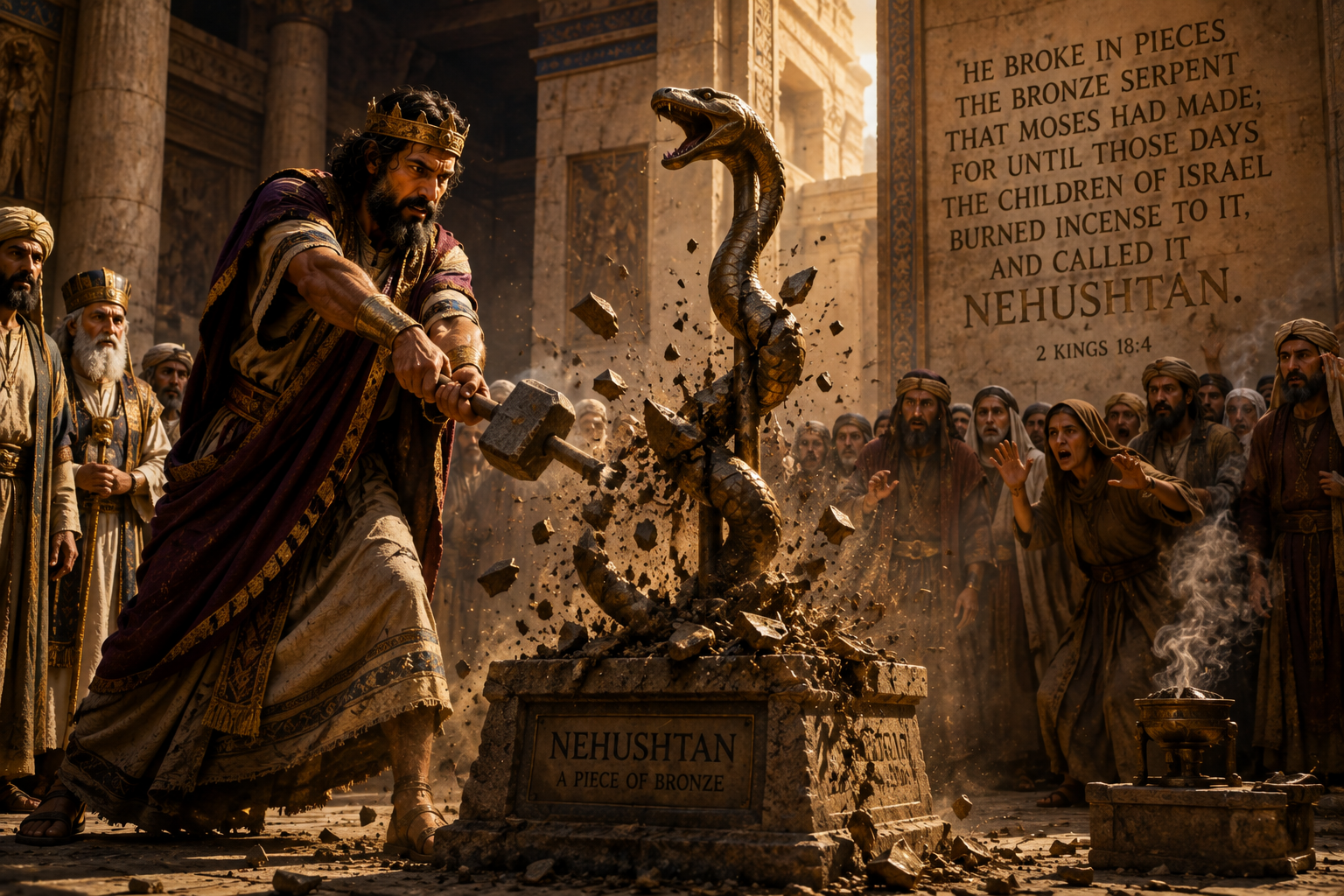
At least, that's what I imagine someone thinking as Hezekiah's men approached an ancient bronze object that had survived for hundreds of years.
This wasn't simply another pagan idol brought into Israel from some foreign nation.
Moses made it.
More than that, God told Moses to make it.
People had once looked upon it and lived.
Grandparents could have told grandchildren stories about what happened that day.
“Our family exists because your ancestor looked at that serpent.”
It was part of Israel's history, a testimony to a genuine act of God.
And Hezekiah smashed it to pieces.
The Serpent God Told Moses to Make
The story begins in Numbers 21.
Israel is once again struggling in the wilderness.
They speak against God and against Moses:
“Why have you brought us up out of Egypt to die in the wilderness?”
Then serpents enter the camp.
People are bitten.
People die.
Eventually Israel comes to Moses and confesses:
“We have sinned, for we have spoken against the LORD and against you.”
Moses prays, and God's answer is strange.
Instead of removing the serpents, He tells Moses:
“Make a fiery serpent, and set it on a pole; and it shall be that everyone who is bitten, when he looks at it, shall live.”
So Moses makes a serpent out of bronze.
The Hebrew itself contains a bit of wordplay:
neḥaš neḥoshet.
A serpent of bronze.
Moses mounts it on a pole and raises it up.
Those who are bitten look, and they live.
Think about what that object represented afterward.
It was connected to a real event.
Real people had been dying.
If they looked, they lived.
God really had instructed Moses to make it.
God really had used it.
There was nothing imaginary about the testimony attached to that bronze serpent.
And that is precisely what makes what happens next so dangerous.
They Kept It
We don't hear much about the bronze serpent for a very long time.
Israel entered the Promised Land.
Joshua and the judges came and went.
Kings rose. Kings fell.
David.
Solomon.
The kingdom divides.
Generations pass.
And apparently, through all of it, somebody keeps the serpent.
Hundreds of years after Moses, it is still there.
There is something almost beautiful about that.
They remembered.
They preserved something that reminded them of what God had done.
I understand that instinct.
We do the same thing.
We save photographs.
We keep journals.
We mark places.
We tell stories.
Churches preserve pulpits.
Families preserve Bibles.
We remember the room where something happened.
The song that was playing.
The person who prayed.
The book that changed us.
The church where we encountered God.
The movement that awakened something in us.
There is nothing inherently wrong with remembering.
God repeatedly told Israel to remember.
The problem wasn't that they kept the serpent.
The problem was what they eventually began doing with it.
They Burned Incense to It
Centuries later, Hezekiah becomes king.
Second Kings tells us that he begins removing the high places, breaking sacred pillars and cutting down objects associated with idolatrous worship.
And then, almost buried among those obvious pagan objects, we find something surprising:
“He broke in pieces the bronze serpent that Moses had made; for until those days the children of Israel burned incense to it.”
Read that carefully.
The bronze serpent that Moses had made.
Baal, Asherah, Molech... an object made for these would have been understandable.
This object, though, had a legitimate history.
It was something God once used.
It was something that had once been connected to healing and deliverance.
And now people are burning incense to it.
Somewhere along the way, something changed.
Testimony became tradition.
Tradition became attachment.
Attachment became dependence.
And dependence became worship.
They had stopped remembering what God did through the serpent.
They had begun looking to the serpent.
Nehushtan
Hezekiah calls it Nehushtan.
The word is related to the Hebrew word for bronze and can carry the dismissive sense of something like:
“a bronze thing.”
A piece of bronze.
Imagine the offense.
“But Hezekiah, Moses made that!”
A piece of bronze.
“God told him to make it!”
A piece of bronze.
“People were healed because of that!”
No.
People were healed because God healed them.
The bronze serpent was an instrument.
A sign.
A thing God used.
And apparently Hezekiah understood something that Israel had forgotten:
Something does not become God simply because God once used it.
Sometimes the only way to restore proper perspective is to call the thing what it is.
Nehushtan.
It's bronze.
The power was never in the object.
When Yesterday's Encounter Becomes Today's Idol
This may be one of the more subtle dangers in the life of faith.
We usually imagine idolatry as loving something obviously wrong.
But some of the most difficult idols to recognize are things that were once genuinely connected to God.
A church.
A movement.
A denomination.
A ministry.
A pastor.
A teacher.
A book.
A method.
A song.
A particular theological framework.
A way of doing church.
A season when everything seemed alive. (This one REALLY speak to me!)
Maybe God genuinely met us there.
Maybe lives really were changed.
Maybe people really were healed.
Maybe marriages were restored.
Maybe something awakened in us that had been dormant for years.
We aren't making it up.
God used it.
But “God used it” and “God is in it” are not necessarily the same statement.
And “God used it then” certainly does not mean:
I must cling to it forever.
That is how monuments become idols.
We stop saying:
“Look what God did.”
And begin saying:
“God must do it this way.”
We Do This With Our Own History Too
Sometimes the Nehushtan isn't a church or movement.
Sometimes it's a former version of ourselves.
A season when we were successful.
A role in which we felt important.
A way God used us once.
A revelation that changed us twenty years ago.
An identity that was completely appropriate for one season but has quietly become the thing by which we define every season afterward.
We keep returning to it because something real happened there.
But there is a difference between carrying a testimony and living in a monument.
The bronze serpent testified:
God saved us here.
But eventually Israel seems to have turned that into:
This is where salvation comes from.
Those statements sound similar.
They are worlds apart.
The Sign Was Always Pointing Somewhere Else
Centuries after Hezekiah smashed the serpent, Jesus brings it up again.
Speaking with Nicodemus, He says:
“As Moses lifted up the serpent in the wilderness, even so must the Son of Man be lifted up.”
That changes the story again.
The serpent mattered.
Jesus doesn't dismiss it.
He doesn't say Israel was foolish for ever looking at it.
He says the event was pointing toward something greater.
The serpent was a sign.
And a sign is valuable precisely because it points beyond itself.
That's what Israel eventually forgot.
They stopped looking through the sign, and began looking to it.
And once a sign becomes the destination, it has ceased functioning as a sign.
Maybe that gives us a way to evaluate some of the things we are holding onto.
Does this still point me toward God?
Or has it become something I believe I cannot live without?
Does this testimony remind me of His faithfulness?
Or have I begun trusting the testimony itself?
Does this tradition help me recognize what God is doing now?
Or does it require God to repeat what He did then?
Those are uncomfortable questions.
Especially when the thing we're questioning has Moses' fingerprints all over it.
“But God Used It”
Maybe those are four of the most dangerous words we can use to defend something:
But God used it.
Yes.
He may have.
That's why this is difficult.
God used a bronze serpent.
People looked at it and lived.
And then one day a faithful king smashed it.
Not because God had never used it.
But because people had begun using it wrongly.
There are moments when faithfulness means preserving a testimony.
And there are moments when faithfulness means recognizing that the testimony has become an idol.
Wisdom is knowing the difference.
The Israelites in Numbers 21 needed someone to lift the serpent up.
The Israelites in 2 Kings 18 needed someone willing to tear it down.
Both actions honored God.
What Are You Refusing to Let Go Of?
Maybe there is something in your life that you have protected primarily because God once used it.
Something you're afraid to question because it has a sacred history.
Something you cannot imagine leaving behind because too much happened there.
Maybe it really was from God.
Maybe the testimony is completely legitimate.
Maybe people really did live because of what happened there.
None of that necessarily means you are supposed to keep burning incense to it.
Sometimes honoring what God did yesterday means preserving the memory.
Sometimes honoring what God is doing today means releasing the method.
And sometimes faith requires the courage to look at something precious, something old, something with a remarkable story attached to it, and finally recognize:
It's bronze.
The God who worked through it is still God without it.
The God who met you there is not trapped there.
The God who used that method has not run out of methods.
The God who spoke through that person has not lost His voice.
The God who moved in that season did not stop moving when the season ended.
Keep the testimony.
Keep the gratitude.
Keep the story.
But don't confuse the instrument with the One who used it.
Because one of the easiest things to worship is something God used yesterday.
And sometimes faith means remembering what God did.
Sometimes faith means picking up what you've been running from.
And sometimes faith means having the courage to smash the thing He did it through.
What are you refusing to let go of?