 All praise is due to Allah, the Bestower of blessings, and may peace and blessings be upon His Messenger, the best of creation — our master Muḥammad ﷺ — and upon his family and companions, the lanterns in the darkness, and upon all those who follow his way and walk in his footsteps with uprightness. To proceed:
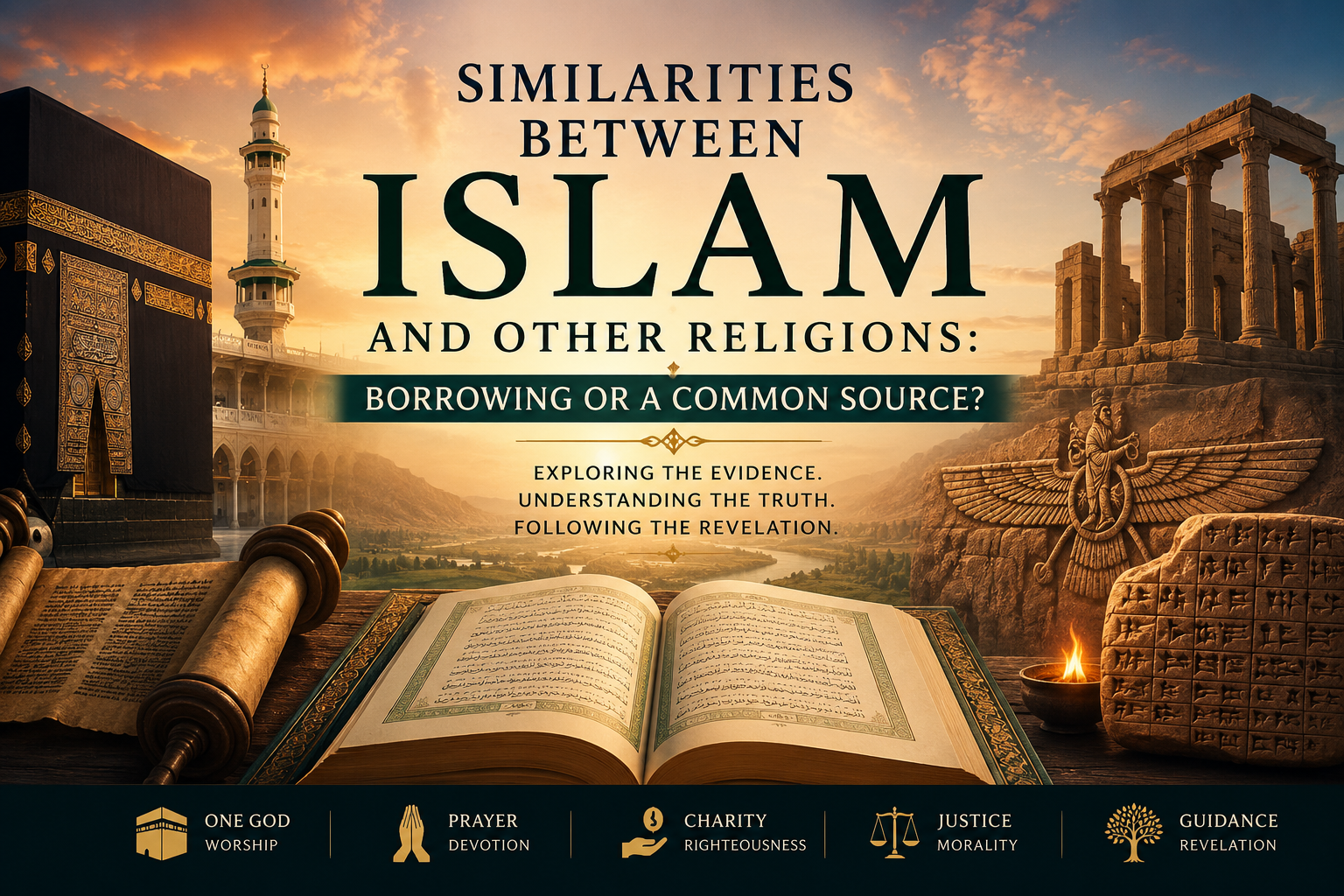
Some people wonder about the apparent similarities between certain Islamic beliefs or acts of worship and those found in earlier religions. Is this the result of borrowing, or does it stem from a shared divine source? And if the answer is a shared source, how do we explain similarities with religions that predate the Abrahamic faiths — such as the ancient Mesopotamian religions or Zoroastrianism — which are generally regarded as man-made rather than preserved revelations?
The following principles, taken together, form a coherent framework through which such claims may be evaluated — without requiring a detailed investigation of every alleged parallel, and without needing an exhaustive study of every religion in question.
Principle One: The Burden of Proof Lies with the Claimant
The one asserting that Islam borrowed from earlier religions must establish this claim with evidence — not mere resemblance. It must be demonstrated that the alleged similarities genuinely existed in those religions before the advent of Islam and were not added to them afterward.
This distinction is critical. Unlike Islam — whose revelation has remained preserved and textually stable — many earlier religious traditions underwent centuries of alteration, redaction, and cultural absorption. Their texts were often subject to additions, omissions, reinterpretations, and the blending of surrounding beliefs.
Careful historical scrutiny has shown that many supposed parallels collapse under examination. In numerous cases, the sources being compared to Islam were compiled or standardized only after the rise of Islam — making it just as plausible, if not more so, that those later texts were the ones influenced by Islamic civilization rather than the reverse.
A well-known example concerns the claim that Islam borrowed aspects of the Miʿrāj — the Prophet’s night journey and ascension — from the Zoroastrian text known as the Arda Wiraz Namag. Yet scholars later established that the extant form of this Persian text postdates Islam. The scholar Mary Boyce noted that it had long been assumed that this story influenced the Islamic account of the Miʿrāj, until it became clear that the final recension of the Persian text came after the rise of Islam.
Furthermore, similarity alone does not establish borrowing. Across history, human societies have independently grappled with the same fundamental realities: morality and its source, the existence of the divine, sacrifice and purification, prayer and ritual, the nature of the soul, the afterlife, divine judgment, and the unseen world. That different traditions share ideas in these areas is not evidence of literary dependence — it is evidence of shared human nature confronting shared existential questions. The presence of parallels requires explanation, but that explanation is not necessarily borrowing.
Principle Two: Similarity Between Religions Is Expected
From the Islamic perspective, the existence of similarities between religions is not surprising — it is precisely what one would expect. Allah is One, and He is the One who sent all the prophets, from Adam عليه السلام to Muḥammad ﷺ. Since the source of all revelation is one, the foundations of religion must necessarily converge on the same truths.
All prophets called to the worship of the one God, to belief in the unseen, to righteous conduct, to prayer, to charity, and to accountability before their Creator. The details of certain laws may have differed from one nation to another, but the core was always the same.
Allah, the Exalted, says:
وَمَا أُمِرُوا إِلَّا لِيَعْبُدُوا اللَّهَ مُخْلِصِينَ لَهُ الدِّينَ حُنَفَاءَ وَيُقِيمُوا الصَّلَاةَ وَيُؤْتُوا الزَّكَاةَ ۚ وَذَٰلِكَ دِينُ الْقَيِّمَةِ
"And they were not commanded except to worship Allah, [being] sincere to Him in religion, inclining to truth, and to establish prayer and to give zakāh. And that is the correct religion."
— Qurʼān, Sūrah Al-Bayyinah (98:5)
And He says:
شَرَعَ لَكُم مِّنَ الدِّينِ مَا وَصَّىٰ بِهِ نُوحًا وَالَّذِي أَوْحَيْنَا إِلَيْكَ وَمَا وَصَّيْنَا بِهِ إِبْرَٰهِيمَ وَمُوسَىٰ وَعِيسَىٰ
"He has ordained for you of religion what He enjoined upon Noah and that which We have revealed to you, and what We enjoined upon Abraham, Moses, and Jesus…"
— Qurʼān, Sūrah Ash-Shūrā (42:13)
Allah also says:
قُولُوا آمَنَّا بِاللَّهِ وَمَا أُنزِلَ إِلَيْنَا وَمَا أُنزِلَ إِلَىٰ إِبْرَاهِيمَ وَإِسْمَاعِيلَ وَإِسْحَاقَ وَيَعْقُوبَ وَالْأَسْبَاطِ وَمَا أُوتِيَ مُوسَىٰ وَعِيسَىٰ وَمَا أُوتِيَ النَّبِيُّونَ مِن رَّبِّهِمْ لَا نُفَرِّقُ بَيْنَ أَحَدٍ مِّنْهُمْ وَنَحْنُ لَهُ مُسْلِمُونَ
"Say, ‘We believe in Allah and what has been revealed to us and what was revealed to Abraham, Ishmael, Isaac, Jacob, and the Descendants, and what was given to Moses and Jesus and what was given to the prophets from their Lord. We make no distinction between any of them, and to Him we submit.’"
— Qurʼān, Sūrah Al-Baqarah (2:136)
This continuity of revelation is fundamental to the Islamic worldview. Islam does not present itself as a new religion disconnected from what came before, but as the final and preserved expression of the same divine message entrusted to the prophets throughout history.
From this perspective, similarities between authentic revelations are not evidence against Islam — they are precisely what a Muslim would expect, and precisely what the Qurʼān teaches.
Principle Three: We Do Not Know All of Allah’s Prophets
Islam teaches that Allah sent a messenger to every nation and people. However, the Qurʼān did not narrate the stories of all of them, and we do not possess the full history of every revelation sent before Islam.
Allah says:
وَإِن مِّنْ أُمَّةٍ إِلَّا خَلَا فِيهَا نَذِيرٌ
"And there was no nation but that there had passed within it a warner."
— Qurʼān, Sūrah Fāṭir (35:24)
And He says:
وَرُسُلًا قَدْ قَصَصْنَاهُمْ عَلَيْكَ مِن قَبْلُ وَرُسُلًا لَّمْ نَقْصُصْهُمْ عَلَيْكَ
"And [We sent] messengers We have already told you about, and messengers We have not told you about."
— Qurʼān, Sūrah An-Nisāʼ (4:164)
Absence of knowledge is not knowledge of absence. Our ignorance regarding certain prophets or revelations does not mean they never existed. Therefore, if traces of monotheistic truth or echoes of revealed teaching appear in religions now classified as man-made, it remains entirely possible — and theologically consistent — to explain this as the residue of earlier divine revelations that became distorted over time.
From the Islamic perspective, the Qurʼān describes this process of distortion as a recurring pattern in human religious history.
Principle Four: Similarity Does Not Explain the Qurʼān
Even granting the most generous possible assumption — that the Prophet ﷺ had some incidental exposure to surrounding religious traditions through trade or contact with Jews and Christians — this still fails entirely to account for what Islam actually is.
The borrowing theory does not merely claim that Islam shares isolated themes with earlier traditions. It implies that an unlettered Arab man in seventh-century Mecca somehow synthesized theology, law, ethics, spirituality, eschatology, historical narrative, and linguistic discourse of the highest order into a single, internally coherent religion that went on to transform civilizations across the earth.
For this theory to hold, it must explain:
The extraordinary literary and linguistic nature of the Qurʼān, unmatched in the Arabic language before or since.
Its profound theological consistency across twenty-three years of revelation.
Its comprehensive legal and moral system.
Its correction of distortions found in earlier scriptures.
Its remarkable preservation across fourteen centuries.
The unparalleled character, honesty, and moral excellence of the Prophet ﷺ himself.
Mecca was not Athens, Alexandria, or Constantinople. It was not a seat of libraries, theological academies, or translation movements. The Prophet ﷺ was not known as a scholar, linguist, historian, or student of scripture. The borrowing theory does not merely fail to account for isolated similarities — it fails to account for the existence of Islam as a complete, unified, and transformative civilization.
Principle Five: The Historical Reality of Literacy in Arabia
The historian Ibn Khaldūn observed that literacy among the Arabs was a rarity, particularly among the desert Arabs, for whom writing and formal scholarship were the exception rather than the norm.
The revealed texts, the earliest biographical accounts of the Prophet’s life, and the historical records of early Islam contain no credible evidence that Muḥammad ﷺ could read or write. This is entirely consistent with the historical reality of the Arabian Peninsula in that era, where the ability to read and write was the notable exception — not the default.
To claim, therefore, that the Prophet ﷺ independently accessed, studied, translated, and synthesized religious material from numerous civilizations and languages without leaving behind any evidence of formal study, multilingual ability, or scholarly mentorship is not merely unlikely. It is historically implausible. The borrowing claim requires a figure of extraordinary scholarly reach and institutional resources. What history gives us is an unlettered man in a city with no such institutions.
Principle Six: Islam Must Be Studied as a Whole
Islam cannot be fairly evaluated by isolating fragments and comparing them to fragments from other traditions. It must be studied as a complete and integrated system — one whose parts are coherent, mutually reinforcing, and internally consistent.
When examined as a whole, Islam presents:
A coherent and rational theology rooted in pure monotheism.
A comprehensive moral and legal framework governing both individual and social life.
A profound spiritual tradition with a clear path of worship and purification.
An intellectually consistent worldview that addresses the deepest questions of existence.
A preserved scripture of unparalleled linguistic power and beauty.
The teachings of Islam are interconnected in a way that reflects unity of source, not the patchwork assembly of borrowed fragments. A religion stitched together from disparate sources across dozens of languages, cultures, and centuries would inevitably show the seams. Islam shows none.
The sincere and fair-minded seeker who studies Islam with care and honesty will find that the explanation of divine revelation accounts for the evidence — its coherence, its depth, its preservation, its transformative power, and its linguistic uniqueness — far more convincingly than any theory of borrowing or accidental synthesis.
Conclusion
Whoever reflects carefully upon the mutawātir — mass-transmitted — proofs of the prophethood of Muḥammad ﷺ, in all their clarity, abundance, and power, will find no reasonable ground for doubt that he was truly sent by Allah, Lord of all worlds.
The evidences for his prophethood are numerous and varied. Among them:
The linguistic and literary miracle of the Qurʼān, which challenged the greatest masters of Arabic and remains unchallenged to this day.
His unmatched honesty, integrity, and moral excellence, attested even by his fiercest opponents.
The miracles and extraordinary events associated with his mission, witnessed and transmitted by multitudes.
His fulfilled prophecies regarding matters of the unseen — each category containing numerous distinct and documented instances.
These evidences together form a cumulative and compelling case — one accessible to the scholar and the layperson alike — that Islam is not the product of human invention, synthesis, or borrowing, but the final and preserved revelation of Allah to all of humanity.
And our final prayer is that all praise belongs to Allah, Lord of all worlds. May Allah’s peace and blessings be upon our Prophet Muḥammad ﷺ, his family, his companions, and all those who follow his guidance with excellence until the Day of Judgment.