

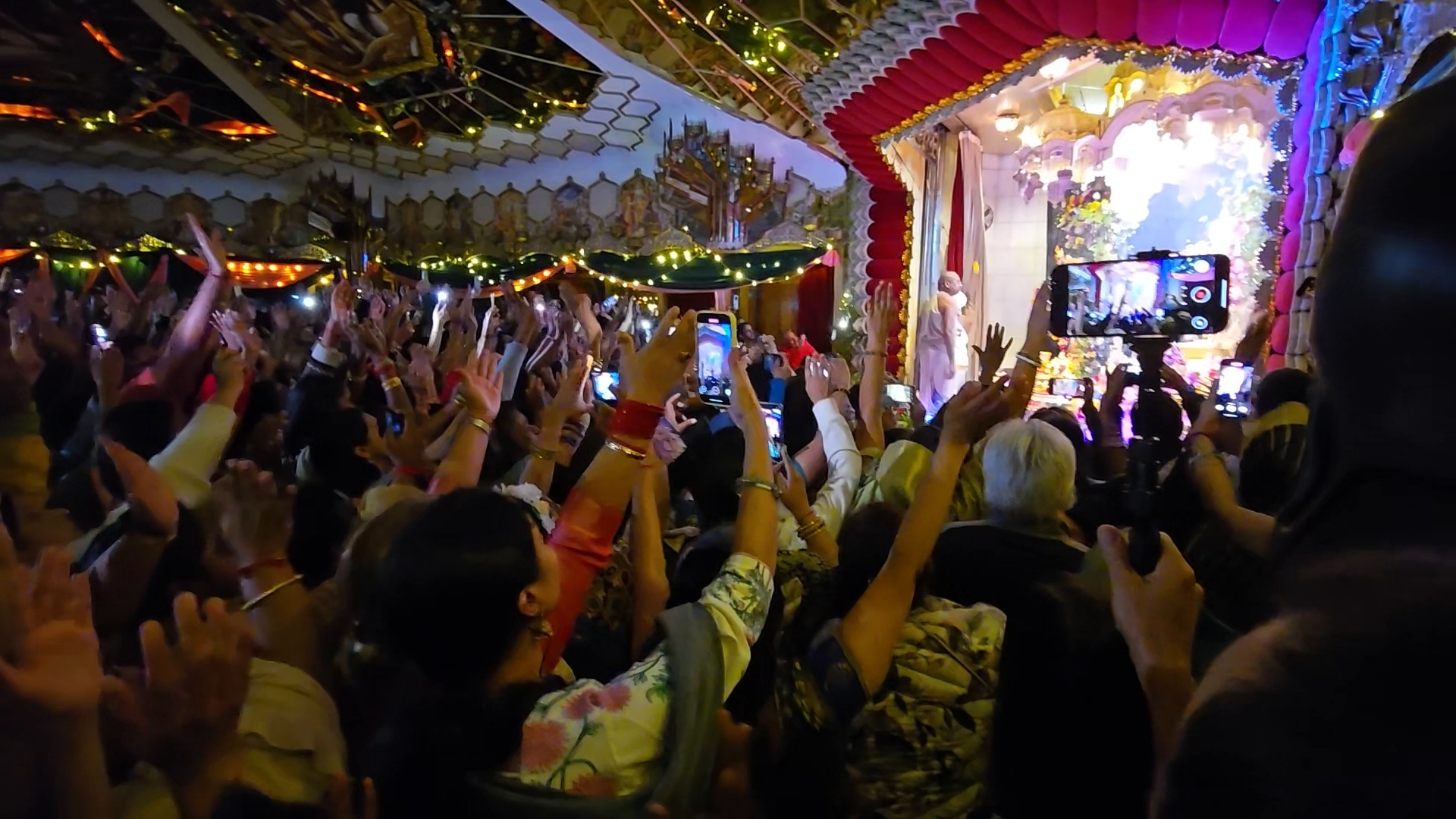
Janmashtami celebrates the birth of Lord Krishna, and while its roots are deeply devotional, the festival can also be understood as a human experience designed to heighten awareness, focus, and emotional sensitivity.
The Practice of Janmashtami
The day of Janmashtami is structured to draw body and mind into an unusual rhythm:
Early Rising (4 AM)
Devotees rise before sunrise, long before the world stirs. This early start resets the body clock and sets the day apart from ordinary life, creating a moment of quiet focus.
Fasting
Throughout the day, participants abstain from food. Hunger sharpens the senses, heightens emotions, and removes distraction. The mind naturally becomes more alert and sensitive to experiences.
Prayer and Darshan
Devotees spend the day chanting, singing, and performing darshan — standing in mindful presence before the Deities. Repetition keeps attention focused and builds momentum toward the day’s climax.
Midnight Darshan
At midnight, the Deities are revealed in their special birthday outfit. After nearly twenty hours of fasting and focus, the beauty of the scene is striking: music, color, and devotion converge to create a moment of heightened perception and joy.
The Origin and Cultural Context
Janmashtami originates from Mathura, India, where Lord Krishna appeared in the prison of his parents, Devaki and Vasudeva, as described in the Bhagavata Purana (Canto 10). Over centuries, it has become a major festival across India, particularly in Mathura, Vrindavan, Mumbai, and Gujarat.
While the rituals are unique to Krishna devotees, the human principles underlying them are universal: fasting, focused attention, communal celebration, and heightened awareness of beauty. Similar practices exist in other cultures — for example, Ramadan in Islam, Lent in Christianity, or solstice festivals that mark renewal and reflection.
My Take: Janmashtami as a Mind–Soul Practice
Stripping away mythology, Janmashtami can be seen as a structured human experiment. The combination of waking early, fasting, and focusing all day prepares the mind and body for a peak experience:
Early rising interrupts routine and opens the mind.
Fasting heightens perception and emotion.
Repetitive focus builds mental clarity and alignment.
Midnight climax — after hours of preparation — amplifies the impact of beauty and communal energy, leaving the participant feeling uplifted, alert, and renewed.
In essence, the festival is a life hack for presence: it removes ordinary distractions, sharpens attention, and creates a moment of awe that the heart and soul can carry beyond the day. The “god-like” beauty of midnight darshan is, at its core, the natural effect of this heightened state.
What the Bhagavad Gita Teaches
The Gita reinforces the principle behind such devotion:
Focus and surrender: “Fix your mind on Me, be devoted to Me, and you will reach Me.” (9.34)
Purification through discipline: “One who is devoted, whose mind is fixed, and whose senses are controlled attains peace and union with Me.” (6.18-19)
Experiencing joy beyond material life: “Those who are devoted to Me, meditating and surrendering fully, I bring them eternal happiness.” (12.20-21)
Janmashtami’s rituals — waking early, fasting, chanting, and midnight darshan — provide a tangible way to live these teachings.
Conclusion
Midnight darshan and the birthday outfit are not just ritualistic displays. They are living practices that combine time, focus, and communal energy to awaken the mind and soul. Whether approached devotionally or as a mindful life practice, Janmashtami offers a rare opportunity to experience clarity, beauty, and presence — a moment when the ordinary world falls away and the heart is fully alive.