

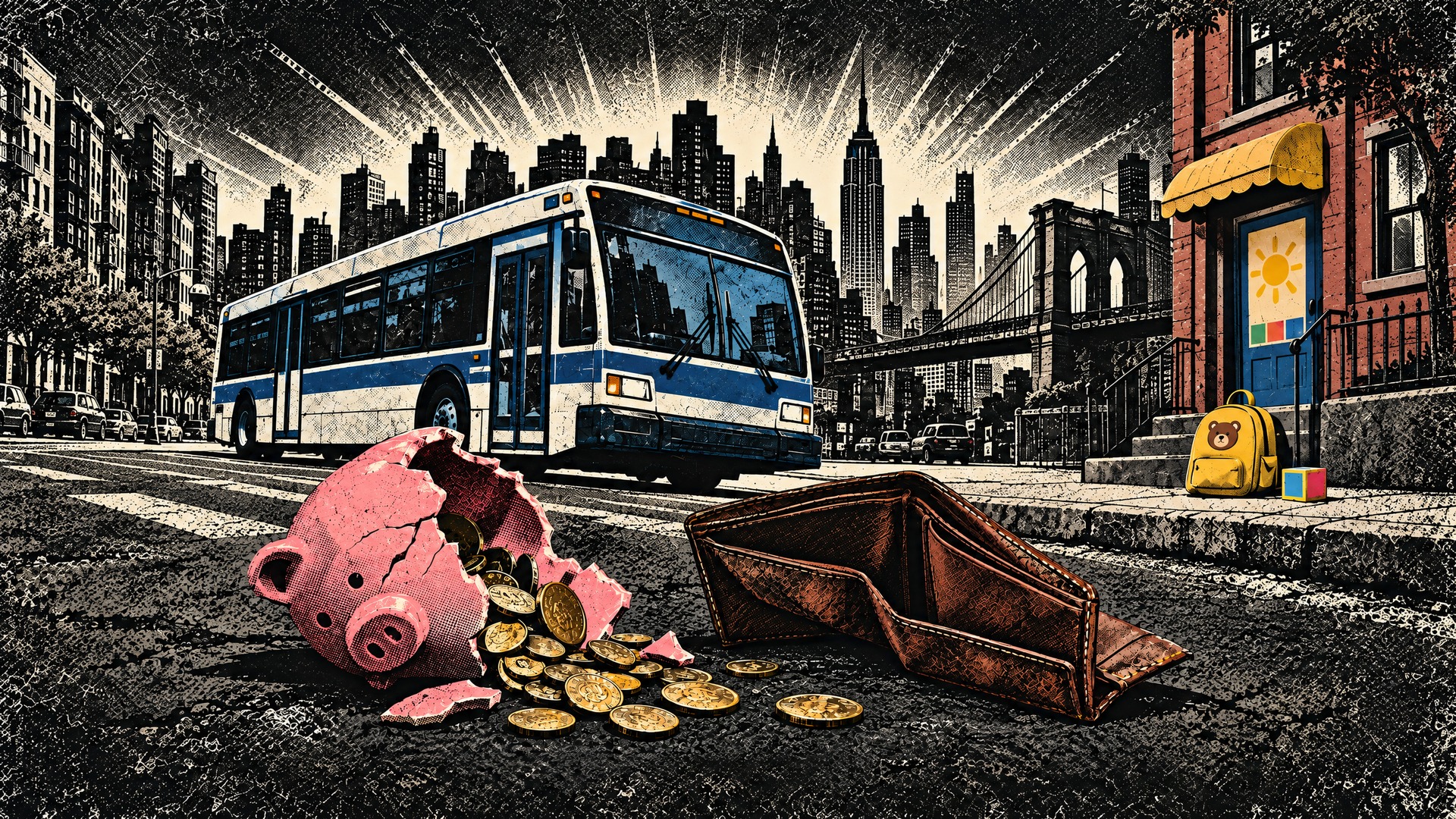
Appendix: Line-By-Line, what "The Math Don't Lie" really means
Companion to the Earth's Lost History article "The Math Don't Lie"
Commentary/opinion based on public reporting and public budget data. Not legal advice.
Intro
"They sold a dream."
Not a plan. Not a policy. A dream. The word is doing work here. A dream doesn't have to balance. A dream doesn't have to survive a budget hearing. A dream just has to be believed long enough to get you elected.
"Universal childcare. Free for everyone."
The promise in five words. "Universal" is the key word. It means everyone. It means no waitlists, no lotteries, no phase one. If the program delivers two thousand seats to sixty thousand children, it is not universal. It's the opposite of universal.
"Sounded good… until you ran the numbers."
The thesis of the song in one line. The dream is not the problem. The arithmetic is.
"Let's talk about what's actually possible."
Not what's moral. Not what's fair. What's possible. That distinction is the whole song.
Pre-Chorus
"Remember when he promised free buses for all?"
The callback. Before childcare, there was the bus promise. It is the proof that the pattern is not new.
"Said 'zero fare, zero cost, answer the call.'"
The slogan. Zero fare, zero cost. It rhymes, it sounds confident, and it is the exact promise that any transit budget analyst would tell you cannot survive contact with a revenue model.
"Sounded good on paper, sounded great on the stage"
"On paper" and "on the stage" are different things. On paper, you can find a number that works. On stage, you just need a line that lands.
"But the MTA was bleeding—what a mess they made."
The MTA was already running a deficit before the free-fare promise. The promise didn't create the bleeding. It made it worse.
"Ridership jumped, but revenue tanked"
Two things happened at once. More people rode the bus. Less money came in. That is the exact definition of a policy that cannot pay for itself.
"Buses ran empty where the money was banked."
The routes that mattered to the revenue did not get the riders. The routes that got the riders were the ones that already ran at a loss. The free fare increased the losses on the routes that were already underwater.
"They cut the service, slashed the routes instead"
The response. Not "we found a new funding source." Not "we improved efficiency." Cut service. Cut routes. The people who depended on the bus lost the bus.
"Now working families walk just to get ahead."
The outcome. The people the promise was for are the ones who lost the thing they were promised.
"Same playbook, just a different day"
The pattern. Not a one-time mistake. A method.
"Promise the moon, then ghost when they pay"
"Ghost" is the right word. They disappear when the bill arrives. The promise was the campaign. The bill is somebody else's problem.
"Free rides for some, but the system still broke"
Some people got free rides. The system still broke. That is not a failure of the policy. That is the policy.
"Now he's back with childcare—another campaign joke."
The callback. The bus promise failed. The childcare promise is the same playbook, applied to a bigger number.
Verse 1 — The Childcare Promise
"He hit the stage, promised care for every kid"
"Every kid." Not some. Not most. Every. The universal promise.
"Working families cheered like 'finally, this is it.'"
The reaction. The promise worked. The people believed it.
"Fast forward fall, what's the real reveal?"
The reveal. What actually happened when the program launched.
"Two thousand seats—tell me how that's real."
Two thousand. Against sixty thousand children. That's roughly three percent of the need. Three percent is not universal. Three percent is a pilot program being sold as a revolution.
Social media is abuzz about how he's already "providing free childcare." He is, technically. But it covers a tiny percentage of the actual need. The headline says delivered. The math says three percent.
"Sixty thousand toddlers, do the math in your head"
The denominator. Sixty thousand children who need care.
"That ain't a system—that's a bottleneck instead."
A bottleneck is when demand vastly exceeds supply. A system is when supply meets demand. Two thousand seats for sixty thousand children is a bottleneck, not a system.
"Waitlists years long, prices through the roof"
The outcome. If you're not one of the two thousand, you're on a waitlist that runs for years, or paying private market prices that start around twenty thousand dollars a year.
"Twenty grand a year just to stay in the groove."
The private market price. For families who can't get a seat in the universal program, the private market is the only option. Twenty thousand dollars a year is not universal childcare. It's the opposite.
"They say 'phase one,' yeah, kicking that can"
The excuse. Phase one. It's a pilot. It's the first step. It's a promise deferred.
"By phase two hits, that kid's a grown man."
The math on the delay. By the time phase two arrives, the children the program was supposed to serve have aged out of the eligibility window.
"Fifty-eight thousand still stuck in line"
The arithmetic. Sixty thousand need care. Two thousand got seats. Fifty-eight thousand are still waiting.
"But the press release swears everything's fine."
The press release. Not the budget. Not the waitlist. The press release. The story that gets written before anyone reads the numbers.
Verse 2 — The Bus Callback
"Remember when he promised free buses for all?"
The callback repeated. The song is teaching the pattern.
"Said 'zero fare, zero cost, answer the call.'"
The exact quote. Same as the pre-chorus. The promise hasn't changed. The pattern hasn't changed.
"Sounded good on paper, sounded great on the stage"
Same phrasing. The song is showing that the childcare promise is a repeat of the bus promise. Same method, bigger number.
"But the MTA was bleeding—what a mess they made."
The budget reality. The MTA was already in trouble. The free-fare promise made it worse.
"Ridership jumped, but revenue sank"
The mechanism. More riders, less money.
"Service got cut just to balance the bank"
The response. Cut service. Balance the budget. The people who lost the bus are the people who voted for the promise.
"They slashed the routes, pulled runs off the grid"
The specifics. Routes cut. Runs eliminated. The grid got smaller.
"Now moms push strollers where a bus once did."
The image. The mother with a stroller walking the route the bus used to run. That's the cost of the promise.
"Same playbook, different day"
The pattern.
"Promise the moon, then bail when it's time to pay."
The method.
"Free rides for some, but the books still broke"
The outcome. Some people got the free ride. The budget still didn't balance.
"Now he's back with childcare—same campaign joke."
The callback. The childcare promise is the bus promise with a bigger number.
Pre-Chorus
"You say 'universal' like it's just a choice"
The word "universal" is being used to mean "we would if we could." The song is saying the word doesn't work that way. Universal means everyone. It's not a choice.
"But who's gonna pay when there's no voice?"
The question the politician never answers. If the program is universal, who pays for it? The people who voted for it. And they don't get a voice in the budget meeting.
"You say 'free for all' like money grows on trees"
The slogan. "Free for all." But nothing is free. Somebody pays. The song is naming the somebody.
"But budgets don't bend to campaign guarantees."
The budget doesn't care about the campaign promise. The budget is arithmetic. The promise is a slogan. They are not the same thing.
Chorus
"Universal? Nah, that's a fantasy."
The verdict. The universal promise is not a plan. It's a fantasy.
"For who? Not the folks who pay the tax, not the ones who see."
The people who pay the tax are not the people who get the program. The program is for the people who vote for it. The tax is paid by the people who can afford to pay it. Those are different people.
"Two thousand seats, sixty K in need"
The arithmetic. Two thousand seats. Sixty thousand children. The gap is the story.
"That's not a plan—that's a political feed."
A political feed is a program that exists to generate headlines, not outcomes. The two thousand seats are not a childcare program. They are a photo op.
"You can't build systems on borrowed time"
Borrowed time. The program is funded by money that won't last. The tax base can leave. The deficit can grow. The program can't be funded forever. That's borrowed time.
"Can't fund a dream when the well runs dry"
The well is the tax base. When the top earners leave, the well runs dry. The dream cannot be funded.
"They point to Europe like it's ironclad proof"
The standard defense. Europe has universal childcare. Europe is proof it can be done.
"But crack their books—the truth ain't smooth."
Open Europe's books. The truth is not smooth. The deficits are real. The debt is real. The programs are funded by borrowing.
Verse 3 — The Budget
"Let's talk budgets, let's talk scale"
The song shifts from the promises to the arithmetic.
"Big-talk promises, numbers set to fail"
The promises are big. The numbers are not designed to succeed. The numbers are designed to get the promise through the campaign.
"Billions more just to make it real"
The actual cost of universal childcare is in the billions. The song is not naming a specific figure because the figure doesn't matter. The figure is always larger than the political system is willing to fund.
"Question is—where's the funding deal?"
The question. Not whether the program is good. Whether there's a funding source that can sustain it.
"NYC spends roughly a hundred-sixteen billion"
The budget. $116 billion for one city.
"Rivaling whole states, serving eight-odd million."
The comparison. One city spending what whole states spend. Eight million people. The state of Florida has 23 million people and spends roughly the same.
"One city acting like fifty states"
The scale. The city is acting like a country.
"That's not sustainable—that's tempting fate."
The verdict. The scale is not sustainable. The budget is already stretched. Adding more programs without a funding source is a bet that the tax base will hold. The tax base is already leaving.
"Forty thousand people, top one percent"
The tax base. The top one percent of earners in New York City.
"Cover near half of the income tax spent."
The dependency. The top one percent pays near half of the city's income tax revenue. The budget is dependent on a very small number of people who can relocate.
"That's not a base—that's a house of cards"
The metaphor. A base is stable. A house of cards is not. The tax base is not a base. It's a concentration of wealth that can move.
"Tax them more, they bounce—those are the odds."
The prediction. Raise the tax, the top earners leave. That's not a theory. That's what has already been happening.
Verse 4 — Europe
"They love to cite the Nordic model, Swedish way"
The standard defense. The Nordic model. Sweden, Norway, Denmark. Universal childcare. Free college. Strong safety net.
"'Free childcare for everyone, hip-hip hooray.'"
The cheer. The song is mocking the uncritical celebration of the European model.
"But look at the deficits, look at the debt"
The reality. Open the books. The deficits are real. The debt is real.
"They're spending tomorrow on promises today."
The mechanism. The European model is funded by borrowing against the future. The programs work today. The bill arrives tomorrow.
"Germany's shrinking, France deep in red"
The specifics. Germany's economy is shrinking. France's debt is at a level that would trigger a crisis in a less protected economy.
"EU-wide gaps in the books they've bled."
The pattern. Across the EU, the books are bleeding. The programs are not self-funding. The deficits are structural.
"And while they preach about the social state"
The hypocrisy. The European left celebrates the social state.
"Who's paying for the shield that secures their gate?"
The question the comparison never answers. Who pays for Europe's defense?
"The U.S. taxpayer, that's who, year by year"
The answer. The American taxpayer. Year after year.
"Subsidizing Europe's conscience while they cheer."
The result. Europe can afford generous benefits because it does not have to pay for its own defense. The American military umbrella covers the continent. The social model is funded by the savings on defense.
"They fund more daycare while their armies stall"
The contrast. Europe funds daycare while its militaries are underfunded. It can do both because it doesn't have to pay for defense.
"Then dial America when the Russians call."
The reality. When there is a security crisis, Europe calls the United States. That is the deal. That is the accounting trick.
Bridge — Spoken
"This isn't about if free childcare is right"
The song is not arguing that childcare is bad. It is arguing that the arithmetic doesn't work.
"Mamdani math? Not too bright!!"
The callback to the earlier song. "Mamdani Math" is the term for the arithmetic that doesn't add up.
"And the math says no."
The verdict. Not the morality. The math.
"You can't tax your way out of a deficit."
The mechanism. Raising taxes on the tax base doesn't solve the deficit if the tax base leaves.
"You can't spend your way to solvency."
The other half of the trap. Spending more doesn't make the budget balance.
"Europe learned that the hard way—"
The example. Europe is learning the lesson now.
"they just get to hide behind our flag."
The punchline. Europe gets to hide behind the American military. The American taxpayer funds the defense that allows Europe to fund its social model.
Final Chorus
"Universal? Say it again."
The challenge. Say the word again. See if it means what you think it means.
"Who's gonna pay when the bills roll in?"
The question. Not whether the program is good. Who pays.
"Two thousand seats for sixty K"
The arithmetic. Two thousand seats. Sixty thousand children. The gap is the story.
"That's a fraction of what they sold on the way."
The gap. The fraction is tiny. The promise was universal. The delivery was a fraction of what was sold.
"You raise the taxes, the base takes flight"
The mechanism. Raise the tax. The base leaves.
"High earners leaving in the dead of night."
The image. The people who pay the tax pack up and leave. The budget loses its funding.
"Less revenue, more demand—that's the trap"
The trap. Less revenue from the departing tax base. More demand for the program from the people who were promised it. The trap closes.
"A fiscal death spiral, clear as the map."
The metaphor. A fiscal death spiral is a cycle that gets worse with each turn. The tax base leaves, revenue falls, the program is cut, the voters get angrier, the next politician promises more. The cycle continues.
"You can't fund dreams on a credit card"
The mechanism. Credit cards have limits. The dream can't be funded forever on borrowed money.
"Can't build a future while ignoring the yard."
The metaphor. You can't build something new if you're not maintaining the foundation. The foundation is the tax base. The tax base is leaving.
"Europe tries it, runs deficits deep"
The example. Europe is trying it. Europe is running deficits.
"Then leans on America when it's time to keep."
The punchline. Europe leans on America. America pays for the defense. Europe funds the social model.
Outro
"Free buses. Free childcare. Same story."
The pattern. The promises are different. The method is the same.
"Promise big. Deliver crumbs."
The method. Promise the moon. Deliver a fraction of the moon.
"Then blame the taxpayers when it all falls apart."
The response. The program fails. The politicians blame the taxpayers. The taxpayers are the ones who paid for the program.
"The check always comes due."
The warning. The bill always arrives.
"And when it does…"
The pause.
"Average Joe's holding the bag."
The answer. The average taxpayer is the one who pays. Not the politicians. Not the wealthy who left. The average taxpayer.
Post-Outro
"NoSocialism… Earth's Lost History"
The brands. The closing tag.
Bottom Line
This song is a receipt. It is not a moral argument about whether childcare is good. It is an argument about whether the arithmetic works.
The receipts:
The bus promise: Free fare. Ridership increased. Revenue fell. Service was cut. The people who depended on the bus lost the bus.
The childcare promise: Universal. Two thousand seats delivered against sixty thousand children in need. That is roughly three percent of the need. The rest are on waitlists or paying twenty thousand dollars a year in the private market.
The budget: New York City spends roughly $116 billion a year. One city. Eight million people. That is a scale that most countries do not reach.
The tax base: The top one percent pays near half of the city's income tax revenue. The budget is dependent on a small number of people who can relocate.
The Europe comparison: The European social model is funded by borrowing and by the American military umbrella. If Europe had to pay for its own defense, the model would not survive the budget meeting.
The trap: Raise taxes, the base leaves, revenue falls, the program is cut, the voters get angrier, the next politician promises more. That's the fiscal death spiral.
The question: Who pays when the bills roll in?
Not the politicians. Not the wealthy who left. The average taxpayer.
The math don't lie.
That's the receipt.
Read the full The Math Don't Lie article on substack, click here.