

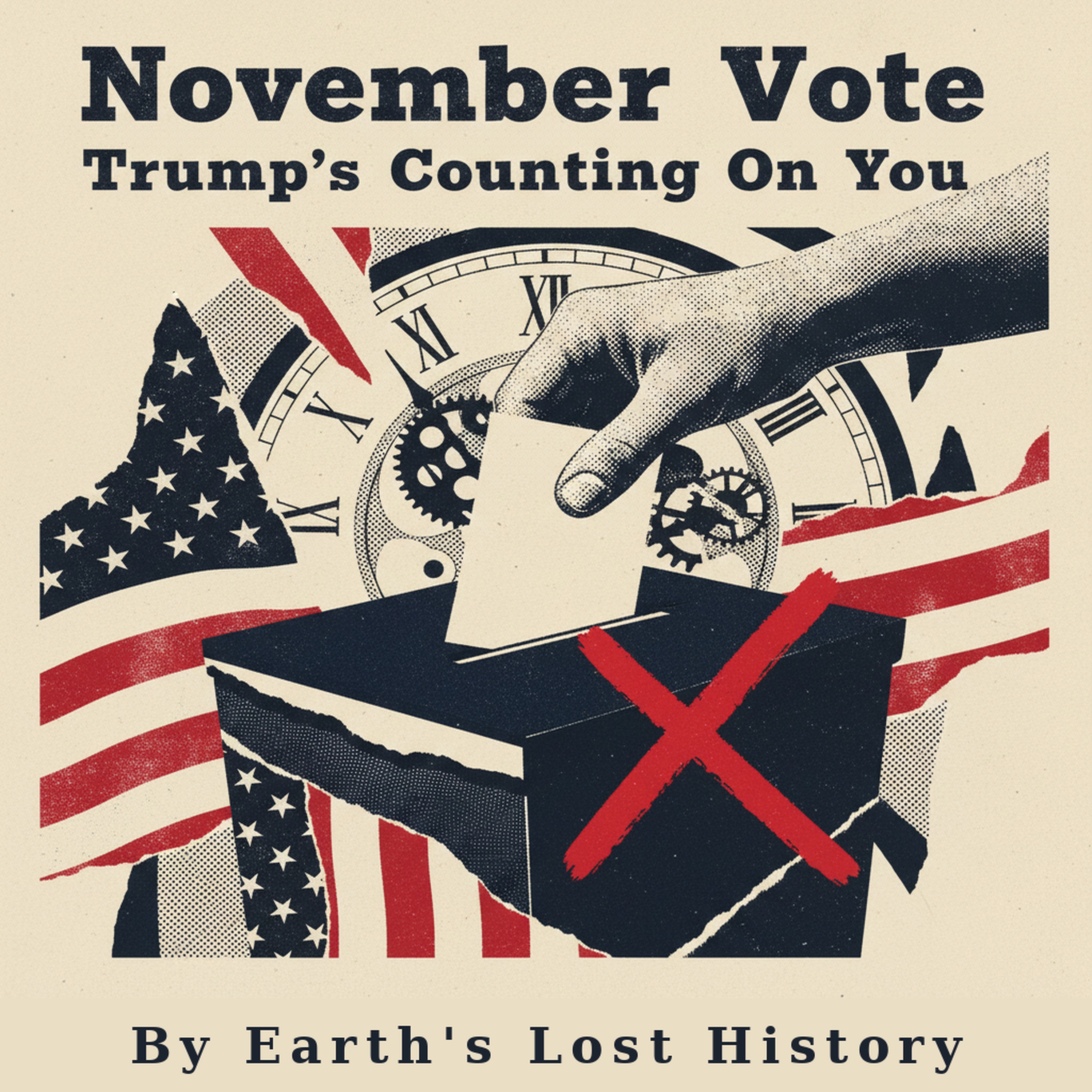
Appendix: Line-By-Line, what "November Vote" really means
Companion to the Earth's Lost History song "November Vote | Trump's Counting on You"
Commentary/opinion based on public reporting. Not legal advice.
Artist: Earth's Lost History
Words and music: Juan M Fermin
Length: 3:46
The Structure
This one is built for three voices, and the voices are doing different jobs.
Voice 1 is the melodic lead. It carries the emotional argument, the urgency, the part that reaches someone who is not yet convinced.
Voice 2 is the sharp, fast, articulate voice. It carries the receipts. The dates, the numbers, the policy specifics.
Voice 3 is the hypnotic one. The deep, auto-tuned, low voice. It carries the warnings and the accusations. It's the voice that says the thing the other two circle around.
When all three stack on the hook, that's the crowd. That's the moment the song stops being a solo and becomes something people can shout together. That structure matters for understanding every line that follows, because the song is deliberately dividing labor: one voice for the heart, one for the record, one for the threat.
Hook
"It's now or never, hear the pressure in the tone"
Voice 1 opens with the deadline. Not a policy argument. Not a receipt. A warning about time. The song's whole frame is that there is a clock and it's running out.
"Tick-tick-tick… future ain't loaned"
Voices 2 and 3 answer. "Future ain't loaned" is the thesis in three words. You don't get to borrow tomorrow and pay it back later. The future is either taken now or handed to someone else.
"When November come, better stand, better choose / Cast that vote — ain't no time to lose"
The command. "November" is the deadline made concrete. This is a get-out-the-vote song and it doesn't hide it.
"It's now or never, Trump's counting on you"
Voice 1 names the man directly. The song is not neutral and never pretends to be. The whole piece is a closing argument for one side, made with the other side's receipts.
"One shot, one chance"
Voice 3, deep and hypnotic. This is the voice that makes the stakes feel physical.
"Make the truth break through / They been lying so long they forgot what's true"
The lie isn't a single false statement. It's a habit so old that the people doing it have lost track of where the truth ended. That's a stronger accusation than "they're lying." It's an accusation about a class that has been operating inside its own frame for so long it can't see out.
"Earth's Lost History remembers — now it's on you"
The brand lands on the responsibility. The record is kept. The question is what the listener does with it. That's the turn from the song to the voter.
Verse 1
"They say the dream's for all, but who holds the key?"
The opening question of the verse is the same question that runs through every Earth's Lost History piece: who is actually in charge, and who benefits from the arrangement being described as fair.
"Streets divided, still we chasing liberty / From penthouse towers down to the cracks in the street"
The image is the gap. The penthouse and the cracked pavement are in the same city, and the policies the song is about are written by people in the first and paid for by people in the second.
"Truth in my pen — I don't run, don't retreat"
The song's posture. It's not backing down and it's not apologizing for the position.
"Sold us a bill, said 'free and fair' / Fine print written in the midnight air"
"Free and fair" is the slogan. "Fine print" is the budget. The line is saying the thing was sold on the label and the cost was hidden in the details that came out after the vote.
"Childcare for some, waitlist years long / Free college for all? Who pays for that song?"
This is the childcare promise with the numbers attached. The program was sold as universal. What got delivered was a fraction of the need and a waitlist measured in years. The second line asks the question that never gets answered in a campaign: who is paying for the promise, and when does the bill arrive.
Voice 3: "Green New Deal… rent freeze… open the gate"
The hypnotic voice lists the platform. Three items, delivered flat. The point is the accumulation. These aren't separate proposals. They're one agenda with several doors.
"Four guys, five plans — math seals their fate"
Four politicians, five plans. The song's shorthand for the New York machine that The Kingmaker's Three article documented in detail. "Math seals their fate" is the thesis of the whole piece: the plans don't fail because they're evil. They fail because the arithmetic doesn't work, and the arithmetic always arrives.
"Wave red flags on Stars and Stripes / Then cry 'austerity' when the bill arrives in tripe"
The contradiction. The people who wave foreign flags at protests are the first to complain about austerity when the budget can't cover the promises. "Arrives in tripe" is the song's way of saying the bill comes back ugly.
The Switch
Voice 3: "Land of the free but they feel locked out"
The voice shifts. This is the accusation section. The claim is that the people who run the frame feel excluded from the country they claim to represent, which is why they're trying to remake it.
Voice 1: "Raise up the verse… drown all doubt"
The melodic voice comes in as an echo, lifting the energy before the accusation lands. It's a build.
Voice 3: "Power to the people, not just a few / We the song now — yeah we writing it too"
"Power to the people" is the slogan. "We writing it too" is the claim to the record. The song is saying: you don't own the narrative anymore. That's the Earth's Lost History thesis in a bar of rap.
"Burned the flag, ashamed to be American / 24 percent young Dems say they proud — that's the plan"
The pride numbers. They are from the Harvard Youth Poll, Spring 2025: among young Democrats, 24 percent said they were proud, and 54 percent said they were embarrassed.
"54 percent embarrassed by the Stars and Stripes"
Same poll, same question, the other half of the pair.
"Democrats hate America — that's the vibe of their types"
This line is a conclusion, not a statistic. It's the judgment the song is drawing from the pride numbers and the flag burning. A critic will call it overreach. The song is willing to take that hit because the preceding lines are the evidence it's leaning on. Whether the leap holds depends on the sourcing above.
Verse 2
"Pick up the pen— / Raise your voice— / Take a stand— / We ain't toys!"
The three voices trade bars, and the crowd answers. This is the most chantable moment in the song. Four short commands, then the refusal. "We ain't toys" is the emotional core: the voters are not props for somebody else's campaign.
"Change don't wait, made by the hand / Build that anthem, make 'em understand"
The song is calling itself an anthem. That's a confident move, and it works because by this point the crowd is already shouting the responses.
"Obama signed the deal, unfroze the cash / Billions to the mullahs — body count rise fast"
The JCPOA. Sanctions relief unfroze Iranian assets held abroad, estimated at $100 billion to $150 billion, though Iran only accessed a fraction. The claim that the money funded proxies that killed people is an argument about complicity, not a documented causal chain. The song states it as the argument.
"Trump banned Epstein, kicked him out the door / Rest of the elite kept flying — that's the score"
Documented. Trump barred Epstein from Mar-a-Lago around 2007. The flight logs are public and include a long list of prominent names. The line's point is the selectivity: one man gets held responsible for the whole network, the others get a footnote.
"Biden killed the pipeline, gas through the roof / No protests in the street, no righteous proof"
Keystone XL was revoked on day one. Gas went from around $2.40 to over $5 by June 2022. The second line is the double-frame observation: the same people who spent a summer in the streets over other issues didn't march over gas prices.
"But Trump's the warmonger — that's the story you require"
The frame. The label doesn't match the record, but the label is what travels.
"Double frame in action… liar's choir"
The callback to the earlier song and article. The double frame is the mechanism. "Liar's choir" is the image: a lot of voices singing the same false note in unison.
The Break / Drop
"They built more jails than any before / Locked up our brothers, showed us the door / Then turned around and called us racist / The irony? It's almost basic"
The beat strips down and the most serious accusation lands in the quietest moment. The 1994 crime bill, mass incarceration, and the label inversion. The party that built the jails calls the other side racist. "Almost basic" means the irony is not subtle. It's the plainest contradiction in American politics.
"They abort Black babies, call it 'choice' and 'fate' / Whole communities erased while Dems celebrate"
The disparity. Black women are roughly 14 percent of American women and account for roughly 40 percent of abortions in states that report race. The rate is more than four times the white rate. The causal claim about intent is the song's argument. The disparity itself is documented.
"Oppose school choice, trap the poor in chains / Same playbook… different names"
The charter school and voucher argument. The families on the waitlists are disproportionately Black and Hispanic. The party that says it speaks for them blocks the doors. "Same playbook, different names" is the thesis: the mechanism doesn't change, only the branding does.
Verse 3
"Remember when they marched 'No Kings!' in the street? / But when their guy wins, they wave the flag complete"
The consistency charge. The same people who protest one administration celebrate the next. The song is not saying protest is wrong. It's saying the outrage is selective.
"Obama dropped more bombs than Bush in two terms flat / Seven countries lit — where the protests at?"
"Deported three million, built the cages they decry"
Documented. The Obama administration deported roughly three million people, more than any previous administration at that point, and the family detention facilities that became a political flashpoint later were built during that period.
"Seventy U.S. citizens shipped — crickets, no outcry"
"Scream 'authoritarian!' when Trump tweets something raw / But cheer when their side locks the world for the 'Rona cause"
The lockdown comparison. The song's argument is that the response to COVID involved real coercion at a scale no tweet ever reached, and the people who screamed about authoritarianism said nothing about it.
"Venezuela starving, Iran executing thousands / Where's the righteous tone? Where's the protest crowds?"
The selective outrage charge, applied internationally. Both situations are documented: Venezuela's economic collapse and humanitarian crisis, Iran's execution rates and crackdowns on protests.
"Maduro's prisons full, women beaten in the street / But the real threat's the guy who lost a billion in the seat?"
The comparison lands as a question. Maduro's abuses are real and documented. The line asks why the man who lost money in office is treated as the global threat while actual abuses go unprotested.
The Bridge
"They don't hate kings — they just hate losing the crown / Throne changes hands, the story gets flipped around"
The thesis of the bridge, and arguably of the whole song. The objection isn't to power. It's to who holds it. When the throne changes hands, the same behavior that was tyranny becomes statesmanship.
"Earth's Lost History rewritten faster than the news cycle spins / Yesterday's hero is today's original sin"
The brand, doing its work. The record is being rewritten in real time, and the speed is the point. What was true last week becomes unacceptable this week, and the people doing it don't have to explain the change because the news cycle buries the inconsistency.
"Mamdani made his move, three protégés in the win / Avila Chevalier, Lander, Valdez — let the chaos begin"
The Kingmaker's Three. Three endorsements, three wins, two incumbents unseated. "Let the chaos begin" is the song's framing of what those wins mean for the city.
"Abolish ICE, tax the rich, housing on the greens / Socialist agenda — that's the new regime"
The platform. Specific and documented.
"But the math don't lie and the check comes due / Sixty thousand toddlers waiting — what they gonna do?"
The callback to the childcare program. The promise was universal. Two thousand seats were delivered against roughly sixty thousand children in need. "What they gonna do" is the question the plan can't answer.
"Free college, free rent, open borders wide / Who's gonna pay when the well runs dry inside?"
The closing question of the bridge. Every promise has a cost. The tax base that would pay it is already leaving. When the well runs dry, the promises don't disappear. They get handed to the people who believed them.
The Call and Response
"They said 'Vote for us — we're saving democracy!' / NO!"
The crowd rejects the slogan. This is the moment the song has been building toward since the first chorus. The slogan that opened the Save Democracy piece gets shouted down by the people it was aimed at.
"'Free everything — it's the moral decree!' / NO!"
The second rejection. The promise is not accepted as an answer. The crowd is saying the math matters more than the moral framing.
"Who's holding the bag when the bills come through? / AVERAGE JOE!"
The answer. Same as the closing line of The Math Don't Lie. The bill lands on the person who never made the promise.
"And who's counting on YOU? / TRUMP!"
The turn. The song stops being a protest and becomes a call to action. The final answer is the name on the ballot.
Final Hook
"It's now or never, clock running fast / Future in our hands, we ain't living in the past"
The hook returns at full volume, with the choir behind it. The "clock running fast" line is the deadline restated.
"When November…"
"When November"
The chant repeats to the fade, no new words after it. The last thing the song says is the deadline itself.
Bottom Line
This song is a closing argument, and it's structured like one.
The hook states the deadline. The verses lay out the receipts: the childcare promise that delivered a fraction, the four politicians and five plans, the JCPOA, the pipeline, the crime bill, the abortion disparity, the school choice trap, the deportation numbers, the selective outrage. The break drops the music and puts the accusation in the quietest, most exposed moment. The bridge ties it to the New York machine and the arithmetic that machine can't escape. The call and response hands the decision to the crowd.
The song's claim is not that the listener should like Trump. It's that the listener has watched a decade of the same machine do the same thing, and that November is the moment when the record either gets kept or gets buried.
The receipts:
Universal childcare: two thousand seats against roughly sixty thousand children
Four candidates, five plans, no funding mechanism
JCPOA sanctions relief: $100 billion to $150 billion in unfrozen assets
Keystone XL revoked, gas from $2.40 to over $5
1994 crime bill and mass incarceration
Abortion disparity: 14 percent of the population, 40 percent of the procedures
School choice blocked while the wealthy exercise it privately
Obama deportation figures and the detention facilities built during that period
Selective outrage: what gets protested and what doesn't
The question: who's holding the bag when the bills come through?
The answer: Average Joe.
The deadline: November.
Words and music by Juan M Fermin. Earth's Lost History.
Read the essay on Substack: https://earthslosthistory.substack.com/p/november-vote