

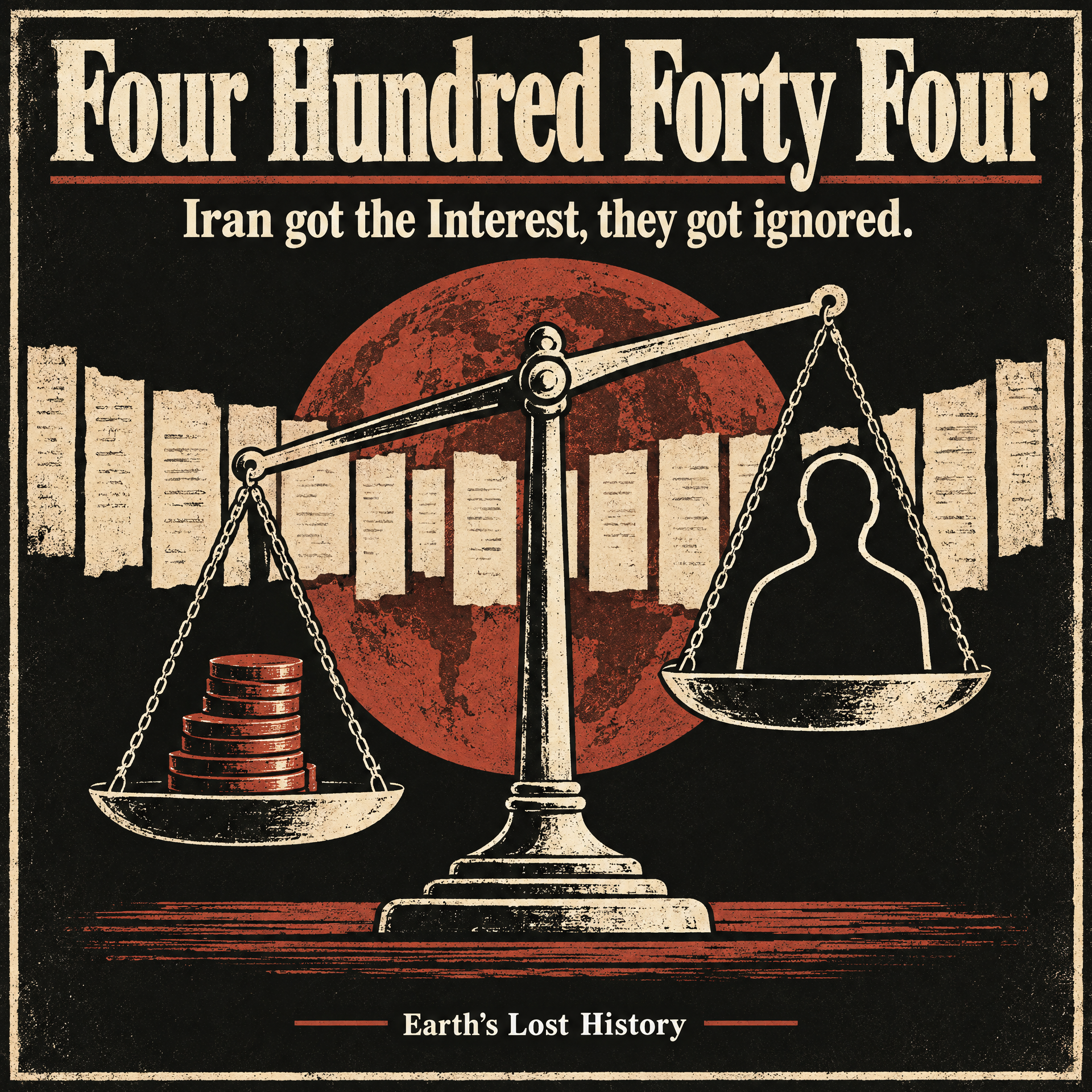
 Appendix: Line-By-Line, what "Four Hundred Forty-Four" really means
Companion to the Earth's Lost History song "Four Hundred Forty-Four"
Commentary/opinion based on public reporting and historical record. Not legal advice.
Intro
"The money belonged to Iran."
The song opens by conceding the strongest argument against it. The $400 million principal came from a Foreign Military Sales trust fund — Iran paid the United States for military equipment before the 1979 revolution, the equipment was never delivered, and the money sat in escrow for decades. That money was Iran's. The song says so in the first three seconds, so nobody can spend the next four minutes arguing a point that was never in dispute.
"Now tell me— / what did Iran owe the people?"
The pivot. The legal question is settled by the first line. The moral question is what the rest of the song is about. Iran owed something to the 52 Americans it held for 444 days, and that debt was never collected.
Hook
"Four hundred forty-four!"
"(Count the days!)"
The number of days the hostages were held. November 4, 1979 to January 20, 1981. It is the single most famous number of the crisis, and the song puts it first because everything else is measured against it.
"Fifty-two lives!"
"(Say their names!)"
The number of hostages. "Say their names" is a request the song never fulfills — no names are listed — and that's deliberate. The point isn't that you should memorize 52 names. The point is that they were people, and the paperwork treated them as a category.
"They got interest, they got older"
The whole thesis in one couplet. Iran got interest on the frozen money. The hostages got older. One account accrued value. The other accrued time. The rhyme is doing the argument: both things happened, and only one of them was ever compensated.
"Tell me what the papers don't show."
The papers are the settlement documents, the press releases, the court filings. What they don't show is the second ledger — the one the song has been keeping.
"You can settle every dollar— / who settles what the people are owed?"
The hook's question, and the song's thesis. A dollar can be settled. A claim can be settled. The thing the hostages were owed isn't a dollar amount, and it was never on the table.
Verse 1
"Nineteen seventy-nine, embassy seized"
November 4, 1979. The U.S. Embassy in Tehran was overrun by student militants. The date matters because it starts the clock the hook counts.
"American lives brought down to their knees"
The image. Diplomats and staff, most of them in their twenties and thirties, taken from a working day into captivity.
"Blindfolds on, threats hanging in the air"
Documented. Hostages were blindfolded, threatened with execution, and paraded in front of cameras. Several reported mock firing squads.
"Families back home staring at an empty chair"
The domestic side of the crisis. The song is shifting the frame from the geopolitical to the household, because the household is where the cost actually landed.
"Four hundred forty-four, count it out slow"
The hook's number, reintroduced as a command. "Count it out slow" is asking the listener to feel the length, not just register the figure.
"Not a number on a screen—days you couldn't go"
The distinction. A number on a screen is data. Days you couldn't leave a room is experience. The song is saying the settlement treated the first and ignored the second.
"Days you couldn't call, nights you couldn't sleep"
The texture of captivity. Small, specific, and human.
"Promises of freedom somebody had to keep"
The diplomatic track. The promise of release was being negotiated at a level the hostages couldn't see and couldn't influence.
"Then came Algiers, signatures and seals"
The Algiers Accords. Signed January 19, 1981, mediated by Algeria. The agreement ended the crisis and brought the hostages home. It also contained a provision that is the heart of the song's grievance: the hostages could not sue Iran in U.S. courts.
"Freedom on the runway, wounds that wouldn't heal"
The release. The hostages flew out on January 20, 1981, the day Ronald Reagan was inaugurated. The wounds are the part that didn't come home with a plane.
"The agreement brought them home, but it shut the case"
The precise language. "Shut the case" is accurate — the Algiers Accords closed the legal avenue. The song isn't claiming the agreement was wrong. It's claiming the agreement had a cost, and the cost was assigned to the hostages.
"One door swung open, another closed in place"
The structure of the deal. Freedom was the open door. The barred claims were the closed one.
"Don't tell me getting home ended the strife— / You can leave a cell and carry it for life."
The line that preempts the standard dismissal. "They got out, what more do you want" is answered before it's made. The cell ends. The thing the cell did doesn't.
"The cameras caught the landing, flags against the sky"
The footage everyone remembers. Yellow ribbons, flags, the return.
"They couldn't film the years still passing by"
The footage that doesn't exist. The years after the cameras left are the part the record doesn't keep.
Pre-Chorus
"You kept a record of the money. / Who kept a record of the pain?"
The two ledgers, stated as a question. The U.S. government kept meticulous records of the frozen assets, because they were a legal claim with a dollar value. Nobody kept an equivalent record of the harm, because the harm wasn't a claim that could be collected.
"One account was earning interest— / one was counting days."
The best four lines in the song. The two accounts are the thesis. The money accrued value while it sat. The hostages accrued time. Only the first was ever redeemed. Note that this couplet doesn't rhyme, and the non-rhyme is doing work — the two ledgers shouldn't match, because they were never treated as equivalent.
Verse 2
"Twenty-sixteen, another set of names"
January 2016. The nuclear deal with Iran was being implemented, and the frozen assets were part of it. The song is linking the 1981 grievance to the 2016 payment, because the hostage issue is what the settlement left unresolved.
"Different prisoners caught in the same old game"
Four Americans were released from Iran in January 2016. The song is saying the pattern repeated: Americans held, a negotiation, a release tied to money.
"Four hundred million, cash across the sky"
The $400 million was flown to Tehran in wooden crates on an unmarked plane on January 17, 2016.
"An old arms deal—yes, I know the reason why."
The concession. The money was from the pre-revolution arms deal. The song says so. It's the same move as the intro — concede the legal argument, then make the moral one.
"Equipment never shipped, the money never moved"
The facts. Iran paid for equipment, the equipment was never delivered after the revolution, and the funds sat in a U.S. account.
"I can read the ledger, understand what it proved."
"Proved" is a precise word. The ledger proved the money was Iran's. That's what it proved. It didn't prove anything about the hostages.
"But a ledger isn't justice just because it adds"
The line that makes the song impossible to dismiss. The arithmetic is correct. Correct arithmetic is not the same thing as justice. Anyone who tries to answer the song with the accounting is answering the wrong question.
"Where's the line for everything those people had?"
The question. If the ledger is the standard, what's the entry for 444 days?
"One point three billion interest on the claim"
The $1.3 billion was the interest component of the settlement. The total was $1.7 billion. The interest was the portion that made headlines, because it was the part that felt least like returning money and most like paying a bill.
"Say the figure slowly, let it carry the shame"
A performance instruction as much as a lyric. The number should land with weight.
"One point seven total—now the books can close?"
The question. Does the settlement balance everything?
"Not for everybody. That's the part I oppose."
The answer. The song is not opposing the payment. It's opposing the claim that the payment closed the account.
"First they said the tracks were separate, no connection"
The Obama administration initially said the cash payment and the prisoner release were unrelated.
"Then they said the cash was leverage—flip the direction."
The State Department later acknowledged the cash was used as leverage to secure the release. Both statements are on the record. The song is noting the reversal without needing to editorialize — the reversal is the editorial.
"Glad those people made it home—that part is real"
The concession that protects the verse. The 2016 prisoners were released, and the song is glad. It's saying so explicitly so nobody can accuse it of rooting against the outcome.
"But the older wound was left outside the deal."
The 1981 hostages were not part of the 2016 settlement. The deal resolved a claim between two governments. It did not resolve the debt to the people from 1979.
Verse 3 — "steady, cold"
"The money went out, the lawyers went in"
The sequence. The payment was made, and the legal work continued.
"The same Justice Department, arguing against them."
This is the verse's heaviest claim, and it's documented. The U.S. government took the position in federal court that the hostages' claims against Iran were barred by the Algiers Accords. That position was filed under multiple administrations, including the one that sent the cash.
"Not against Iran—against the ones who were held"
The reversal that makes the verse land. The Justice Department wasn't in court to collect from Iran. It was in court to block the people Iran had held.
"Filing briefs in the court that their claims were barred"
Accurate. The briefs argued the Accords barred the claims.
"I know it's precedent, I know it's the law"
The concession again. The government had a legal argument. The song acknowledges it.
"But the law got a lawyer and the hostages got a wall."
The most quotable line in the song. Both sides got representation. Only one of them got representation that worked.
"Crates came off the plane in the dark"
The January 2016 delivery. The crates, the cash, the unmarked plane.
"Same week four prisoners walked out of the yard"
The timing. Same day, in fact — January 17, 2016.
"Said it wasn't connected, then said it was leverage"
The same reversal from Verse 2, restated. The song is repeating it because it's the receipt that can't be argued.
"Pick whichever version keeps the story in the clear"
The accusation about the framing. Whichever version gets used, the outcome was the same: cash out, prisoners out, hostages from 1979 still waiting.
"Somebody owed. Somebody didn't get called."
The plainest sentence in the song. Somebody owed something. Somebody didn't get contacted. That's it.
"That's the part that doesn't balance at all."
The ledger metaphor returns. The books balance. The thing they were supposed to represent doesn't.
Verse 4 — "low, relentless"
"Congress made a fund, wrote the promise into law"
The Justice for United States Victims of State Sponsored Terrorism Act, passed in 2015, created a fund for victims of state-sponsored terrorism, including the Iran hostages. Eligible claimants could receive up to $4.4 million.
"But a promise isn't payment—and the ceiling is the flaw."
Two distinct criticisms. The fund was created but underfunded, and it was capped. A ceiling means the promise can't reach its full amount.
"Some relief came through—not the whole amount"
Accurate. The fund has paid out, unevenly and slowly.
"Try telling time to wait while they sort another account"
The human cost of the administrative delay. The hostages were in their seventies and eighties by the time the fund existed. Some died before payment.
"Don't mix up compensation with Iran making amends"
The precise distinction. The U.S. government paying its own citizens is compensation. Iran paying is amends. The fund is the first. Nobody ever got the second.
"Don't call a chapter finished while the injury extends"
The charge against the settlement's framing. "Settled" implies an ending. The injury didn't end.
"Their money had a history. Those people had a past."
The parallel. Both had a record. Only one was treated as a record.
"Why's the first the headline and the second coming last?"
The ordering question. The money got the lead. The people got the bottom of the page.
"It's complicated"—yes, I heard the explanation."
The preemptive answer to the standard defense. The song knows the legal analysis is complicated. It's saying complicated isn't the same as closed.
"But complicated shouldn't mean forgotten by the nation."
The thesis of the verse. Complexity is an explanation, not an excuse.
"No, I don't need a fairy tale to make it disappear"
The song is not asking for a comforting version. It's asking for the record to include both ledgers.
"I need the human cost to get an equal hearing here."
The ask, stated plainly. Not revenge. Not a different outcome. Equal weight in the record.
"Earth's Lost History keeps the question in the light: / Who gets made whole when the governments make it right?"
The brand, placed where it does the most work. The question isn't whether the governments settled. They did. The question is who got made whole when they did.
Bridge — spoken
"I'm not asking you to pretend the money wasn't theirs."
The third concession. The song has now said this three times: intro, Verse 2, and here. That repetition is the strategy. It makes the song impossible to dismiss as uninformed, because it has already agreed with the strongest counterargument.
"I'm asking why that answers everything."
The actual charge. The money being Iran's is true, and it answers one question. It doesn't answer the others.
"A legal settlement can settle a claim."
What a settlement does.
"It cannot tell a family: 'You've waited long enough. Now stop counting.'"
What a settlement cannot do, and what the framing of the settlement tried to do anyway. The families kept counting because the counting was never about the money.
Final Hook
"Four hundred forty-four! / (Not erased!) / Fifty-two lives! / (Not a footnote on a page!)"
The second half of the final hook changes the crowd responses. The first version was about the record. This one is about the erasure. The crowd is now refusing to be the footnote.
"They got interest, they got older— / you can't balance that with gold."
The settlement was money. The grievance is time. Time can't be settled with money, and the song is saying the attempt to do so is the insult.
"You can close the country's ledger; / you can't call the people whole."
The distinction between closing a ledger and healing a person. A ledger can be closed by definition — that's what closing it means. A person can't be closed.
Outro — piano only
"Four hundred million in principal. / One point three billion in interest."
The numbers, stated flat. No adjectives. The flatness is the point — this is how the settlement was reported, as a pair of figures.
"They calculated what the money lost."
The government did this. It calculated the time value of the frozen assets. It knew exactly what the money was worth after being held.
"Who calculated what the people lost?"
The question the song leaves the listener with. Nobody did. That's the whole song.
(The version in the file ends here. Earlier drafts had a final line, "They calculated what the money lost. Who calculated what the people lost?" — if the spoken outro is meant to close on the question, this is the right place to stop.)
Bottom Line
I got a LOT of pushback from The Double Frame, and a couple of other songs, where I talked about Obama's deal with the Mullahs. This song is not an argument that the money shouldn't have been returned. It says three times, in three different places, that the money was Iran's. I'm conceding the legal question completely, the song removes the only defense the settlement's defenders have, and forces them onto the questions they never answer.
Those questions are, "What about the Hostages? Why didn't THEY get their share of the money? Was their 444 days of suffering nothing? Do they deserve to be ignored?
The receipts:
1979–1981: 52 Americans held for 444 days.
January 1981: The Algiers Accords brought them home and barred their claims against Iran.
1980: The Hostage Relief Act paid them roughly $50 a day — about $22,200 for the captivity.
2015: Congress created the USVSST Fund, with a cap that meant the promise couldn't be paid in full.
January 17, 2016: $400 million in cash delivered to Tehran, same day four American prisoners were released.
$1.3 billion in interest on top, for a total of $1.7 billion.
The administration first said the cash and the prisoners were unconnected, then acknowledged the cash was leverage.
The question: who settles what the people are owed?
The answer the song gives: nobody did. The books closed. The wound didn't.