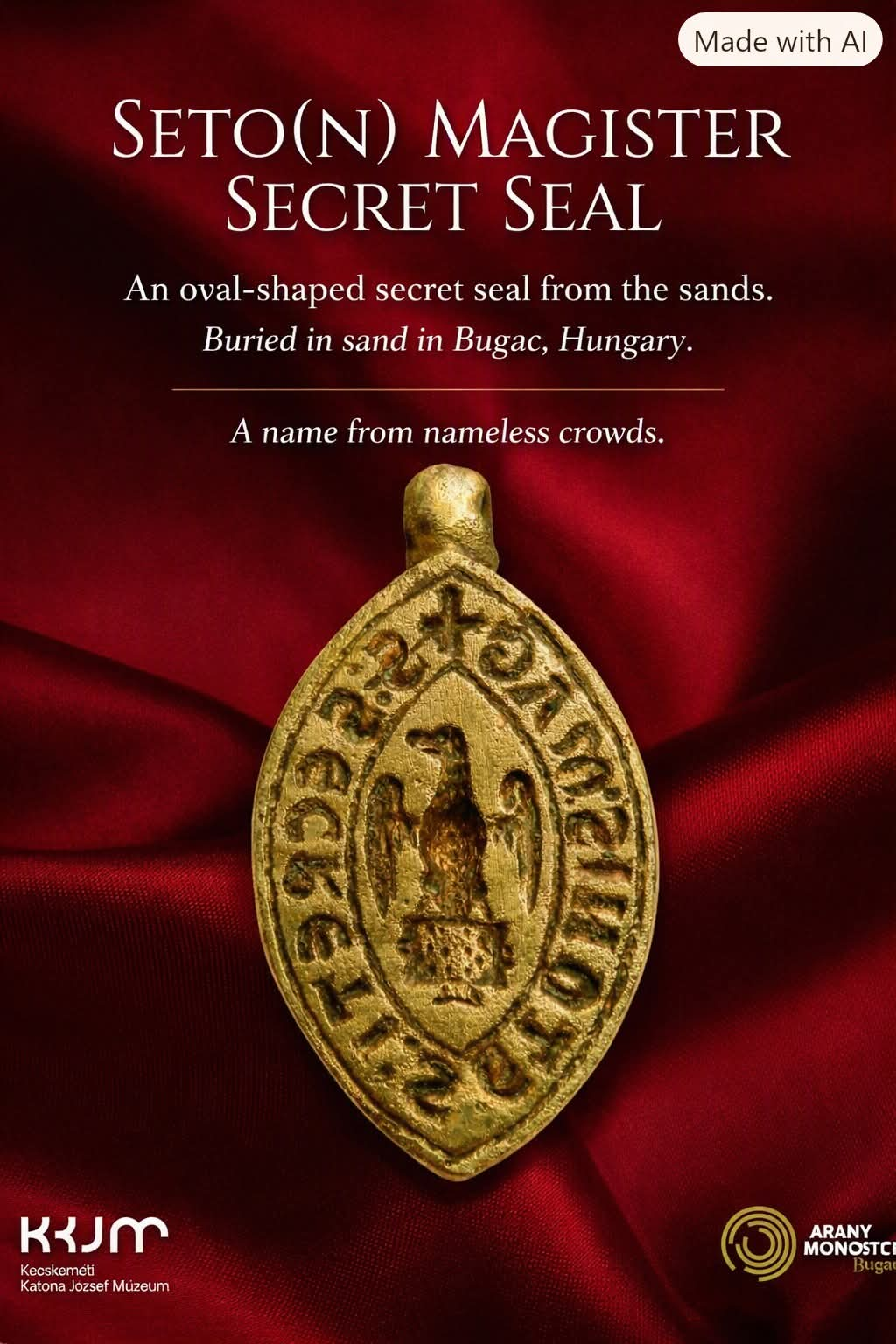

There was once a man who graduated from a university. His seal still exists today.
One of the greatest challenges for a medieval archaeologist is that the person behind the objects is almost never visible. We uncover graves, find rings, draw buildings — but the names are lost.
At Pétermonostora, there is an exception. A mandorla-shaped secret seal was found here, belonging to a man named Seto(n) Magister, who had completed university studies. Someone lived or passed through this 12th–13th-century settlement on the Hungarian Sand Ridge — a person with a university education and his own seal. In that era, this was far from ordinary.
Around the monastery, numerous pilgrim badges have been discovered, clear evidence that the people of Pétermonostora once journeyed as pilgrims to Rome. Pilgrimage itself was not uncommon at the time. Even Saint Stephen founded pilgrim houses and monasteries for those traveling to Jerusalem, and by the 11th century, the overland route crossing Hungarian and Byzantine territories had become increasingly popular among travelers.
Seto(n) Magister may well have arrived at Pétermonostora during his pilgrimage.
Just think about it: tens of thousands of artifacts have been unearthed from this site, and most of them have no name attached. This seal is the exception.
This place was not a closed, isolated community. Some of its inhabitants traveled across Europe — and brought something back home.
The inscription on the seal reads: S(igillum) Secreti Setonis Mag(ister).
That is, “The secret seal of Seton Magister.”
Research on the seal matrix is still ongoing, so we cannot yet draw definitive conclusions. Based on a written source, the owner of the seal matrix may be mentioned as a canon in a document written in Liège around the late 1220s or early 1230s.
He may have arrived with the English knights who joined the Fifth Crusade led by King Andrew II—for example, with the Earl of Chester— or he may have arrived ahead of them to prepare their arrival. During this period, Andrew II did invite specialists from abroad. Seto(n) Magister may have had commercial, administrative, organizational, translation, or religious duties.
It is also possible that he left his seal in the monastery as collateral — for instance, to obtain supplies for the journey — and was unable to return. Despite the devastation of the Mongol invasion, the monastery preserved this seal, a sign of how important such an object was at the time.
What kind of person do you think Seto(n) Magister was? Share your thoughts in the comments.
Aranymonostor – We brought history buried in sand back to life.