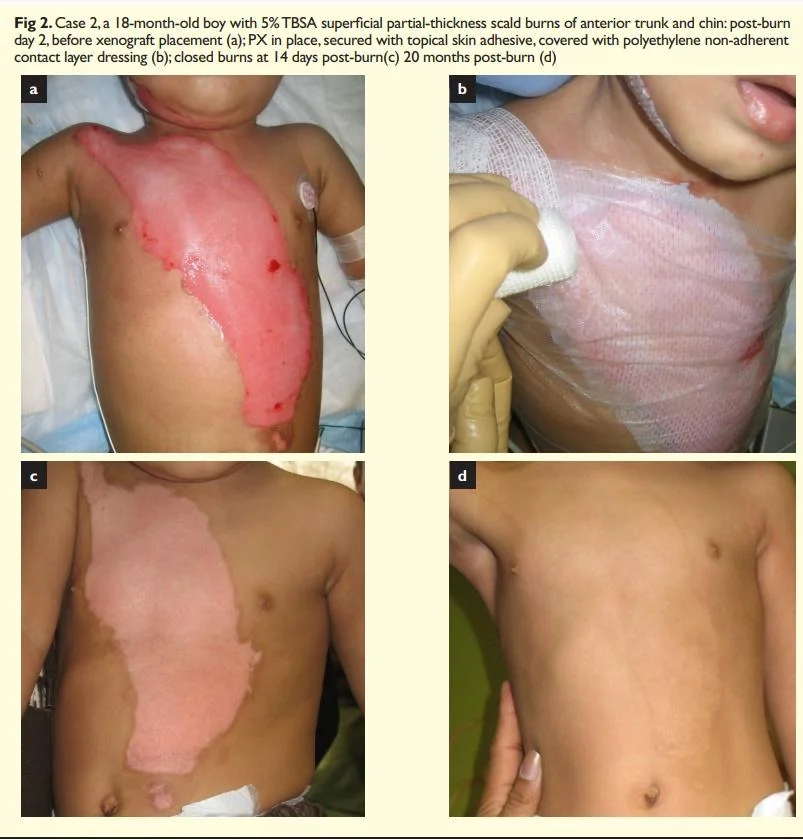

Case 1
Patient 1 was a 22-month-old girl who sustained 6.5% TBSA superficial partial-thickness scald burns from an accidental hot cereal spill. The burns primarily involved the face, with small burns of the upper chest and upper arms. Before PX placement, she underwent daily burn debridements and dressing changes with moderate sedation with ketamine and midazolam. Topical medications used were bacitracin and collagenase ointments. She required an average of 41mg/ kg/day of PO acetaminophen and 0.056mg/kg/day of IV morphine for background pain management. She underwent burn debridement and PX placement under general anaesthesia on post-burn day three. Her inpatient postoperative course was uneventful. She did not require any IV morphine or PO acetaminophen on postoperative day 1, and she was discharged home on that day. The burns were healing well at outpatient visits on postoperative days 4 and 11. The xenograft was completely separated from the healed burns at 1 month post-burn. At 13 months post-burn, the healed burns had excellent cosmesis with normal skin texture and pigmentation, except for a small area of improving hypertrophic scar of the left chest (Fig 1a–e).
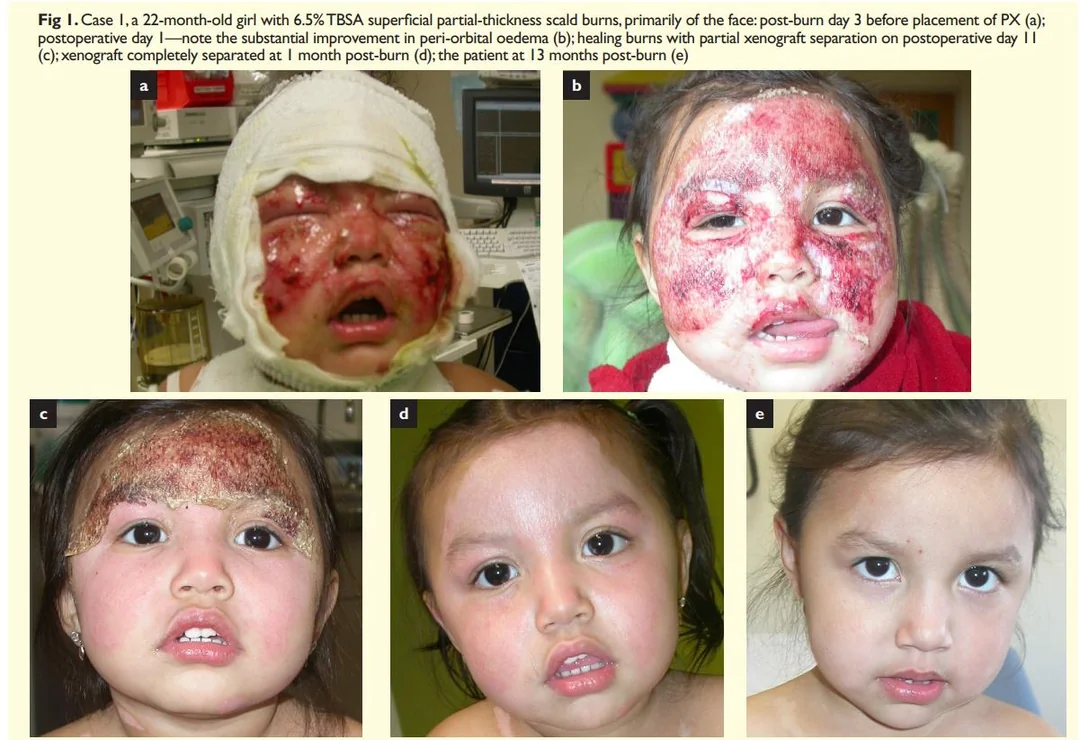
Case 2
Patient 2, an 18-month-old boy, transferred from a nearby emergency room to our burn centre with 5% TBSA superficial partial-thickness scald burns of the anterior trunk and chin from an accidental hot tea spill. He was initially treated with daily burn debridement and dressing changes with collagenase ointment/polysporin powder performed with moderate sedation with ketamine and midazolam before placement of PX; he required an average of 60mg/kg/day of PO acetaminophen and 0.07mg/kg/day of IV morphine for background pain control. On post-burn day 2, he underwent placement of PX in our treatment room under moderate sedation with ketamine and midazolam. After PX placement, he required an average of 30mg/kg/day of PO acetaminophen for background pain control. He did not require any postoperative narcotics. He was discharged home on postoperative day 2. His burns were fully closed at an outpatient visit 14 days post-burn. At 20 months post-burn, only very minimal dyschromia remained, with normal skin texture and no scar tissue (Fig 2a–d).